Short answer
Seven days is enough to learn each Solve game's rules and rehearse them on a clock. Check your invitation length first: candidates report 65 minutes as Redrock and Sea Wolf, and 85 as those two plus the Sustainable Futures Lab. Then spend one day per skill, one on a full rehearsal, and rest the day before.
Key takeaways
- Your invitation's length decides the plan. Candidates report 65 minutes as Redrock (35) and Sea Wolf (30), and 85 minutes as those plus a 20-minute Sustainable Futures Lab.
- Do a timed baseline on day 1. Without it you will spend the week practicing what you are already good at.
- Rehearse once at full length on the machine you will use, two days before the test, then stop. The last day is for the tech check and sleep.
In this article
- What does your invitation length tell you?
- What should you do on each of the 7 days?
- Why a baseline on day 1?
- Why rehearse on day 6, not day 7?
- What if you only have 3 days?
- Which mistakes waste a week of Solve prep?
- What should test day look like?
- Where can you practice for a 7-day plan?
- What if the test does not go well?
Part ofWhat Is McKinsey Solve? A Guide to Redrock, Sea Wolf and SFL
Your Solve invitation arrived, and the date in it is a week away. A week is enough. It is not enough for the plan most people follow, which is to read five guides, watch walkthroughs and then sit the test having practiced each game once. This plan gives every day one job, starts with a timed baseline so you work on your real weak spot, and ends with a full rehearsal two days out, so the last day is rest, not cramming.
What does your invitation length tell you?
McKinsey's only official statement is that "the length of your Solve assessment is outlined in your invitation email." Which games each length contains is reported by candidates and prep sites:
| Invitation length | Games candidates report | How sure |
|---|---|---|
| 65 minutes | Redrock Study (35) + Sea Wolf (30) | High: consistent across sources |
| 85 minutes | Redrock Study (35) + Sea Wolf (30) + Sustainable Futures Lab (20) | High since spring 2026 |
| 95 minutes | The 85-minute games with a longer Lab of about 30 minutes | Low: early reports, possibly a limited test |
| 110 minutes | Redrock and Sea Wolf, possibly the older Ecosystem game | Low: reported rarely |
Sources as dated in our McKinsey Solve guide, checked against MyConsultingCoach, StrategyCase, psgsecrets and Solve Games Guide.
The plan below covers 65 and 85 minutes. If your invitation says 95 or 110, follow the 85-minute version and read the Sustainable Futures Lab guide for what is reported about the longer Lab.
If you are not sure what your invitation means, the free Invite Decoder shows the games and clocks candidates report for your length and turns this plan into one email a day, timed to your own date.
What should you do on each of the 7 days?
Each day takes 45 to 75 minutes. Day 1 is your test date minus seven.
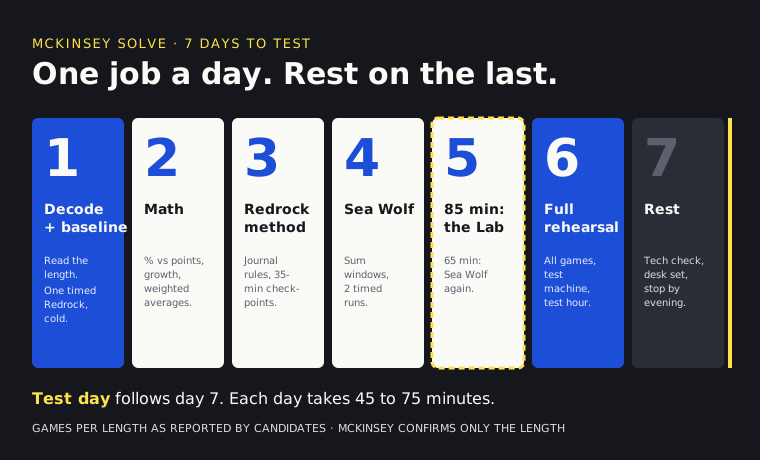
| Day | Job | Task | You are done when |
|---|---|---|---|
| 1 | Decode and baseline | Confirm your games from the invitation length. Do one timed Redrock-style study, cold | You know your games, and you have a written note of where the 35 minutes went |
| 2 | Math | 30 minutes of percentages, percentage points, growth and weighted averages, timed | Standard operations take about 15 seconds; you can explain percent vs percentage points |
| 3 | Redrock method | Read the Redrock guide. Redo day 1's study using the journal rules and the 35-minute checkpoints | You reach the six cases with at least 10 minutes left |
| 4 | Sea Wolf method | Read the Sea Wolf averaging rule. Two timed Sea Wolf-style runs | You convert ranges to sum windows without thinking, and site 3 always gets submitted |
| 5 | The third game, or Sea Wolf again | 85 minutes or more: read the Lab guide and do one Lab-style set. 65 minutes: two more Sea Wolf runs | Lab: about 75 seconds per decision. Sea Wolf: three sites inside 27 minutes |
| 6 | Full rehearsal | Every game at your invitation length, back to back, on the machine and network you will use, at the time of day you plan to test | No game ends unfinished; you have written down one fix per game |
| 7 | Rest | Tech check, desk set up, 15 minutes of light math at most | Laptop charged, two-hour slot booked, practice stopped by early evening |
Why a baseline on day 1?
Because without it you will spend the week on what you already enjoy. A cold, timed Redrock-style run shows you where the minutes go. Most people find one of three patterns: too long in the investigation, slow arithmetic in the analysis, or no time left for the cases. Each points to a different day 2 and 3.
Why rehearse on day 6, not day 7?
A full run takes close to two hours with tutorials. Doing it the day before the test costs sleep and confidence if it goes badly, and leaves no time to fix what it shows. Day 6 leaves a day to fix one thing and rest.
What if you only have 3 days?
Keep the three days that move the score most:
| Day | Job |
|---|---|
| 1 | Decode the invitation, timed Redrock baseline, 20 minutes of math drills |
| 2 | Sea Wolf method and two timed runs, 20 minutes of math drills |
| 3 | Full rehearsal in the morning, tech check and rest in the evening; test the next day |
Leave out the Lab day unless your invitation is 85 minutes or more; if it is, read the Lab guide on day 2 and do one set.
Which mistakes waste a week of Solve prep?
Most wasted weeks look busy. The candidate reads, watches and practices every day, and still reaches test day with the same weak spot. Five patterns cause most of it:
| Mistake | Why it wastes time | Do this instead |
|---|---|---|
| Reading guides for days before practicing | Understanding the rules is not the same as applying them on a clock | Do the timed baseline on day 1, then read what it shows you need |
| Practicing every game equally | Your weakest game gets the same time as your strongest | Give the extra day to the game your baseline exposed |
| Practicing untimed only | Untimed runs hide the real problem, which is pace | Put a clock on every run after day 1 |
| Skipping the full rehearsal | Two hours of back-to-back games feels different from one game | Rehearse once at full length on day 6 |
| Cramming the night before | Costs sleep and adds nothing you can still use | Stop by early evening on day 7 |
Write down after every practice run where the minutes went and what you would change. Three lines are enough. By day 6 those notes are a better guide than any article, including this one.
What should test day look like?
McKinsey's FAQ says each task "will begin with an untimed tutorial," so the session runs longer than the minutes on your invitation. StrategyCase estimates 5 to 10 minutes of tutorial per game.
| When | What |
|---|---|
| Night before | Tech check on the same machine and network. Charge the laptop. Close other apps |
| One hour before | Light meal, water, desk clear except pen and blank paper |
| Start | Read each tutorial properly; it is untimed and it is where the rules are |
| Redrock | Objective twice, 8 to 12 journal cards, cases started with 10 minutes left |
| Sea Wolf | Sum windows written first, about 9 minutes per site, site 3 always submitted |
| Lab (if included) | About 75 seconds per decision; consistent choices, not clever ones |
Where can you practice for a 7-day plan?
Days 1 and 3 need a Redrock-style study on a 35-minute clock. DrillCase's Ecotopia study is free, without sign-in, and is a full Redrock-style study with a research journal, so you can do your day 1 baseline today. Day 2 works with the free math drills. Days 4 to 6 need Sea Wolf-style runs and, for 85-minute invitations, Lab-style sets; the McKinsey practice page lists what each plan opens, including unlimited Sea Wolf runs.
DrillCase is independent practice and is not affiliated with McKinsey. Scenarios are built from what candidates and prep guides report, not from McKinsey material.
What if the test does not go well?
Write down, the same day, which game felt worst and where the time went. McKinsey gives no score breakdown, so that note is the best diagnosis you will have. Coaches most often report a 12-month wait before you can reapply. Our guide to what to do after a failed Solve covers the diagnosis and the plan for next time.
Frequently asked questions
Is 7 days enough to prepare for McKinsey Solve?
For most candidates, yes. McKinsey says no business knowledge or preparation is needed, and each game opens with a tutorial. What a week of practice buys is speed on the mechanics, so the 35 minutes of Redrock and 30 of Sea Wolf go to thinking, not to learning the screen.
How long do you have to complete McKinsey Solve after the invitation?
McKinsey does not publish a standard window. MConsultingPrep reports deadlines of roughly 3 to 7 days after the invitation, so read the date in your email first and, if you can, start preparing before you apply.
What if I only have 3 days?
Do day 1 (baseline and decode), day 4 (Sea Wolf method) and day 6 (full rehearsal) from the plan below, with 20 minutes of percentage and averaging drills on each day. Skip the Sustainable Futures Lab day unless your invitation says 85 minutes or more.
Should I take Solve early or late in the window?
Leave yourself a buffer. A late start leaves no room for a technical problem or a bad night's sleep. Most candidates are better served by testing a day or two before the deadline than on the last evening.
What should I do the day before McKinsey Solve?
No new practice. Run the tech check on the machine and network you will use, charge the laptop, clear the desk except pen and blank paper, and book a quiet two-hour slot. Each game starts with an untimed tutorial, so the session runs longer than the invitation's minutes.
Practice what you just read
Rehearse Redrock, Sea Wolf and the Lab on a clock
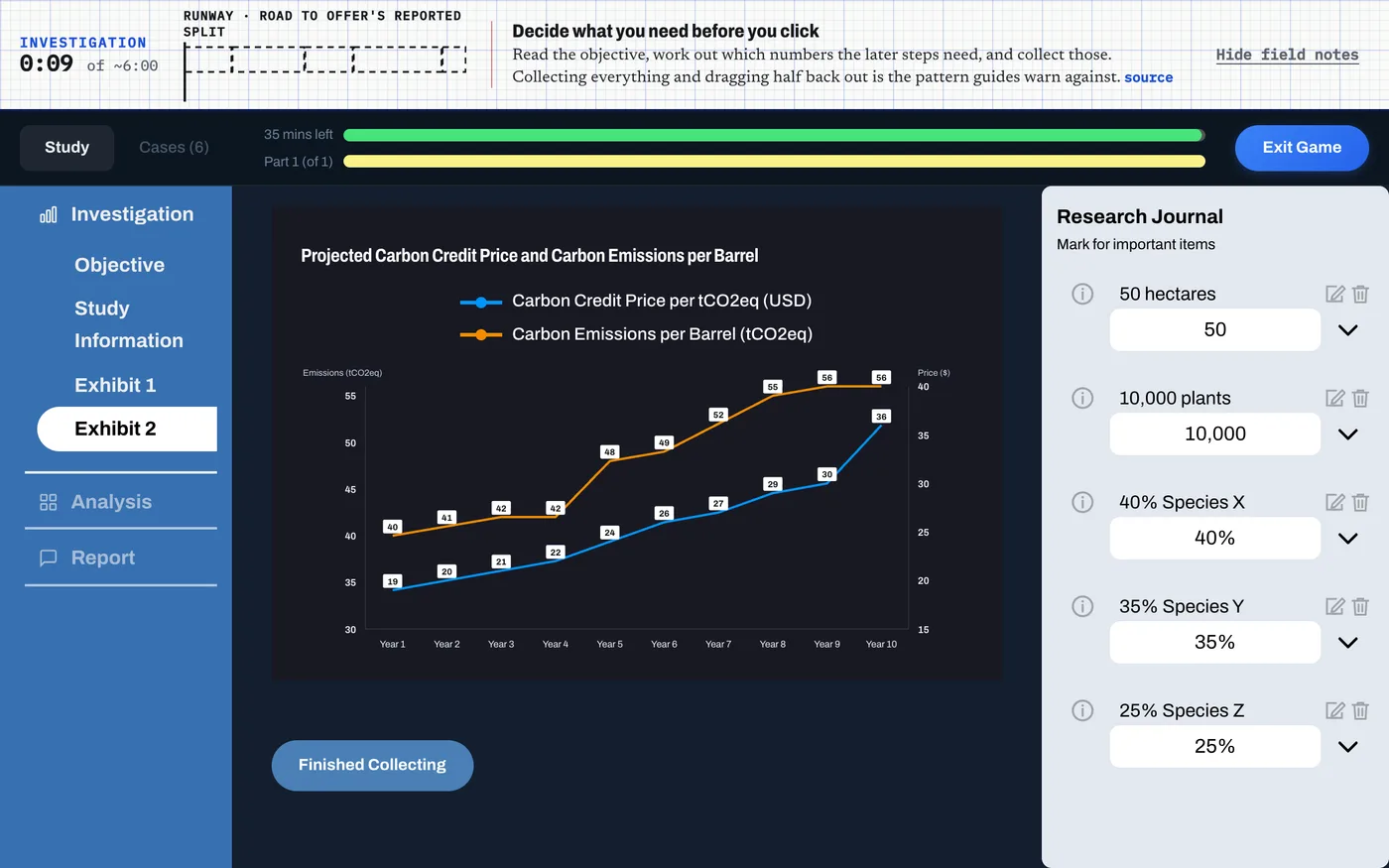
Solve rewards candidates who already know where everything is on the screen. DrillCase's scenarios follow the working layout candidates describe (investigation menu, exhibits, research journal, timer), so on test day your attention goes to the numbers.
- Solve-style scenarios
- 21
- Redrock-style studies
- 10
- free demo scenario
- 1
- 10 Redrock-style studies, 10 Sustainable Futures Lab-style sets, a Sea Wolf-style game with unlimited generated runs, and an archive of 2 Ecosystem games
- Timed sessions with a built-in tutorial on the first screen
- 1 demo scenario is free, so you can check the fit first
Solve VIP ($159) carries a 7-day money-back guarantee, even if used; Basic is final sale. Refund policy. DrillCase is independent practice material and is not affiliated with McKinsey, BCG or Bain.
Sources
- McKinsey & Company, Solve: McKinsey's Assessment Game FAQs (August 2025 PDF)
- McKinsey & Company, Getting ready for your interviews (careers page)
- MyConsultingCoach, McKinsey Solve Guide (updated June 2026)
- StrategyCase, McKinsey Solve (updated September 2026)
- psgsecrets, McKinsey Solve Game guide and game history (September 2026)
- MConsultingPrep, McKinsey Solve (Imbellus Game) overview
- Solve Games Guide, McKinsey Solve 65 vs 85 minutes and SFL (updated September 2026)