Short answer
McKinsey Solve is the online game McKinsey uses to screen most consulting applicants. Most invitations reportedly run 65 minutes (Redrock and Sea Wolf) or 85 minutes (plus the Sustainable Futures Lab). It is reported to score your answers and the way you reach them. McKinsey says no preparation is needed, but knowing each game's interface saves time.
Key takeaways
- Your invitation email sets the length. Candidates report that 65 minutes means Redrock and Sea Wolf, and 85 minutes adds the Sustainable Futures Lab.
- Solve reportedly scores both your final answers and the path to them, so collect only the data a task needs instead of everything on screen.
- McKinsey bans apps, websites, AI tools and pre-prepared notes during Solve. Practice beforehand, and use only what the game gives you on test day.
In this article
- Where to go next: every Solve question, answered in depth
- What is McKinsey Solve?
- PSG, Imbellus, Digital Assessment, Solve: one test, several names
- Which games are in Solve now?
- 65 vs 85 minutes: what your invitation length tells you
- How is McKinsey Solve scored?
- What is the Redrock Study?
- How to split Redrock's 35 minutes
- A worked example of Redrock-style math
- How does the Sea Wolf game work?
- The averaging rule in one line
- What is the Sustainable Futures Lab?
- How hard is McKinsey Solve, skill by skill?
- Can you use a calculator, Excel or notes on Solve?
- Setup checklist
- What happens on test day, step by step?
- How should you prepare for McKinsey Solve? A 3-week plan
- When do you get Solve results, and can you retake it?
- What has changed in McKinsey Solve? A dated changelog
- The short version

McKinsey Solve is the gamified online assessment McKinsey sends to most consulting applicants before any interview. Today it contains two or three timed games: the Redrock Study (a data-and-math research case), Sea Wolf (a microbe-selection puzzle) and, on longer invitations, the Sustainable Futures Lab (a judgment module). No business knowledge is required, and every candidate gets different numbers.
This guide covers which games you will get, how long your invitation will be, how scoring reportedly works, what you may use during the test, and a three-week plan for getting familiar with the formats. Each game and each common question has its own detailed article, linked from the table below.
A note on certainty. McKinsey publishes very little about Solve beyond its official FAQ. Everything else in this guide (game timings, question counts, scoring mechanics) comes from candidate reports compiled by prep providers. We label those claims as reported, and the page shows the date each fact was last checked.
- estimated share of test takers who pass (third-party estimate)
- 20–30%
- Source: careerservices.fas.harvard.edu
Where to go next: every Solve question, answered in depth
| Your question | Short answer | Full article |
|---|---|---|
| How is Solve scored, and what is a passing score? | A product score and a process score (reported); no published cut-off | McKinsey Solve score and pass rate |
| How does the Sea Wolf averaging rule work? | Each attribute's average across your 3 microbes must sit inside the site's range | Sea Wolf averaging rule |
| What is the Sustainable Futures Lab, and do I get it? | A judgment module on 85-minute (and some 95-minute) invitations | Sustainable Futures Lab guide |
| Can I use a calculator, Excel or paper? | Apps, websites, AI tools and prepared notes are banned; use the in-game tools | Calculator and tool rules |
| I failed. Can I retake it? | Not in the same cycle; you reapply after a waiting period | Failed McKinsey Solve? |
| When will I hear back? | Usually within one to two weeks (reported) | Consulting assessment timeline |
| How does Solve compare with BCG and Bain tests? | Different formats, different prep | MBB online assessments |
What is McKinsey Solve?
Solve is a gamified online assessment. It puts you in a simulated natural environment (an island ecosystem, an ocean with contaminated sites, a research study on a species) and asks you to make decisions with data. McKinsey's careers page calls it "a gamified assessment that tests your natural problem-solving abilities" and says it is "one of the exciting steps in our process for most consulting roles" (McKinsey).
Three things make Solve different from a classic aptitude test:
- No business knowledge is needed. McKinsey's FAQ says Solve "does not require previous business knowledge or gaming experience." The scenarios are about biology and ecology, not revenue and cost, so a finance background gives you no head start.
- Every candidate gets different numbers. McKinsey states that Solve "uses advanced AI methods to ensure that there is ample variation in each scenario" and "is designed so that no two individuals have the same parameters and combinations of data" (McKinsey FAQ). Memorized answers are useless, so the only thing worth practicing is method.
- It is one input, not the decision. McKinsey says results are "taken into consideration together with the rest of your application and any other assessment results." A strong Solve does not guarantee an interview, and a borderline one does not automatically end your application.
PSG, Imbellus, Digital Assessment, Solve: one test, several names
You will see the test under four names, and they refer to the same thing at different points in its history.
| Name | Where you will see it | Why it exists |
|---|---|---|
| Imbellus game | Older forum threads, prep sites | Imbellus, a Los Angeles startup, built the original simulation-based assessment. In December 2020 Roblox announced it had acquired Imbellus's intellectual property assets (Reuters) |
| Digital Assessment | Older McKinsey emails, university career pages | An early generic label |
| Problem Solving Game (PSG) | McKinsey's earlier FAQ PDF | McKinsey's own name before the rebrand; that FAQ described a 70-minute test (McKinsey, earlier FAQ) |
| Solve | Current invitations, current FAQ | Rebranded around 2022, according to Leland's history of the test (Harvard FAS / Leland) |
Solve replaced the paper-style McKinsey Problem Solving Test (PST), which Tufts describes as "a more traditional GMAT-style test" (Tufts Career Center). The PST skills still matter, though. Reading exhibits and doing fast percentage math are exactly what Redrock asks for.
Which games are in Solve now?
The game lineup has changed several times since the Imbellus era. Here is the status as of the "last verified" date on this page.
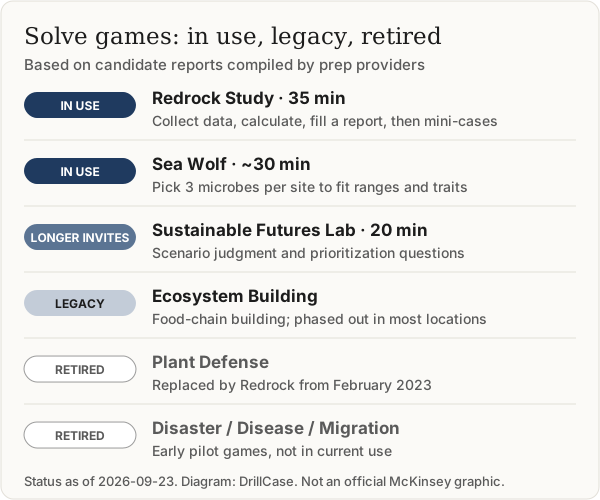
| Game | Status | What you do | Reported time |
|---|---|---|---|
| Redrock Study | In use on current invitations | Collect data on a species study, calculate, complete a report, then answer standalone mini-cases | 35 min |
| Sea Wolf (Ocean Cleanup) | In use on current invitations | Choose 3 microbes per contaminated site so each site's constraints are met | About 30 min (some sources say 35) |
| Sustainable Futures Lab (SFL) | On longer invitations since early 2026 | Scenario questions about prioritization, trade-offs and teamwork | 20 min (a 30-min rebuild is reported) |
| Ecosystem Building | Legacy; phased out in most locations | Build a food chain that survives in a chosen location | Varies |
| Plant Defense | Retired; replaced by Redrock from February 2023 | Defend a plant from invaders on a grid | n/a |
| Disaster, Disease, Migration Management | Early pilots, not in current use | Various | n/a |
Sources: MyConsultingCoach, psgsecrets, StrategyCase, CaseBasix.
Sea Wolf's timing is the one real disagreement among sources. StrategyCase, MConsultingPrep and psgsecrets say 30 minutes, and CaseBasix says 35. The 30-minute figure matches the 65-minute invitation (35 + 30), so we use it here, but your on-screen timer is what counts.
65 vs 85 minutes: what your invitation length tells you
McKinsey's current FAQ says only that "the length of your Solve assessment is outlined in your invitation email." It does not say which games each length contains. Candidates and prep providers, however, report a consistent pattern.
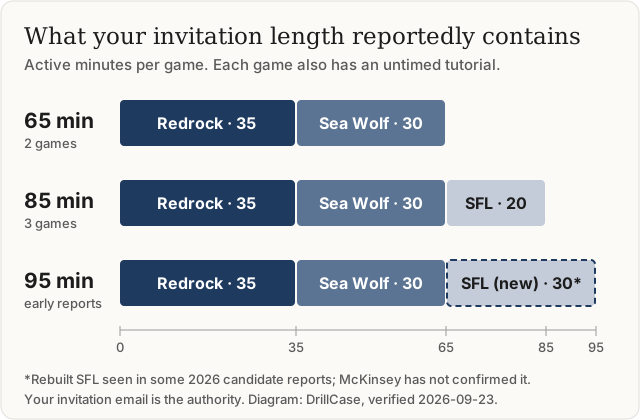
| Invitation says | Games you will most likely get | Confidence |
|---|---|---|
| 65 minutes | Redrock + Sea Wolf | High: consistent across sources |
| 85 minutes | Redrock + Sea Wolf + SFL (20 min) | High since spring 2026 |
| 95 minutes | Redrock + Sea Wolf + a rebuilt SFL (about 30 min) | Low: "early candidate reports", possibly a test version (Solve Games Guide) |
| 110 minutes | May still include Ecosystem Building | Low: legacy, reported rarely (psgsecrets) |
Two practical consequences follow:
- Pace each game against its own limit. Prep sources describe a separate time limit per game (35 for Redrock, about 30 for Sea Wolf, 20 for SFL). Do not count on time saved in one game being available in the next.
- Budget more time than the invitation says. Each task "will begin with an untimed tutorial" (McKinsey FAQ). StrategyCase estimates 5 to 10 minutes of tutorial per game, so book a two-hour quiet slot for an 85-minute invitation.
The Sustainable Futures Lab guide covers the 65 vs 85 question in more depth, including how to read the invitation email.
How is McKinsey Solve scored?
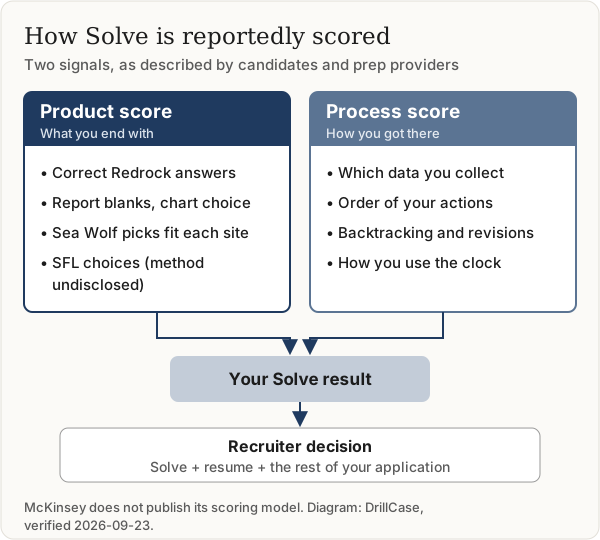
McKinsey has not published a scoring model. What is widely reported by prep providers is a split between two signals:
- Product score: how good your final outcome is. Are the Redrock answers correct? Do your chosen microbes meet each site's constraints?
- Process score: how you got there. Which data you collected, in what order, how much you backtracked, and how you used the clock. CaseBasix's summary is that "every click, drag, and decision you make is tracked."
A few points are firmer than the rest:
| Claim | Status | Source |
|---|---|---|
| Solve results are weighed with the rest of your application | McKinsey states this | McKinsey FAQ |
| You may be asked "to explain your logic used" or take an extra task in person | McKinsey states this | McKinsey FAQ |
| There is a product score and a process score | Widely reported, not confirmed | MyConsultingCoach, StrategyCase |
| The two are "weighted roughly equally" | One provider's estimate | StrategyCase |
| Results are ranked as percentiles, and the top quartile is safe | One provider's model; it cites McKinsey's FAQ, but the current FAQ says nothing about percentiles | MConsultingPrep |
| Roughly 20 to 30 percent pass | Third-party estimate; McKinsey publishes no rate | Harvard FAS / Leland |
The practical lesson from the process signal: decide what you need before you click. Read the objective, work out which numbers the later steps will need, and collect those. Collecting everything "just in case" and dragging items back out is the pattern most guides warn against.
For deciles, office differences and what a "good" score looks like, read McKinsey Solve score and pass rate.
What is the Redrock Study?
Redrock is a short, timed research case. You play a researcher analyzing fictional wildlife data (Road to Offer mentions wolf packs and elk across regions) and move through a fixed sequence of phases. Candidates describe two parts inside the 35 minutes.
Part 1: the study.
- Investigation. You read text, charts and tables and drag the relevant data points into a research journal.
- Analysis. You answer calculation questions using the data you collected. Road to Offer notes that some versions include an on-screen calculator.
- Report. You complete a partly written report: fill in numbers, choose "higher" or "lower", and pick the chart type that best shows a finding.
Part 2: the cases. A set of standalone mini-cases on related themes, six in current versions according to Road to Offer and psgsecrets (psgsecrets says the count fell from ten). Each one is self-contained, so a mistake in one does not spoil the next.
The flow runs one way. Road to Offer notes that "once you advance you cannot return", so a data point you skipped in Investigation stays skipped. Its other practical tip: if your version has a calculator log, chain unrounded results from it, because rounding errors cascade through later answers.
How to split Redrock's 35 minutes
No official split exists. Two prep providers publish suggested splits, and they agree on the main point: protect at least 10 minutes for the cases.
| Phase | Road to Offer's suggested split | StrategyCase's suggested split | What slows people down |
|---|---|---|---|
| Investigation | ~6 min | ~5 min | Collecting data the analysis never uses |
| Analysis | ~9 min | ~10 min | Percent vs percentage-point errors |
| Report | ~6 min | ~5 min | Chart-type choice |
| Cases | ~11 min, plus ~3 min buffer | ~10 min (5 min unallocated) | Starting them with 5 minutes left |
A worked example of Redrock-style math
The math is simple, but it is easy to get wrong under time pressure. Here are two traps built into a Redrock-style question. The numbers are invented for illustration and are not from the real game.
Trap 1: percent vs percentage points. A species' diet was 20% fish last year and 26% fish this year. The increase is 6 percentage points, which is a 30% relative increase (6 ÷ 20). The answer choices will usually include both. Read which one the question asks for.
Trap 2: simple vs weighted average. Three zones hold 400, 250 and 350 animals with average weights of 12 kg, 18 kg and 10 kg. The simple average of the three weights is 13.3 kg, which is wrong. The weighted average is (400×12 + 250×18 + 350×10) ÷ 1,000 = (4,800 + 4,500 + 3,500) ÷ 1,000 = 12.8 kg.
For the report phase, Road to Offer's chart rules are a useful default. Use a bar chart to compare categories at one point in time, a line chart for a trend over time, a stacked bar for composition over time, a scatter plot for correlation, and a pie chart only for parts of a single whole.
How does the Sea Wolf game work?
In Sea Wolf (also called the Ocean Cleanup game) you treat contaminated ocean sites with microbes. Candidates report three sites. At each one you build a prospect pool of about ten microbes and choose three to treat the site (MConsultingPrep, CaseBasix). Each microbe has numerical attributes and traits. Each site has a target range for each attribute and conditions on traits it wants or must avoid.
The key rule, as CaseBasix and Road to Offer describe it, is that the average of each attribute across your three microbes must fall inside the site's range. No single microbe has to be in range on its own.
The averaging rule in one line
Turn the range into a band for the sum. If a site wants attribute A between 5 and 7, the three microbes' A values must add up to between 15 and 21 (three times each end of the range). Adding three whole numbers and checking them against a band is faster than averaging each time.
Illustrative example (invented numbers): candidates have A values of 8, 4, 6 and 9.
| Trio | Sum of A | In the 15–21 band? |
|---|---|---|
| 8 + 4 + 6 | 18 | Yes (average 6.0) |
| 8 + 6 + 9 | 23 | No (average 7.7) |
| 4 + 6 + 9 | 19 | Yes (average 6.3) |
Microbe 4 is out of range on its own, but it is useful because it pulls a high microbe back into the band. This is the step candidates most often miss.
Sources describe the trait conditions slightly differently, so check the site brief in the game each time. CaseBasix's reading: at least one microbe must have the desired trait, and none may have the undesired trait. The Sea Wolf averaging rule article walks through elimination order, time per site and three full practice scenarios.
What is the Sustainable Futures Lab?
The Sustainable Futures Lab (SFL) is the newest module. It appears only on longer invitations. psgsecrets dates its arrival to March 2026, and MConsultingPrep to early 2026. Unlike Redrock and Sea Wolf, SFL is closer to a situational-judgment test: you run a sustainability project and make calls about priorities, trade-offs and your team.
The reported format in its 20-minute version:
| Element | Reported detail | Source |
|---|---|---|
| Length | 20 minutes | MConsultingPrep, MyConsultingCoach, Solve Games Guide |
| Questions | 13 | MConsultingPrep, Solve Games Guide |
| Question 1 | A drag-and-drop prioritization task (CaseBasix: rank four actions) | MConsultingPrep, CaseBasix |
| Questions 2–13 | Scenario multiple choice: 2 options (Q2–5), 3 (Q6–9), 4 (Q10–13) | MConsultingPrep |
| What it measures | Prioritization, ambiguity and teamwork | Solve Games Guide |
| Rebuilt version | About 30 minutes split across three "project days", with a limited pool of tokens for questioning researchers | StrategyCase, Solve Games Guide (early reports) |
How SFL answers are scored is not public, and it may not be a simple right-or-wrong key. Be wary of any guide that claims to know "the correct answer" to judgment items. What you can practice is reading the scenario for the stated goal and constraints before you look at the options, and keeping your choices consistent from one question to the next. The Sustainable Futures Lab guide has a trait-by-behavior table and example scenarios.
How hard is McKinsey Solve, skill by skill?
"How hard is Solve?" has no single answer, because each game stresses a different skill. Here is where the difficulty comes from, based on the formats described above.
| Skill | Redrock | Sea Wolf | SFL |
|---|---|---|---|
| Speed of arithmetic (percentages, averages) | High | Medium | Low |
| Reading charts and tables | High | Low | Low |
| Holding several constraints at once | Medium | High | Medium |
| Judgment under ambiguity | Low | Low | High |
| Time pressure | Very high | High | Medium |
If you are strong at math but slow to read exhibits, Redrock is your risk. If you rush, Sea Wolf's constraints catch you. If you like a single right answer, SFL will feel uncomfortable. Put most of your practice time on your weakest column.
Can you use a calculator, Excel or notes on Solve?
McKinsey's current FAQ is explicit about what is banned. Unless a disability accommodation has been approved in writing, you may not:
- "Use applications, websites, AI tools, or pre-prepared notes"
- "Record or capture screenshots of any part of the assessment"
It also expects you to "participate in this assessment alone, without assistance from others." McKinsey's careers page adds a table in which "Using AI during assessments (unless specifically permitted)" is marked Not Allowed, while "Asking AI to explain concepts or frameworks as part of your prep" is Encouraged (McKinsey). Using AI to learn before the test is fine. Using it during the test is not.
What the FAQ does not mention is a handheld calculator or scratch paper. Prep sites disagree, sometimes with themselves: CaseBasix's system-requirements page says you cannot use Excel, while its full guide suggests keeping pen, paper and a calculator ready for Sea Wolf. MyConsultingCoach says not to assume any external tool is allowed unless the on-screen rules say so. The safe rule is to use the in-game calculator where one is provided and paper only if the on-screen instructions allow it. The calculator and tool rules article sets out every case.
Setup checklist
| Check | What McKinsey says | Practical note |
|---|---|---|
| Device | "Only available on a PC or Mac"; no iPad or phone | Use a laptop plugged into power |
| Tech check | Runs automatically when you open your link | Run it on the same machine and network you will test on |
| Mouse and sound | "Sound is not necessary, and a mouse is optional" | A mouse still makes drag-and-drop faster |
| Language | English, Spanish, Portuguese or Japanese | Pick the one you read fastest |
| Technical problem | Contact gbil-support@mckinsey.com or live chat at the time it happens | McKinsey says it "cannot make any exceptions to allow for reset" if you do not |
| Browser and network | Not specified in the FAQ | Prep guides suggest current Chrome, Edge or Firefox, one monitor and a stable wired connection (CaseBasix) |
| Accommodations | Available for disability, health conditions or learning difficulties; ask your recruiter | Ask before you start, not after |
What happens on test day, step by step?
McKinsey's FAQ describes the sequence, and prep guides fill in the gaps. In order:
- Open your link and pass the tech check. It runs before Solve starts and tells you whether your device meets the minimum specification. PC or Mac only.
- Choose a language. English, Spanish or Portuguese (each in an Iberian or Latin American version), or Japanese.
- Work through each game's untimed tutorial. McKinsey says it "directs you to the task's objective and provides guidance on how to navigate the task." Read the objective slowly here. The tutorial costs you nothing, and the timed task does.
- Play the timed game. The clock starts after the tutorial. Repeat steps 3 and 4 for each game on your invitation.
- If something breaks, contact support at once. Email gbil-support@mckinsey.com or use the live chat while the problem is happening. McKinsey says support can "offer you extra time or reset your link depending on the issue", but not if you report it afterwards.
The FAQ says nothing about showing you a score when you finish. Your recruiter makes the decision, weighing Solve alongside the rest of your application and any other assessment results.
How should you prepare for McKinsey Solve? A 3-week plan
McKinsey's FAQ says "no preparation is needed", and its careers page says "there's no need to prepare." Each task opens with a tutorial. That is true in the sense that no outside knowledge is required. The case for preparing is time. Every minute of the timed clock you spend working out the interface or re-reading a rule is a minute you are not solving. Familiarization moves that learning to before test day.
This plan assumes about 45 to 60 minutes a day and an invitation that arrives with a few days' notice. Candidates report deadlines of roughly 3 to 7 days after the invitation (MConsultingPrep), so start before you apply if you can.
| Week | Goal | Daily work | Check you are ready to move on |
|---|---|---|---|
| 1: Rules and math | Know every game's rules without the tutorial; make the math automatic | 20 min percentage, ratio and weighted-average drills; read one game's rules each day | You can explain the Sea Wolf sum band and the percent vs percentage-point trap from memory |
| 2: Game-by-game practice | Build a repeatable method for each game | Alternate untimed and timed runs of Redrock-style and Sea Wolf-style scenarios; do 2 SFL-style scenario sets | Redrock-style runs finish with at least 10 minutes left for cases |
| 3: Full dress rehearsal | Match test-day conditions | 2 full-length runs at your invitation's length on the machine you will use; review your process, not just your score | No run ends with a game unfinished |
The night before, run McKinsey's tech check, charge the laptop, close other apps and book the two-hour slot. Then stop practicing.
DrillCase's McKinsey practice has 20+ Solve-style scenarios covering Redrock, Sea Wolf, the Sustainable Futures Lab and the legacy Ecosystem game, with one free demo scenario. They are original practice material, not copies of McKinsey's games, and they are built for rehearsal before the test.
When do you get Solve results, and can you retake it?
When you hear back. McKinsey does not publish a timeline. Third-party guides report "within one to two weeks" (Leland, via Harvard FAS), "7 to 14 days" (CaseBasix) and "1 to 14 days, depending on office processes and candidate volume" (StrategyCase). If you pass, the next step is interviews: for most client-facing roles, McKinsey says that means a Personal Experience Interview followed by a problem-solving (case) interview (McKinsey). The consulting assessment timeline compares this with BCG and Bain.
If you do not advance. Prep guides agree you cannot retake Solve in the same application cycle. The waiting period before you can reapply varies, and sources disagree:
| Source | Reported waiting period |
|---|---|
| CaseBasix | 6 to 12 months, depending on location |
| Leland (via Harvard FAS) | "Several months to a year," depending on region and program |
| StrategyCase | 12 to 24 months, depending on office |
The only reliable answer is your recruiter's. The failed Solve guide covers how to work out which game cost you and a 30-day re-prep plan.
What has changed in McKinsey Solve? A dated changelog
Solve changes more often than most guides are updated. This log records each reported change, its date and its source. We re-check it on the "last verified" date at the top of this page.
| When | Change | Status | Source |
|---|---|---|---|
| By May 2020 | More than 15,000 candidates in over 30 countries had taken the Imbellus-built game | Reported | PrepLounge |
| Dec 1, 2020 | Roblox announces it has acquired Imbellus's intellectual property assets | Confirmed (news) | Reuters |
| Earlier FAQ | McKinsey describes a 70-minute "Problem Solving Game" | Confirmed (McKinsey) | McKinsey, earlier FAQ |
| ~2022 | Rebranded as "Solve" | Reported | Harvard FAS / Leland |
| Feb 2023 | Redrock replaces Plant Defense as the second game | Reported | psgsecrets |
| 2024 | Sea Wolf launched; psgsecrets says every candidate it coached from January 2025 got it | Reported | psgsecrets |
| Mid to late 2025 | Ecosystem Building phased out in most locations | Reported | psgsecrets, MConsultingPrep |
| Aug 2025 | McKinsey's FAQ says the invitation email sets the length, and lists banned tools, including AI | Confirmed (McKinsey) | McKinsey FAQ |
| Early 2026 (March per psgsecrets) | Sustainable Futures Lab added on 85-minute invitations | Reported | psgsecrets, MConsultingPrep, MyConsultingCoach |
| 2026 | Early reports of 95-minute invitations with a rebuilt, 30-minute SFL | Early reports | Solve Games Guide, StrategyCase |
If your invitation or your games differ from this table, that is useful information. Let us know through the correction contact on our editorial policy page and we will check it and update the log.
The short version
- Read your invitation length first. 65 minutes means Redrock and Sea Wolf; 85 adds the Sustainable Futures Lab.
- Redrock rewards collecting only what you need and leaving time for the cases.
- Sea Wolf is an averaging problem. Convert each range into a sum band.
- SFL is judgment, not arithmetic. Read for the goal and constraints before the options.
- Practice before the test and use only the game's own tools during it.
For how Solve fits alongside BCG's Casey and Bain's online tests, see the MBB online assessments guide, or see how the DrillCase McKinsey Solve simulation works.
Frequently asked questions
How hard is McKinsey Solve?
It is harder than it looks, because the difficulty is time pressure, not the math. Prep providers estimate that roughly 20 to 30 percent of test takers pass. McKinsey does not publish a pass rate, so treat any figure as an estimate. psgsecrets says McKinsey cut Redrock's mini-cases from ten to six, most likely because few candidates finished in time.
How long is McKinsey Solve?
Your invitation email states the length. Candidates report 65 minutes for Redrock and Sea Wolf, 85 minutes when the Sustainable Futures Lab is added, and a small number of 95-minute invitations with a longer SFL. Each game starts with an untimed tutorial, so you will spend more time than that at your desk.
Can you prepare for McKinsey Solve?
McKinsey says no preparation is needed and that the tutorials teach each task. In practice, candidates who have seen the formats spend less of their timed minutes learning the interface. Legitimate preparation means understanding the rules, practicing percentage and average math, and doing timed practice runs before test day, never using tools during it.
Does McKinsey track your process in Solve?
Prep providers widely report that Solve records a process signal (which data you collect, the order of your actions, how often you backtrack) alongside the correctness of your final answers. McKinsey has not published its scoring model, but it does say it may ask candidates to explain the logic they used.
Can you retake McKinsey Solve?
Not within the same application, according to prep guides. If you do not advance, you normally have to reapply after a waiting period. Third-party guides report anything from about 6 to 24 months depending on office and program, so ask your recruiter for the exact rule that applies to you.
Does every McKinsey office use the Sustainable Futures Lab?
No. Candidates report SFL only on longer invitations (85 minutes, and some 95-minute invitations), and it has been rolling out gradually since early 2026. A 65-minute invitation reportedly means Redrock and Sea Wolf only. Check your invitation email rather than assuming.
Can you use a calculator on McKinsey Solve?
McKinsey's Solve FAQ bans applications, websites, AI tools and pre-prepared notes but does not mention handheld calculators or scratch paper. Candidates report an on-screen calculator in some versions of Redrock. The safe default is to use only the in-game tools and whatever the on-screen instructions allow.
Sources
- McKinsey & Company, Solve: McKinsey's Assessment Game FAQs (August 2025 PDF)
- McKinsey & Company, Getting ready for your interviews (careers page, incl. AI in the hiring process)
- McKinsey & Company, McKinsey Problem Solving Game FAQs (earlier PDF, 70-minute format)
- Reuters via Yahoo Finance, Gaming platform Roblox acquires Imbellus assets ahead of IPO (Dec 2, 2020)
- Harvard FAS Mignone Center for Career Success (republished from Leland), What Is the McKinsey Solve Game (June 2026)
- Tufts University Career Center, McKinsey Digital Assessment (Solve Game) (March 2026)
- MyConsultingCoach, McKinsey Solve Guide (updated June 2026)
- psgsecrets, McKinsey Solve Game guide and game history (September 2026)
- Solve Games Guide, McKinsey Solve 65 vs 85 minutes and SFL (updated September 2026)
- StrategyCase, McKinsey Solve (updated September 2026)
- MConsultingPrep, McKinsey Solve (Imbellus Game) overview
- Road to Offer, McKinsey Redrock Study guide (updated September 2026)
- CaseBasix, McKinsey Solve full guide (updated August 2026)
- PrepLounge, The McKinsey Imbellus Game (February 2025)
- CaseBasix, McKinsey Solve system requirements (August 2026)