Short answer
McKinsey publishes no passing score. Prep sites report that Solve combines a product score (what you achieve) and a process score (how you work), and that you are ranked against other candidates. Third-party estimates put the pass rate at about 20–30%, with the top 20–30% (roughly decile 8 or above) usually enough.
Key takeaways
- There is no published cut-off. McKinsey says Solve results are weighed together with the rest of your application, so the bar is relative to other candidates, not a fixed number.
- Prep sites consistently estimate a 20–30% pass rate and a passing zone in the top 20–30%. Treat these as estimates: McKinsey releases neither figure.
- You raise both scores the same way: finish every task, commit to decisions instead of re-working them, and use the in-game tools with a plan. Unfinished work costs you product and process points at once.
In this article
- How does McKinsey score Solve?
- Product score: what you end with
- Process score: how you got there
- A worked example of why process matters
- Is there a fixed passing score?
- What the deciles mean in practice
- What is the McKinsey Solve pass rate?
- Do offices use different thresholds?
- How long until results, and what does the email mean?
- What to do while you wait
- How do you raise your McKinsey Solve score?
- The bottom line

Part ofWhat Is McKinsey Solve? A Guide to Redrock, Sea Wolf and SFL
McKinsey does not publish a Solve cut-off, a score scale or a pass rate. What prep sites report is a relative bar: you are ranked against other candidates, the top 20% (the 80th percentile) is usually cited as enough, and an estimated 20–30% of candidates pass. None of those numbers comes from McKinsey. This page separates what McKinsey states from what candidates and prep sites report, covering scoring, the passing zone, pass-rate estimates and office differences. For the games themselves, start with our complete McKinsey Solve guide.
How does McKinsey score Solve?
McKinsey's public statements describe what Solve is for, not how it is scored. Its game lab says Solve was built to "measure how people think, as opposed to what they know," and that it gives McKinsey "an additional data point in recruiting." A 2020 McKinsey careers post adds that "observing how people approach these tasks gives a picture of how people approach problems more broadly."
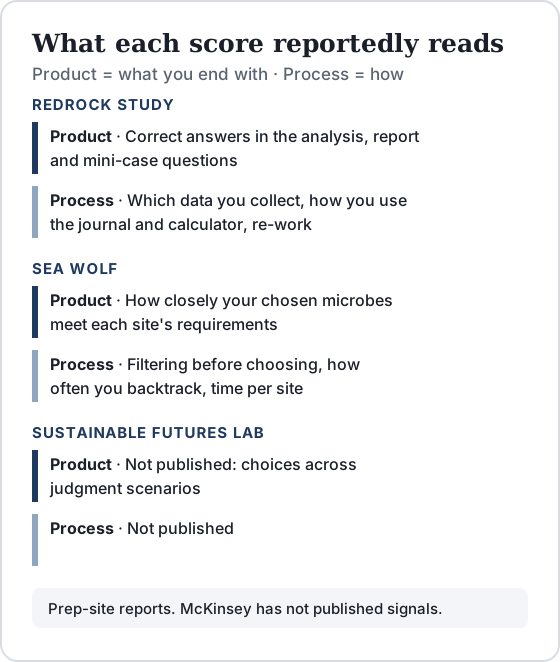
Prep sites build their two-score model on that idea: one score for what you achieve, one for how you work. McKinsey has not confirmed the model in any document we found, but the prep sources agree on its shape.
Product score: what you end with
The product score measures results against each game's objective. MConsultingPrep and CaseBasix give the examples: correct answers in Redrock Study, how many species survive in the older Ecosystem Building game. In Sea Wolf, PSG Cracked describes the goal as the highest possible treatment effectiveness at each of the three sites. case-prep calls an unanswered item "a guaranteed zero on the product side", which is why running out of time is so expensive.
Process score: how you got there
The process score is built from telemetry: the record of what you do while you play. MConsultingPrep says "every keystroke, every click, and every mouse movement" is captured. MyConsultingCoach describes it as "what you prioritize, what you click on, and how structured you are." StrategyCase lists the signals it believes matter: time spent reading the brief before acting, how many data sources you open, how often you switch back between screens, and whether you use the in-game calculator and notepad. CaseBasix adds how you organise data in Redrock's research journal.
MConsultingPrep is also careful to add that McKinsey "has never explicitly stated the measurement method" for process. StrategyCase reports the two scores are weighted roughly equally; nobody else offers a weighting.
A worked example of why process matters
This is an illustration, not a McKinsey rule. Two candidates get the same Redrock questions right, so their product scores match.
| Candidate A | Candidate B | |
|---|---|---|
| Reads the brief | Fully, then sets up the journal | Skims, starts dragging data at once |
| Data collected | Only what the question needs | Everything, then deletes half |
| Answer changes | 1 | 7 |
| Time left at the end | 3 minutes | 0 (last question guessed) |
If the prep-site descriptions are right, A scores higher on process with the same answers. B also carried more risk on product: with no time left, one more slow question would have cost a correct answer.
Is there a fixed passing score?
No, not one McKinsey publishes, and probably not one fixed number at all. McKinsey's Solve FAQ says it will not make a decision on your candidacy "just on the results from Solve." Results are "taken into consideration together with the rest of your application and any other assessment results." A recruiter weighing Solve alongside a resume is not applying a single universal cut-off.
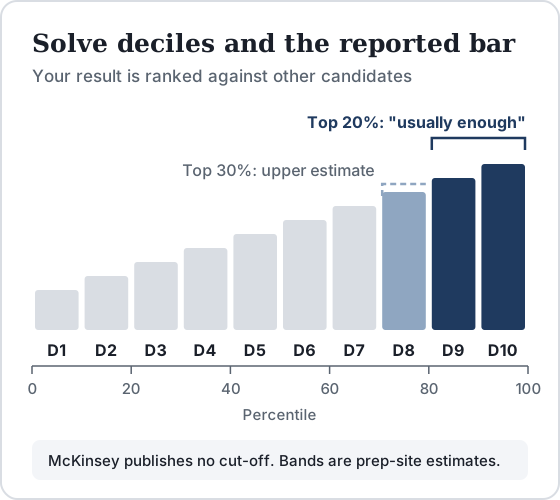
What prep sites report instead is a relative bar. You are ranked against other candidates and placed in a percentile or decile (a tenth of the ranked pool: decile 10 is the top 10%).
- case-prep: the 80th percentile, the top fifth, "is usually enough," which it calls a "commonly cited rule of thumb."
- PSG Cracked: the 80th percentile is "usually enough to pass," though it varies with case and applicant volume.
- PSG Secrets: "decile 8 or above" means your performance was good; a strong result sits in the top 20–30%.
What the deciles mean in practice
Decile 8 covers the 70th to 80th percentile. If the bar for your pool is the top 20%, decile 8 falls just short. If it is the top 30%, decile 8 clears it. That is why sources quoting "top 20%" and "top 30%" can both be right: they describe different pools.
The sources disagree about who you are ranked against. PSG Secrets says every candidate taking Solve worldwide. case-prep says your own candidate pool, so "the bar moves with the strength of the cohort." Neither cites McKinsey. The practical rule is the same either way: aim well above the 80th percentile in practice, because you cannot see where the line is on the day.
What is the McKinsey Solve pass rate?
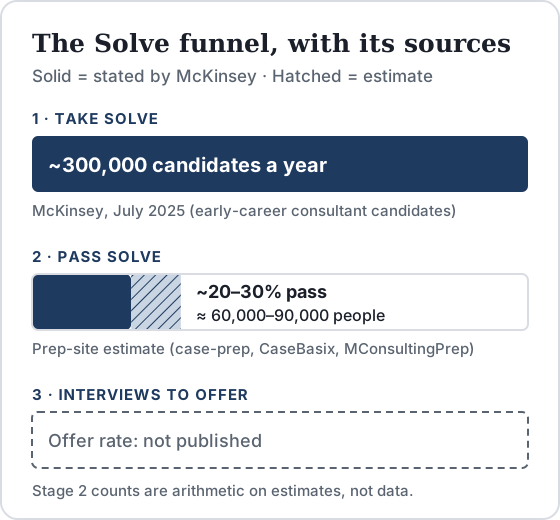
McKinsey has published one relevant number: Solve is "given to around 300,000 early career consultant candidates per year" (McKinsey's game lab, July 2025). It has not published a pass rate. Every figure below is a third-party estimate.
| Source | Estimated pass rate | Basis given |
|---|---|---|
| case-prep | 20–30%, some estimates nearer 20% | Aggregated prep-site reports |
| MConsultingPrep | Roughly 20–30% | Not stated |
| PSG Secrets | About 20–30% | Candidate reports "since 2022"; calls the figure "rumors" |
| CaseBasix | Around 20% ("one in five") | Not stated |
| StrategyCase | 10–20% without structured prep | Its own survey data and coaching clients |
Two things to keep in mind when you read any pass rate:
- It is an estimate of a relative bar. If your pool is stronger, the same performance can pass one year and fail the next.
- Prep-site conversion claims are marketing. StrategyCase reports 75–90% for candidates who follow its structured prep, against 10–20% unaided. No independent source verifies figures like these, so leave them out of your planning.
Do offices use different thresholds?
This is where the online advice is least reliable. Here is what is stated by McKinsey and what is only reported:
| Claim | Status | Evidence |
|---|---|---|
| Solve is not the only basis for a decision | Stated by McKinsey | Solve FAQ |
| The process is "consistent, fair" regardless of office | Stated by McKinsey | Interviewing page |
| No two candidates get the same parameters | Stated by McKinsey | Solve FAQ; 2020 careers post |
| New York and London have tougher thresholds | Reported | case-prep, CaseBasix; no data given |
| You are ranked globally, not by office | Disputed | PSG Secrets says global; case-prep says your own pool |
| Pass rates differ by role | Reported | MConsultingPrep, CaseBasix |
The office claim is plausible. A large office has more applicants per interview slot, so if thresholds are relative, the effective bar rises. But no source we found gives office-level numbers. Our rule: do not choose an office to dodge a harder Solve bar, because nothing solid supports it.
How long until results, and what does the email mean?
McKinsey does not publish a timeline. Candidates report:
- 1–2 weeks is typical (case-prep, CaseBasix).
- 2–14 days is the range MConsultingPrep and CaseBasix give, with a follow-up to your recruiter after two weeks.
- 5 days to a few weeks per PSG Cracked, and longer in busy offices or peak season per PSG Secrets.
The result is a pass or fail with no score, percentile or per-game breakdown. case-prep and PSG Secrets say some candidates have obtained their decile by asking the recruiter afterwards. There is no reliable way to tell whether you passed from inside the test. The email, or an invitation to interview, is the answer.
What to do while you wait
Do not spend the wait replaying the test. Use it for the next stage, which starts whatever the email says:
- Start case interview prep now. If you pass, the problem-solving interview comes next, and it takes longer to prepare for than Solve.
- Draft your Personal Experience Interview stories. McKinsey's interviewing page says to prepare detailed examples of your own role and actions. That work is useful at any firm.
- Write down how each game went while you remember. Note where you ran short of time and which decisions you changed. If the answer is no, these notes are the start of your re-prep plan.
If you did not pass, CaseBasix and PSG Secrets report a wait of about 12 months before you can reapply. StrategyCase puts it at 12 to 24 months depending on the office. Our guide to what to do after failing McKinsey Solve covers the cooldown and a re-prep plan. For where Solve sits against the other firms' steps, see the consulting assessment timeline.
How do you raise your McKinsey Solve score?
McKinsey's interviewing page says there is "no need to prepare" for Solve, and its FAQ says the task tutorials are untimed. That is true for knowledge: you need no business background. What practice changes is how much of your timed window goes on figuring out the interface instead of solving. The habits that lift both scores are the same.
| Habit | Product effect | Process effect |
|---|---|---|
| Finish every task, even with a rough final answer | Unanswered items score zero | Shows pacing control |
| Read the objective before touching data | Fewer wrong-target answers | Reads as a structured start |
| Commit, then move on | Saves time for later questions | Avoids the backtracking signal |
| Set a time budget per question or site | Protects the final items | Steady, deliberate pace |
| Use the in-game calculator, notepad and journal | Fewer arithmetic slips | Leaves a visible record of your working |
A preparation plan that follows from those habits:
- Practice timed, early. Untimed practice is fine for learning the rules. After that, every session should run against the clock.
- Build the base skills first. Chart reading and mental math make Redrock faster. Our chart drills and math drills are free with a DrillCase account.
- Learn each game's mechanics. For Sea Wolf, that means the averaging rule: see our Sea Wolf averaging rule guide.
- Review every error by type. Sort each miss into ran out of time, misread the data, or flawed logic, and drill the biggest group.
- Start two to four weeks out. StrategyCase calls two weeks its sweet spot and four weeks enough to prepare without rushing. A short daily session beats a weekend cram.
The bottom line
There is no published McKinsey Solve passing score. The best available reading is a relative bar somewhere around the top 20–30% of candidates, applied alongside the rest of your application. You cannot see the line, so the useful goal is to finish every task with a clean process. DrillCase's McKinsey Solve practice has 20+ Solve-style scenarios across Redrock, Sea Wolf, Sustainable Futures Lab and Ecosystem Creation formats for building that habit under time pressure.
Frequently asked questions
What is a good McKinsey Solve score?
McKinsey does not publish scores or a cut-off. Prep sites describe a strong result as landing in the top 20–30% of candidates, which is roughly decile 8 or above, and several say the 80th percentile (top 20%) is usually enough. Treat that as a target, not a rule. The real bar depends on the office, the role and how strong the rest of the candidate pool is.
Does McKinsey tell you your Solve score?
Not by default. Candidates report a pass or fail email with no score, percentile or breakdown by game, and MConsultingPrep and CaseBasix both say McKinsey shares no detailed feedback. case-prep and PSG Secrets report that some candidates got their decile by asking the recruiter. Nothing guarantees an answer, so work out which game hurt you from your own notes.
What percentage of candidates pass McKinsey Solve?
McKinsey does not publish a pass rate. Prep sites estimate about 20–30% (case-prep, MConsultingPrep, PSG Secrets), and CaseBasix puts it nearer 20%. None of them cite McKinsey data, so read these as informed estimates. Figures above 50%, including one that appeared in an older DrillCase article, could not be traced to any source.
Is the process score more important than the product score?
Nobody outside McKinsey knows the weighting. StrategyCase reports the two are weighted roughly equally; MConsultingPrep notes McKinsey has never stated how process is measured. In practice the question matters less than it seems: the habits that lift process (a plan, committed decisions, steady pacing) also protect product, because they are what gets you to the end of each task.
How long does it take to get McKinsey Solve results?
McKinsey does not state a timeline. MConsultingPrep and CaseBasix report 2 to 14 days, and PSG Secrets says it can take a few weeks, longer in busy offices or peak season. Both MConsultingPrep and CaseBasix suggest contacting your recruiter if you have heard nothing after two weeks.
Can a strong resume make up for a weak Solve score?
Possibly, at the margin. McKinsey's own FAQ says it will not decide on your candidacy from Solve alone and that results are considered together with the rest of your application. That makes a borderline score less final than a hard cut-off would be. It does not make a low score safe, so prepare as if Solve is a gate.
Do different McKinsey offices use different Solve thresholds?
Prep sites report that large, high-volume offices such as New York and London are tougher, because more candidates compete for the same number of interview slots. No source publishes office-level data, and McKinsey describes its process as consistent regardless of office. Treat the office effect as plausible but unproven.
Sources
- McKinsey & Company: Solve, McKinsey's assessment game FAQs (PDF)
- McKinsey & Company: Interviewing at McKinsey
- McKinsey & Company: Meet McKinsey's game-based innovation lab (July 2025)
- McKinsey & Company: Innovating recruiting through online gaming (May 2020)
- case-prep: What score do you need to pass McKinsey Solve?
- MConsultingPrep: McKinsey PSG scoring explained
- CaseBasix: McKinsey PSG scoring explained
- CaseBasix: Pass rate of the McKinsey Solve game
- CaseBasix: Can you fail the McKinsey game?
- PSG Secrets: McKinsey Solve score
- PSG Cracked: What is a good score in McKinsey Solve?
- StrategyCase: How to prepare for McKinsey Solve
- MyConsultingCoach: McKinsey Solve guide (updated June 2026)