Short answer
Bain's online test is either a Sova or a TestGorilla assessment, and your invitation email says which. Bain puts it at about 30 to 40 minutes and allows pen, paper and a calculator. Sova mixes reasoning, situational judgment and personality items with no per-question countdown. TestGorilla runs hard-timed multiple-choice tests with no going back.
Key takeaways
- Bain names the platform in your invitation: Sova or TestGorilla. Office-by-office maps online are candidate reports, not Bain policy, and they change between cycles.
- On TestGorilla you cannot return to a question and wrong answers cost nothing, so never leave one blank. On Sova there is no countdown per question, but prep sites report that speed feeds your score.
- Bain publishes no cut-off. Prep sites report TestGorilla sub-skills are rated 1 to 3 and averaged, so one weak section costs more than one standout section earns.
In this article
- Which Bain online test will you get?
- How do Sova and TestGorilla differ?
- What does the Bain SOVA test ask, section by section?
- Numerical reasoning
- Verbal reasoning: True, False or Cannot Say
- Logical reasoning
- Situational judgment (SJT)
- Personality questionnaire
- What is on the Bain TestGorilla test?
- How is the Bain online test scored?
- How should you prepare for the Bain online test?
- Test-day checklist
- What mistakes cost points on the Bain online test?
- When do you hear back after the Bain online test?
- What changed: Bain online test log

Bain's online test is a screening step between your application and first-round case interviews. It is not one fixed test. Bain runs it on two different platforms, and the platform decides the rules: whether a clock is running, whether you can go back, and whether a personality questionnaire comes with it. Below: which test you will get, each section with an original sample item, scoring, a prep plan for the time you have, and a dated log of changes. For how Bain's test fits alongside McKinsey Solve and BCG Casey, see the MBB online assessments overview.
- Bain-style practice questions in DrillCase's 20+ test sets
- 450+
- Source: /bain/practice
Which Bain online test will you get?
Bain states that if a digital assessment is required, you will receive an email after you apply "detailing whether you are required to complete Sova or Test Gorilla." That email is the only reliable answer. Bain also says intern and full-time applicants "may be required" to take one, so not everyone does.
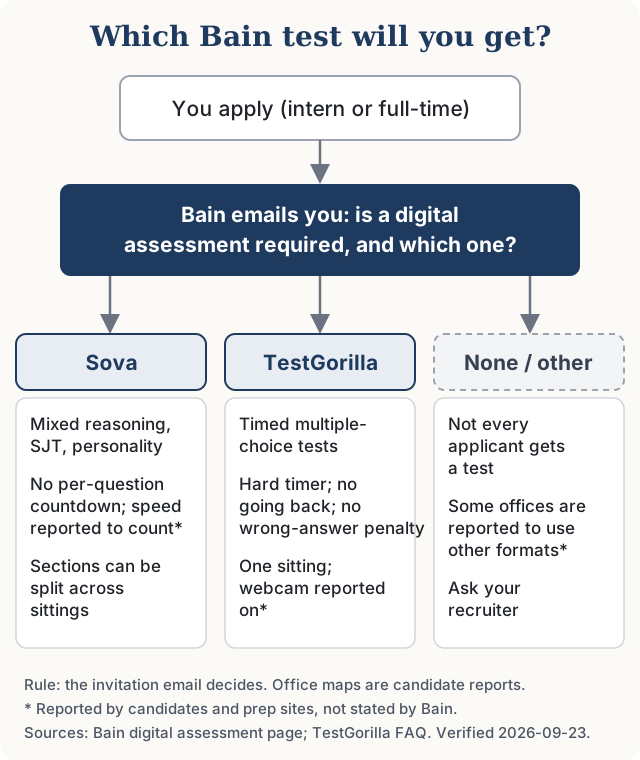
Prep sites have tried to map offices to platforms. The map below comes from Hacking the Case Interview (HTCI, updated March 2026), which bases it on candidate reports. Treat it as a starting guess. StrategyCase (June 2026) says "there is no stable, office-by-office rule," and My Consulting Coach (July 2026) advises preparing for Sova "only when your invitation names Sova."
| Region or office (reported) | Test reported | Confidence |
|---|---|---|
| United States, most offices | TestGorilla | Candidate reports |
| Amsterdam and other European offices | TestGorilla | Candidate reports |
| London and Middle East offices | Sova | Candidate reports |
| Germany | Pymetrics | Single source (HTCI) |
| Southeast Asia and Australia | HireVue | Single source (HTCI) |
Decision rule. If you have not applied yet, build the skills both tests share (numerical reasoning, chart reading, logic, judgment). HTCI notes the skills overlap heavily across formats. Once the email arrives, switch to that platform's format for the final few days. The side-by-side detail is in Bain TestGorilla vs Sova.
How do Sova and TestGorilla differ?
| Sova | TestGorilla | |
|---|---|---|
| Clock | No per-question countdown. Prep sites report completion time is tracked | Hard timer on each test. The timer keeps running if you close the window |
| Going back | Not documented by Sova or Bain | Not allowed. You are warned before skipping |
| Sittings | Can be split. Bain: finish all sections before the deadline | One sitting, per Bain |
| Wrong answers | No published penalty | No penalty, per TestGorilla |
| Tools allowed | Pen, paper, calculator (Bain) | Pen, paper, calculator (Bain) |
| Extra parts | SJT, personality, sometimes recorded video | Webcam on during the test (prep sites) |
| Reported length | 30–40 min (PrepLounge) to about 75 min (HTCI) | 40–50 min (HTCI), about 45 min (StrategyCase) |
| Browser | Not specified | Chrome recommended by Bain |
The length reports disagree. Bain's own figure is 30–40 minutes. Prep-site estimates for Sova run up to about 75 minutes, and CaseBasix says most candidates finish in 45 to 60. Block out 90 minutes of quiet time and you are covered either way.
What does the Bain SOVA test ask, section by section?
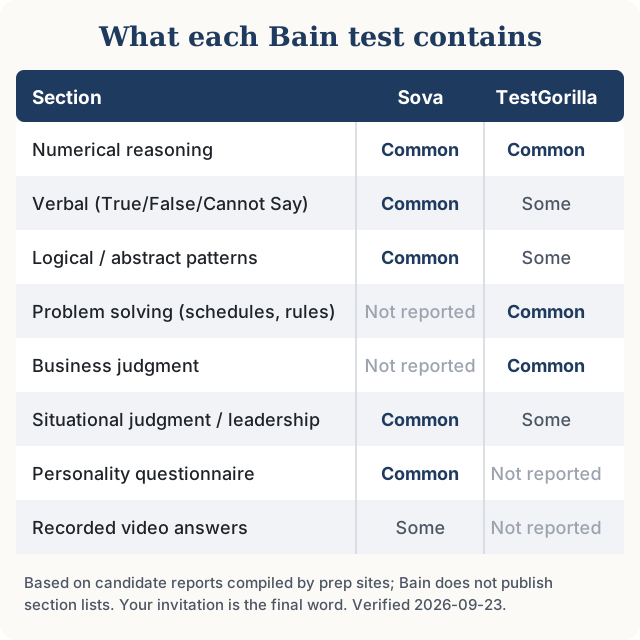
Sova's candidate hub says you will meet situational judgment questions, video interview questions and "three different types of ability questions." Each part opens with a practice question, and practice answers "do not count towards your score on the assessment." Prep sites agree the Bain version usually contains numerical, verbal and logical reasoning, a situational judgment test (SJT) and a personality questionnaire. Road to Offer notes the mix differs by office.
Numerical reasoning
You read a table or chart and answer percentage, ratio, growth and share questions. The skill is picking the fastest route to an answer that is precise enough, rather than calculating everything exactly. Our deeper guide is Bain SOVA numerical reasoning tips.
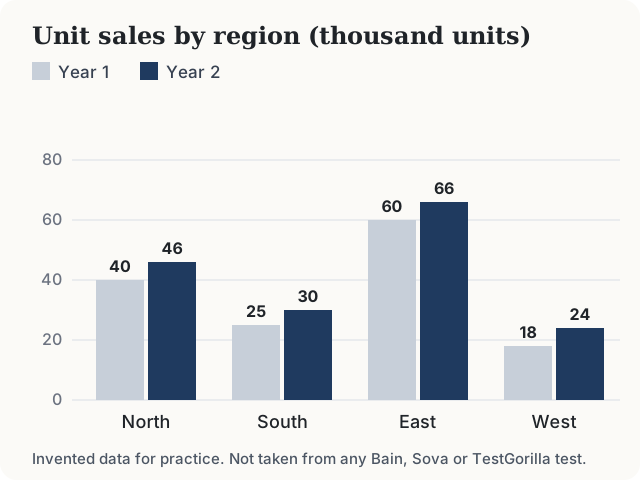
Sample item 1. Which region had the highest percentage growth from Year 1 to Year 2?
Worked answer: West. Don't divide Year 2 by Year 1 four times. Compare change over base instead: North 6/40 = 15%, South 5/25 = 20%, East 6/60 = 10%, West 6/18 = 33%. Three regions grew by the same 6 thousand units, so the smallest base (West) wins among them, and South added less on a bigger base than West. You can see that without any division.
Sample item 2. Roughly what share of Year 2 total sales came from East?
Worked answer: about 40%. Total is 46 + 30 + 66 + 24 = 166. Then 66/166 is a little under 66/165 = 0.4. If the options are 33%, 40%, 45% and 50%, you are done without a calculator. Bain allows one, but estimation is still quicker.
Verbal reasoning: True, False or Cannot Say
You get a short passage and a statement. True means the statement follows from the passage alone. False means the passage contradicts it. Cannot Say means the passage doesn't settle it either way. The two classic traps are using outside knowledge and accepting a claim the passage only reports someone making.
Riverton Bus Company introduced contactless payment on all 120 of its buses in March. Ridership in the six months after the change was 8% higher than in the same period a year earlier. The company's chief executive attributed the increase to faster boarding. Over the same period, the city raised parking charges in the central district.
| Statement | Answer | Why |
|---|---|---|
| Contactless payment is available on every Riverton bus. | True | "All 120 of its buses" |
| Faster boarding caused the rise in ridership. | Cannot Say | The passage reports the CEO's view and gives a rival explanation (parking charges). It establishes neither |
| Ridership fell in the six months after March, year on year. | False | It rose 8% |
Rule to drill: when you see "attributed," "claimed," "believes" or "expects," the underlying fact is usually Cannot Say, and the statement that someone said it is True.
Logical reasoning
Prep sites describe Sova's logical section as abstract patterns: find the rule that moves shapes from panel to panel. Deductive items (ordering, grouping, scheduling) are reported in TestGorilla's problem-solving section, so drill both. For deductive items, write the constraints down before you look at the options.
Sample item 3. Five analysts (A, B, C, D, E) present in sequence. B presents immediately after A. C presents before A. E presents last. D is not first. Who presents first?
Worked answer: C. E takes slot 5. A and B sit together as a pair, with C somewhere before them, and D can't be first. The only orders that work are C-A-B-D-E and C-D-A-B-E. C is first in both. Note what the test could ask next: "Who presents fourth?" The answer to that is "cannot be determined," because it is D in one order and B in the other. Deductive items often reward you for noticing that more than one order fits.
Situational judgment (SJT)
You read a workplace scenario and pick the most and least effective responses. CaseBasix reports three to four options per scenario.
Sample item 4. Two weeks into a team project, a teammate has missed two internal deadlines. The client update is in three days. Pick the most and least effective responses.
- A. Quietly finish the teammate's work yourself tonight.
- B. Talk to the teammate today, ask what is blocking them, and agree on a plan and a check-in before the client update.
- C. Email your manager a list of the missed deadlines.
- D. Wait until after the client update to raise it.
Worked answer: most effective B, least effective D. B deals with the cause, protects the deadline and keeps the relationship intact. D lets the risk grow at the moment it matters most. A fixes this week's work but hides the problem, and C escalates before a direct conversation has happened. Both sit in the middle. Across most SJTs, the top option is direct, early, collaborative action that still gets the work done.
Personality questionnaire
You rate statements about yourself. There are no right answers, and prep sites warn that inconsistent answers get flagged. Answer honestly and at a steady pace. Don't try to guess the profile Bain wants.
What is on the Bain TestGorilla test?
TestGorilla is a library of short, separately timed tests that an employer assembles into one assessment. Prep sites report Bain's version as three or four multiple-choice sections of 8 to 15 minutes each. Hacking the Case Interview describes two variants:
| Variant (reported) | Sections |
|---|---|
| US | Numerical reasoning, business judgment, leadership and people management, problem solving |
| Europe | Cognitive or verbal ability, numerical reasoning, business acumen. Some candidates also report critical thinking and working-with-data sections |
Question counts vary by report. HTCI cites about 12 numerical questions in about 10 minutes, or 50 seconds each. StrategyCase says 6 to 10 questions per 8-to-15-minute block, which gives you up to 2 minutes a question on the looser sections. Expect numerical to be the tightest.
Sample item 5 (problem solving). Three client calls must fit between 9:00 and 12:00. Call X takes 60 minutes, Y takes 45 and Z takes 30. Y must end before X starts. Z cannot start before 10:30. Calls need at least a 15-minute gap between them. What is the latest X can start? (a) 10:00 (b) 10:15 (c) 10:30 (d) 11:00
Worked answer: (b) 10:15. If X starts at 11:00, it ends at 12:00. Z then has to run before X, and that fails: Z can't start before 10:30 and would have to end by 10:45. So Z runs after X. Z has to start by 11:30 to end by 12:00, and X has to end 15 minutes before that. That makes the latest end for X 11:15 and its latest start 10:15. Check it: Y 9:15–10:00, X 10:15–11:15, Z 11:30–12:00. The fastest way in is to test the options from latest to earliest and stop at the first one that works.
Business judgment and leadership items look like SJT items with a commercial angle, such as a pricing decision or a resource trade-off. The same logic applies: choose the option that acts on evidence and moves the work forward.
Three rules from TestGorilla's own candidate FAQ shape your tactics:
- You cannot go back. Once you submit or skip, the question is gone.
- There is no penalty for wrong answers. TestGorilla says: "Better to score a point through luck, than to skip and guarantee no points."
- The clock does not stop. If the timer runs out, only submitted answers count. Closing the window does not pause it, so take breaks only between tests.
Decision rule for TestGorilla pacing: divide the section time by the question count to get your budget per question. When you reach 1.5 times that budget, eliminate what you can, pick an answer and submit. A blank is worth zero, and you can't come back to it.
How is the Bain online test scored?
Bain does not publish a cut-off score. What is known:
| Platform | What is documented | Source type |
|---|---|---|
| TestGorilla | Percentile scores that account for question difficulty. A hard question answered correctly counts for more than an easy one, and you are compared with a reference group | TestGorilla (official) |
| TestGorilla, Bain view | Each sub-skill rated 1 (below what Bain needs), 2 (acceptable) or 3 (strong), then averaged per section | Prep sites (StrategyCase, HTCI) |
| Sova | Accuracy plus speed on ability items. Time is not recorded on video sections | Speed: prep sites. Video timing: Sova (official) |
| Both | Results read alongside your resume, not in isolation | Prep sites (HTCI) |
What this means for your approach:
- Evenness beats peaks. Sub-skill ratings top out at 3, so a brilliant section can't lift the average far, while a 1 drags it down. HTCI adds that candidates who score evenly are viewed more favorably. If your practice shows one section far below the rest, spend your remaining days there.
- Accuracy first, then speed. On Sova, a fast wrong answer is still wrong. Prep-site advice converges on a steady pace without lingering. My Consulting Coach suggests under 45 seconds for numerical and logical items and under 30 for verbal. Road to Offer allows 60 to 90 seconds for verbal. We read the gap as a sign that nobody outside Sova knows the exact weighting. Aim for the faster pace in practice and the accurate pace on the day.
- Pass rates are unknown. Neither Bain nor the vendors publish them. Any percentile target you see, such as PrepLounge's 70th to 80th percentile, is a prep-site estimate.
How should you prepare for the Bain online test?
Bain's page says of TestGorilla that "no preparation is needed," meaning you need no consulting knowledge. That is true of the content. What preparation fixes is the format: the no-return rule, the timer and the T/F/Cannot Say logic. Sova itself points candidates to its Candidate Preparation Hub, and Bain recommends it too.
Pick the plan that matches the time you have. HTCI and StrategyCase report a deadline of about 3 days after the invitation, but your email sets the actual one.
| Time you have | Day or week | What to do |
|---|---|---|
| 3 days (invite in hand) | Day 1 | Read the invitation for the platform, deadline and tools. Set up a laptop, Chrome, a quiet room, pen, paper and a calculator. Do the official samples (Sova hub, or TestGorilla-style items). Do one timed set of each section type and log your accuracy and seconds per question |
| Day 2 | Two timed sets on your weakest section only. Review every miss and write down the rule you broke | |
| Day 3 | Take the test early in the window, not on the last evening. Technical problems need slack | |
| 2 weeks (before or right after applying) | Week 1 | 20 minutes a day of percentages, ratios and chart reading. 15 T/F/Cannot Say items a day, checking against the "attributed" rule. Five ordering or grouping puzzles a day |
| Week 2 | Mixed timed sets under the 1.5x-budget rule. Two sets of SJT scenarios, explaining each ranking to yourself. One full mock under real conditions two days before the test |
DrillCase's Bain practice has 450+ questions across 20+ test sets. They cover numerical, verbal, situational judgment, logical, data interpretation and case-study items, and you can buy single sections or the full set on the Bain SOVA page. For a wider look at aptitude formats across firms, see cognitive aptitude test formats. Terms like percentile and SJT are defined in the glossary.
Test-day checklist
- Use a laptop or desktop with a stable connection. Bain recommends Chrome for TestGorilla.
- Disable browser extensions. Prep sites report that TestGorilla asks for this and runs with your webcam on.
- Have pen, paper and a calculator ready. Bain allows all three for the assessment. The calculator is not allowed in later interviews.
- TestGorilla: plan one uninterrupted sitting and take breaks only between tests. Sova: you may split sections across sittings, but finish before the deadline.
- If you need an adjustment, request it through TestGorilla during setup. For Sova, Bain asks you not to start and to email its EMEA talent acquisition team first.
What mistakes cost points on the Bain online test?
| Mistake | Where it bites | Fix |
|---|---|---|
| Leaving a TestGorilla question blank | Every timed section | No penalty and no return, so always submit a best guess |
| Using outside knowledge on T/F/Cannot Say | Sova verbal | Judge only against the passage. Reported claims are usually Cannot Say |
| Exact arithmetic when options are far apart | Numerical | Estimate first. Reach for the calculator only when options sit within about 5% of each other |
| Pausing mid-question to rest | Sova (time reportedly recorded) | Rest between sections, which Bain allows, not inside one |
| Answering the personality items "strategically" | Sova personality | Answer honestly and consistently. Inconsistency is what prep sites say gets flagged |
When do you hear back after the Bain online test?
Bain says applicants "can expect to hear within 60 days." Prep sites report faster replies in many offices, from a few days to two weeks. If you pass, the next step is first-round case interviews, so switch your preparation to cases straight away. Bain says a completed assessment doesn't need retaking "unless directed otherwise." A TestGorilla link is single-use, and a second attempt is at Bain's discretion. If you don't advance, HTCI reports most offices let you reapply after 12 to 18 months, and StrategyCase says about 12. Both are estimates.
If you are also applying to McKinsey or BCG, their screens work differently. Read the McKinsey Solve guide and the BCG Casey guide.
What changed: Bain online test log
| Date | Change | Source |
|---|---|---|
| 2024 | Bain reported to start using TestGorilla alongside Sova | HTCI (reported) |
| Mar 2026 | HTCI updates its office map (US and Amsterdam on TestGorilla; London and Middle East on Sova; others on Pymetrics or HireVue) | HTCI (reported) |
| Jun 2026 | StrategyCase: no stable office-by-office rule, and usage "can shift from cycle to cycle" | StrategyCase |
| Jul 2026 | My Consulting Coach: prepare for Sova only when the invitation names it | MCC |
| Sep 21, 2026 | TestGorilla candidate FAQ, last updated this day, confirms: no going back, no wrong-answer penalty, timer runs while the window is closed, single-use link | TestGorilla (official) |
| Sep 23, 2026 | We checked Bain's page. It names Sova and Test Gorilla, gives 30–40 minutes, allows pen, paper and a calculator for both, prohibits AI tools and says applicants hear within 60 days | Bain (official) |
We re-check Bain's page and both vendors' candidate pages when we update this guide. The "last verified" date at the top shows when we last did. If your invitation contradicts anything here, trust the invitation.
Frequently asked questions
Is the Bain online test hard?
The content is not advanced. Hacking the Case Interview compares it to GMAT-style questions. The difficulty is pace. TestGorilla sections run on a hard timer, and reported question counts work out to between about 50 seconds and 2 minutes per question. Prep sites report that Sova tracks completion time too. Timed practice is what moves your score.
Is the Bain SOVA test timed?
Not per question. Sova sections have no visible countdown, and Bain lets you split sections across sittings before the deadline in your invitation. Prep sites consistently report that completion time is recorded and that faster correct answers score higher, so treat it as speed-sensitive. Sova's own hub says only that time is not recorded on video sections.
What score do you need to pass the Bain online test?
Bain does not publish a pass mark. TestGorilla reports percentile scores weighted by question difficulty, and prep sites say Bain looks at sub-skill ratings on a 1 to 3 scale alongside your resume. Targets such as the 70th to 80th percentile come from prep sites and are estimates, not Bain figures.
Can you retake the Bain online test?
Generally no. A TestGorilla invitation link works once, and any second attempt is at the employer's discretion. Bain says that if you have already completed the assessment you won't need to retake it unless told otherwise. If you are rejected, prep sites report you can usually reapply in a later recruiting cycle.
Do all Bain offices use the same online test?
No. Bain says its email will state whether you need to complete Sova or TestGorilla, and some applicants get no test at all. Candidate reports link the US and parts of Europe with TestGorilla and London and the Middle East with Sova, but prep sites agree there is no stable office rule.
Can you use a calculator on the Bain online test?
Bain's digital assessment page says a pen, paper and calculator are allowed for both Sova and TestGorilla. The calculator is for the assessment only, not later interviews. StrategyCase still tells candidates to assume no calculator unless told otherwise. Follow Bain's page and your invitation, and practice mental math anyway because it is faster.
Sources
- Bain & Company: Digital assessment (hiring process)
- TestGorilla Candidates: Common questions about assessments and tests
- TestGorilla: Introduction to percentile scores
- Sova: Candidate Preparation Hub
- Hacking the Case Interview: Bain TestGorilla assessment (updated Mar 15, 2026)
- StrategyCase: Bain TestGorilla (updated Jun 10, 2026)
- PrepLounge: Bain Sova test (updated Jun 11, 2026)
- CaseBasix: Bain aptitude test (Sova) guide (updated Aug 17, 2026)
- My Consulting Coach: Bain Sova test (updated Jul 18, 2026)
- Road to Offer: Bain Sova test guide (updated Sep 1, 2026)