Bain SOVA testguide and practice
Bain SOVA test: what it asks and how to practice it
Sova is one of two platforms Bain uses for its online test. Expect numerical, verbal and logical reasoning, situational judgment and a personality questionnaire, with no per-question countdown but your pace on record. Below: each section, a worked sample, and where to practice.
Sova or TestGorilla? Check your invitation's rules first, free →
0:64Walkthrough, sound on
How SOVA-style practice works on DrillCase
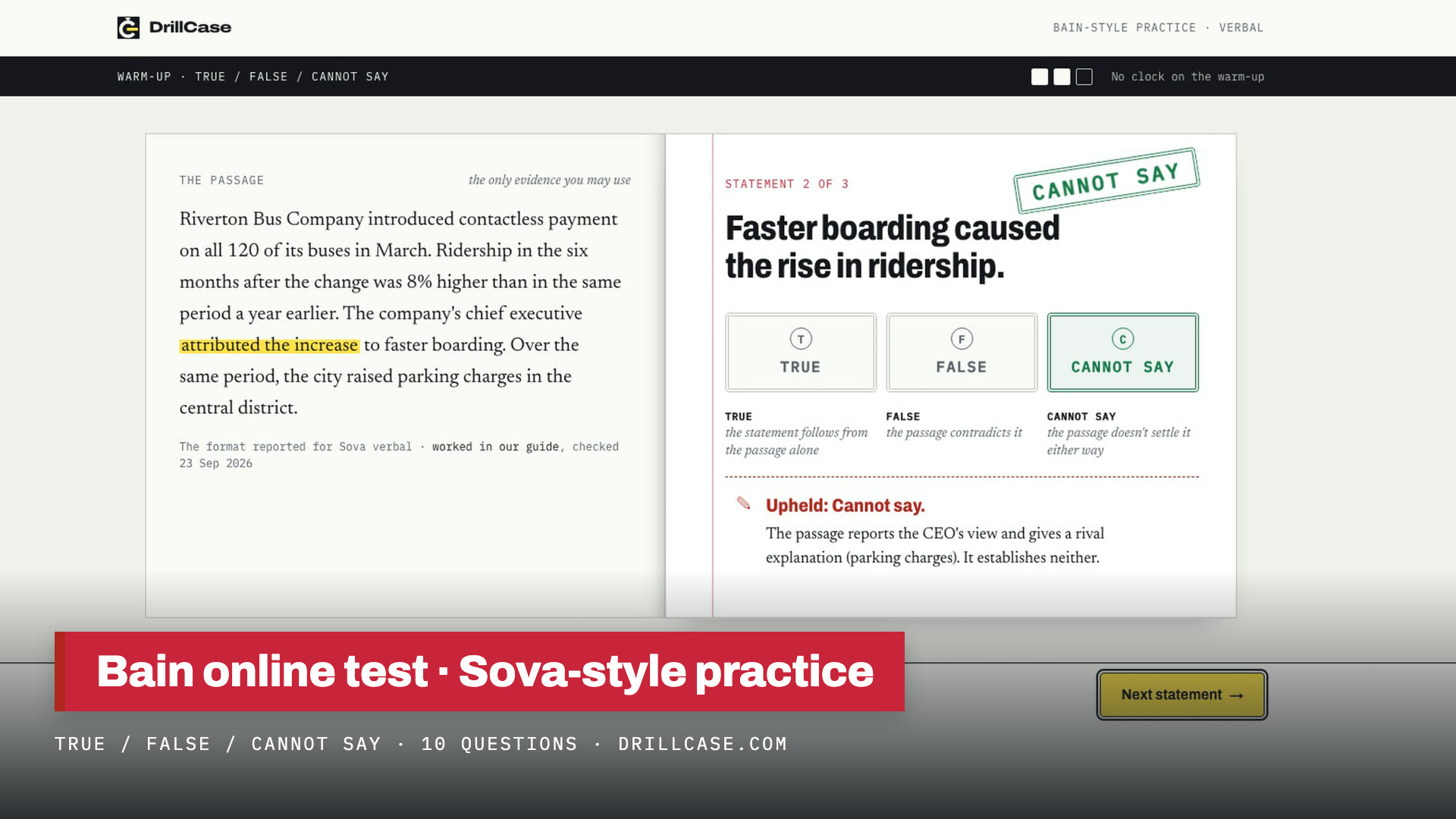
A 64-second walkthrough of a paid mock paper, recorded on DrillCase: the section list and clock, verbal true, false or cannot-say questions, numerical questions from tables and charts, then submit for a question-by-question review. Sound on, English captions.
30–40 minSection map · Bain's estimate
The SOVA sections, and which ones you can practice here
Section names come from prep-site candidate reports; Bain does not publish a list, and the mix can vary by office. We say plainly where DrillCase has no practice.
SectionDrillCase practice
Numerical reasoning
Tables and charts; percentages, ratios, growth, share
Covered198
198 questions in 9 sets (incl. data interpretation)Verbal reasoning
Short passages; True, False or Cannot Say
Covered150
150 questions in 5 sets, plus 10 freeLogical: deductive
Syllogisms, assumptions, rule application
Covered32
32 questions in 2 setsLogical: abstract patterns
Find the rule that moves shapes between panels
Not covered
Not covered. Use Sova's free hub examplesSituational judgment
Rank responses to workplace scenarios
Covered80
80 questions in 5 setsPersonality
Rate statements about yourself; no right answers
Not covered
Not practiced: answer honestly and consistentlyExhibit 1
DrillCase's Bain-style bank by section
- Numerical reasoning174
- Verbal reasoning150
- Situational judgment80
- Logical (deductive) reasoning32
- Data interpretation24
- Written case study16
01–05Section by section
What each section asks, with a worked example
01
Numerical reasoning
198 QsYou read a table or chart and answer percentage, ratio, growth and share questions. The skill is choosing a route that is precise enough, not calculating everything exactly.
Sample item
Which region grew fastest in percentage terms from Q1 to Q2?
South. Compare change over base instead of dividing Q2 by Q1 four times: North 3/24 = 12.5%, South 4/16 = 25%, East 4/40 = 10%, West 2/12 = 16.7%. South and East both added 4, and the smaller base wins.
More shortcuts: Bain SOVA numerical reasoning tips.
02
Verbal reasoning
150 QsA short passage and a statement. True if it follows from the passage alone, False if the passage contradicts it, Cannot Say if the passage does not settle it.
- Judge only against the passage, never what you know about the topic.
- When a passage says someone claimed, believes or attributed something, the underlying fact is usually Cannot Say.
03
Logical reasoning
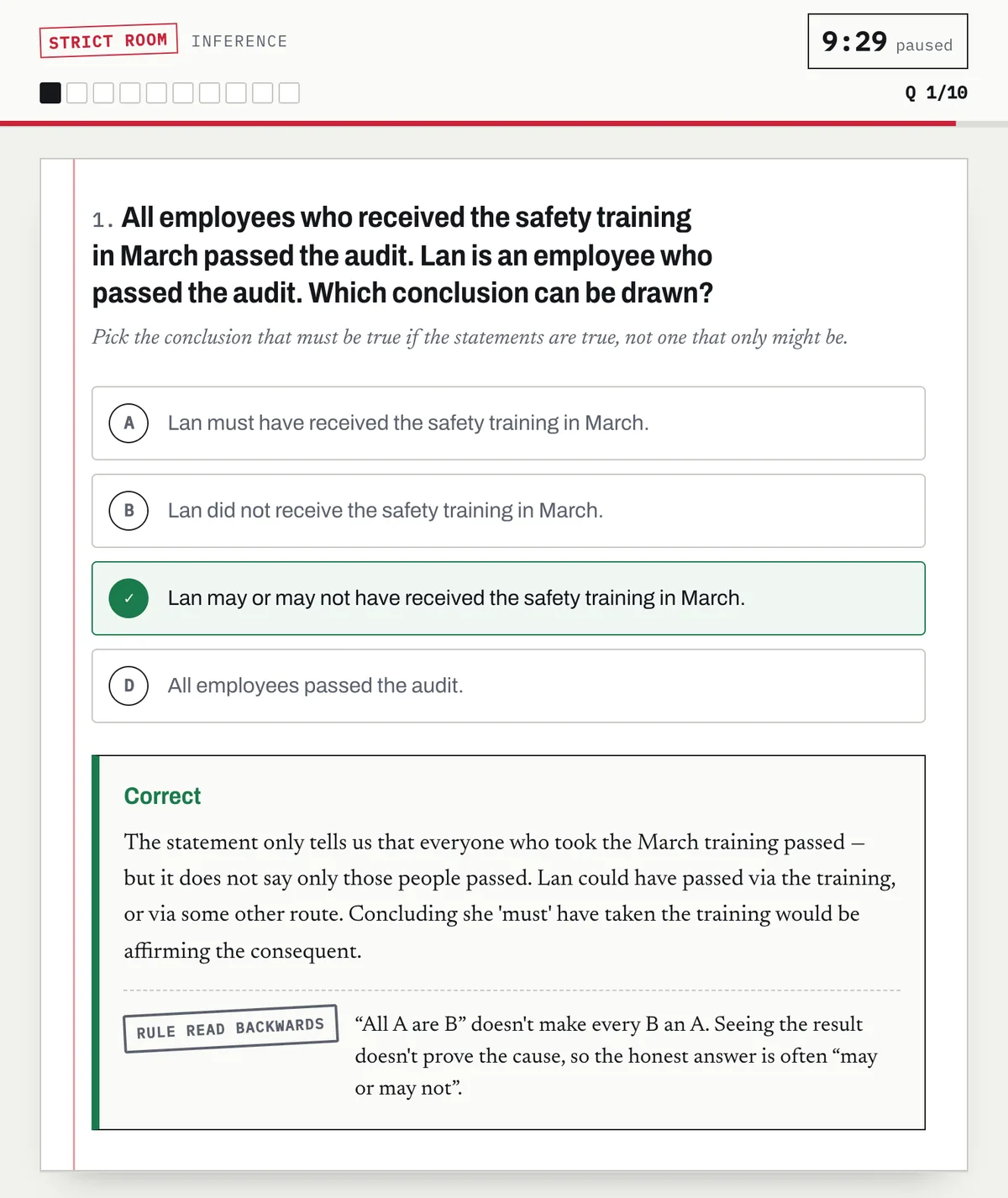
32 QsPrep sites describe two kinds. Deductive items (syllogisms, assumptions, rules) are what the screenshot shows; this explanation, from the free sample bank, names the fallacy: affirming the consequent. Abstract pattern items ask you to find the rule that moves shapes between panels; DrillCase has none of those, so use Sova's own preparation hub.
04
Situational judgment
80 QsA workplace scenario and three or four responses to rank, or to mark most and least effective. The top option is usually direct, early and collaborative, and still gets the work done.
Sample item
A teammate has missed two internal deadlines and the client update is in three days. Most effective?
Most effective: 2. Least: 4. Option 2 fixes the cause and protects the deadline; option 4 lets the risk grow when it matters most.
05
Personality questionnaire
Not practicedYou rate statements about yourself. There are no right answers, and prep sites warn that inconsistent answers get flagged. Answer honestly at a steady pace. It is the one part you should not practice for.
See the format for yourself
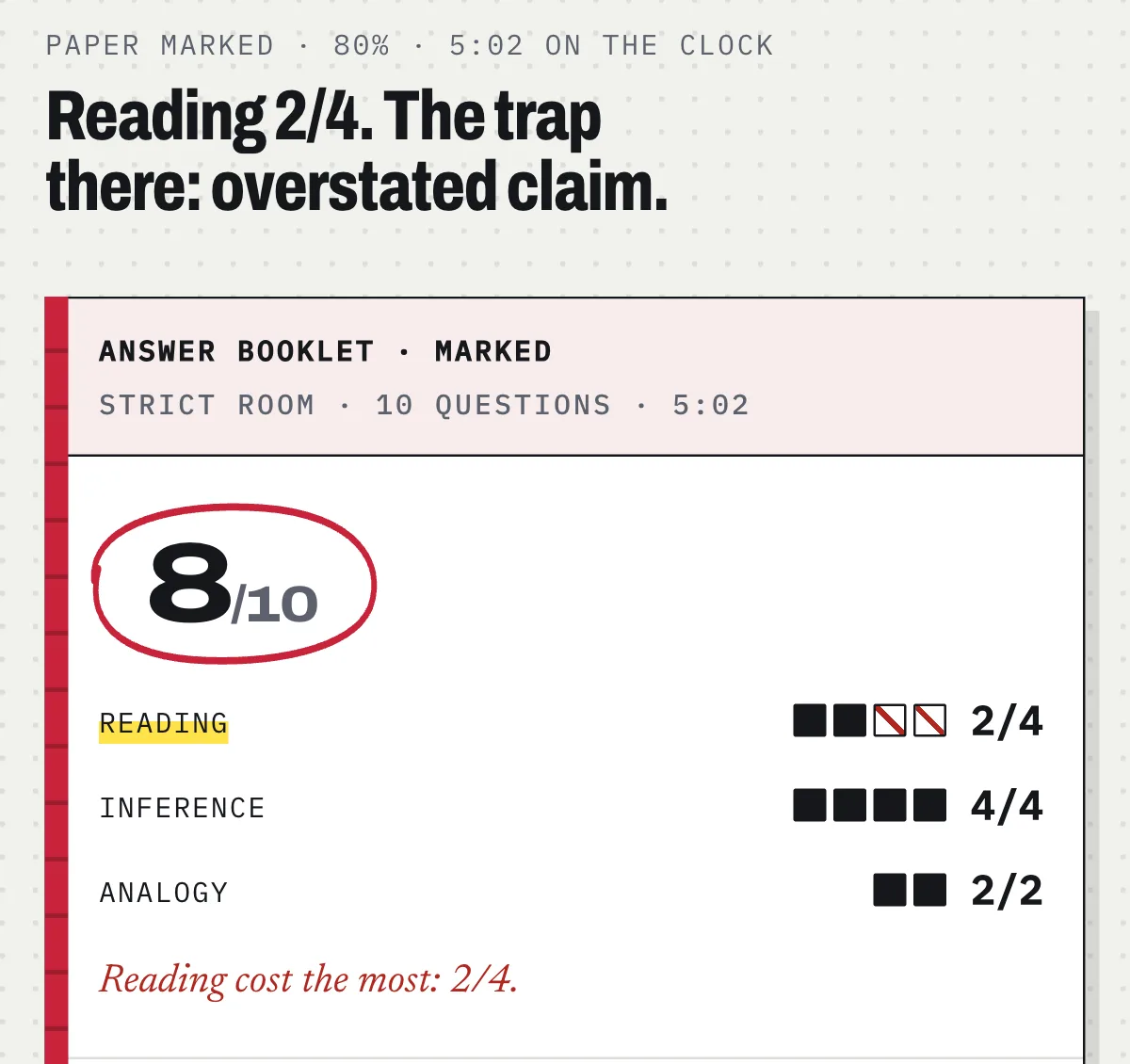
10 timed verbal reasoning questions, a worked explanation after each, and your score by question type. Free, no sign-up.
Start the free session—:—No per-question countdown
Accuracy first, then pace
Bain publishes no pass mark. What is known: Sova shows no countdown per question, and prep sites consistently report that answer time counts, so a fast wrong answer is still wrong and a slow right one may score less.
Prep sites also report that results are read alongside your resume and that even performance across sections looks better than one standout. Any percentile target you see online is an estimate, not a Bain figure.
If Bain sends you TestGorilla instead, the rules change: a hard timer, no going back and no penalty for a wrong answer. See Bain TestGorilla vs Sova.
Exhibit 2
Where the online test sits in Bain's process
| Sova | TestGorilla | |
|---|---|---|
| Clock | No per-question countdown | Hard timer per section |
| Going back | Not documented | Not allowed |
| Sittings | Can be split | One sitting |
| Wrong answers | No published penalty | No penalty |
| Tools | Pen, paper, calculator | Pen, paper, calculator |
Bain, TestGorilla and Sova candidate pages; compiled in the Bain online test guide.
~3 daysPrep plan · reported deadline
Pick the plan for the time you have
Prep sites report a deadline of about three days after the invitation. Your email sets the real one.
Invitation in hand: 3 days
- Day 1Day 1: the free 10-question session, then one timed set per section type. Note accuracy and seconds per question.
- Day 2Day 2: two timed sets of your weakest section. Write down the rule you broke on every miss.
- Day 3Day 3: take the real test early in the window, not on the last evening.
Before you apply: 2 weeks
- Week 1Week 1: 20 minutes a day of percentages and chart reading, 15 True/False/Cannot Say items, a few deductive puzzles.
- Week 2Week 2: mixed timed sets, two sets of judgment scenarios, one full mock test two days before.
$99Practice on DrillCase
Where to practice each section
Start with the free session. If you then want timed sets, one module covers one section; Comprehensive covers every section plus the case-study sets and the mock papers. Full refund on Comprehensive within 7 days if you've opened 3 sets or fewer.
- Free session · 10 Qs
- $0
- One section · 12 months
- $20
- Every section · lifetime
- $99
08Questions, with sources
Bain SOVA test questions
- Bain + prep sitesWhat is the Bain SOVA test?
- It is the online assessment Bain runs on the Sova platform for some applicants. Bain's email after you apply says whether you need a test and which platform it uses, usually Sova or TestGorilla. Prep sites report the Bain version mixes numerical, verbal and logical reasoning with situational judgment and a personality questionnaire. The free Platform Check shows the rules of the platform you got.
- Bain + prep sitesHow long is the Bain SOVA test?
- Bain puts its digital assessment at about 30 to 40 minutes. Prep-site estimates for Sova run from 30 to 40 minutes up to about 75. Block out 90 quiet minutes and you are covered either way.
- Bain + prep sitesIs the Bain SOVA test timed?
- Not per question: Sova sections show no countdown, and Bain lets you split sections across sittings before the deadline. Prep sites consistently report that answer time is recorded and faster correct answers score better, so treat it as speed-sensitive.
- BainCan I use a calculator?
- Yes. Bain's digital assessment page allows pen, paper and a calculator for both Sova and TestGorilla. Estimating is still faster when the options are far apart.
- BainWhat score do I need to pass?
- Bain does not publish a pass mark. Percentile targets you see online are prep-site estimates, not Bain figures. Aim for even performance across sections rather than one standout.
- BainCan I retake the Bain SOVA test?
- Generally no. Bain says a completed assessment does not need retaking unless you are told otherwise, which is why practicing before you start matters.
- DrillCaseWhich SOVA sections does DrillCase cover?
- Numerical reasoning and data interpretation (198 questions), verbal reasoning (150), deductive logic (32) and situational judgment (80), plus written case studies and 3 full mock tests. It does not cover abstract pattern items or the personality questionnaire.
- DrillCaseIs there a free Bain SOVA practice option?
- Yes. A free session gives you 10 verbal reasoning questions from a 50-question sample bank, with a timer and a worked explanation after each one. No sign-up. Paid modules start at $20; everything is $99, as Comprehensive.
8 readsKeep reading
More on Bain and the other MBB screens
- Bain aptitude test practice →450+ questions, 23 sets, plans and demo.
- All Bain practice tests →Every set and the 3 mock tests, listed.
- Bain online test guide →Sova or TestGorilla, scoring and sources.
- MBB online assessments →Bain vs McKinsey Solve vs BCG Casey.
- Aptitude test formats →How the major platforms differ.
- McKinsey Solve guide →The game-based test, explained.
- BCG Casey guide →The chatbot case, explained.
- Assessment glossary →25+ terms such as percentile and SJT.
DrillCase is an independent practice tool. It is not affiliated with, endorsed by or sponsored by Bain & Company, Sova or TestGorilla. Product names are trademarks of their owners.