Short answer
BCG Casey is the chatbot-led online case that BCG calls the Online Case Experience. BCG says it takes about 30 minutes, in English. Candidates report one business case with 8 to 10 questions, starting with dataset selection, no going back, a calculator allowed, and a 60-second recorded video recommendation at the end.
Key takeaways
- Casey is one business case run by a chatbot: about 30 minutes by BCG's own description, 8 to 10 questions by candidate report, then a 60-second video recommendation. Answers are final once submitted.
- BCG publishes no scoring rules or pass rate. Candidates get a pass or fail result, and third-party estimates put the pass rate at roughly 20 to 30 percent.
- The skills are ordinary case skills (structure, math, chart reading, synthesis) under a clock. Two weeks of timed, chat-format practice plus daily math drills covers most of the gap.
In this article
- What is BCG Casey?
- Who gets Casey, and when?
- How does the BCG online case work, step by step?
- How much time do you get per question?
- What question types does Casey ask?
- What does a Casey case look like? A worked example
- Q1. Which datasets would you request?
- Q2. A calculation
- Q3. An exhibit
- The video, scripted
- How is Casey scored, and what is the pass rate?
- How does Casey compare with the Potential Test, the CCA and other BCG tests?
- Where does Pymetrics fit?
- How do you prepare for Casey in two weeks?
- What to have on the desk
- How DrillCase fits
- What has changed in BCG Casey?
- Next steps

BCG's online case is one business case run by a chatbot called Casey. BCG says it takes about 30 minutes. Candidates report 8 to 10 questions that open with a dataset-selection question, allow no going back, and end with a 60-second video recommendation. BCG publishes no pass rate, and prep sites estimate 20 to 30 percent. Below: what BCG itself states, what candidates report, where prep sites contradict each other, and a two-week plan. If you don't yet know which online test each firm uses, start with the MBB online assessments overview.
- Casey-style practice questions across 25+ DrillCase cases
- 250+
- Source: /bcg/casey
What is BCG Casey?
Casey is the chatbot that runs BCG's online case. BCG's careers site calls the test the Online Case Experience (OCE): "an interactive exercise where you solve a business case guided by Casey, a chatbot." BCG says it takes approximately 30 minutes, runs in English, and needs only a personal computer with a reliable internet connection. BCG's own prep advice is short: preparation "is the same as for a Case Interview."
The tool's origin is documented in a 2020 BCG alumni interview: a BCG alumnus partnered with "a local recruiting chatbot company" to build Casey. The interview says the chatbot "presents candidates with a scenario and asks them how they would go about diagnosing the problem and proposing solutions through a combination of structured questions, free-text answers, and a video summary." It lists the skills Casey is meant to test: "problem structuring, business judgment, quantitative rigor, succinct communication, and beyond." In 2020 the tool had been piloted in Southeast Asia and was being rolled out globally. Prep sites name the vendor as HireQuotient, a Singapore company, and your invitation email may carry that name.
In practice, Casey feels like the most interviewer-led case you will ever do. You cannot steer the analysis or ask clarifying questions. The chatbot sets each step, shows the exhibit you need, and waits for your answer. It does not tell you whether you were right.
Who gets Casey, and when?
Undergraduates, MBAs, PhDs and experienced hires have all reported receiving it, according to Hacking the Case Interview. It usually arrives after your résumé passes screening, with a window of about 3 to 7 days to complete it. Some offices instead run Casey alongside the first round of live interviews. Casey is not the only BCG online test (more on that below), so read your invitation and prepare for the test it names.
How does the BCG online case work, step by step?
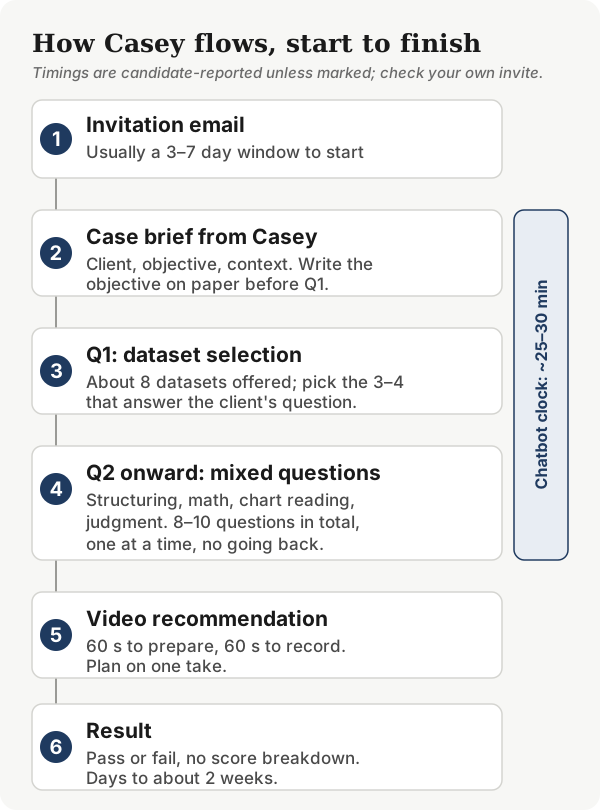
- Invitation. An email with a link, often naming HireQuotient. You choose when to start within the window. Once you start, the clock does not pause.
- Case brief. Casey introduces the client and the objective. The screen is split: the chat and answer options on one side, exhibits on the other.
- Dataset selection. The first question usually asks which data you would request. You pick a few sources from a list of about 8.
- Mixed questions. The rest of the case moves through structuring, calculations, chart reading and judgment calls, one at a time. Several sources report that Casey posts a time reminder every 5 minutes.
- Video recommendation. After the chatbot section, most sources report 60 seconds to prepare and 60 seconds to record a recommendation on your webcam (Management Consulted reports a 5-minute prep window instead). The recording reportedly cuts off at the limit.
- Result. A pass or fail, reported to arrive within a few days to about two weeks, with no score breakdown.
Because every answer is final, a misread objective in step 2 carries through every later answer. The cheapest insurance is 30 seconds with a pen: write the client's goal and the metric that defines it before you touch Q1.
How much time do you get per question?
Hacking the Case Interview sums it up: the difficulty "comes from time pressure rather than content," and running out of time heads its list of reasons candidates fail. Here is a budget for a 30-minute chatbot section with 9 or 10 questions:
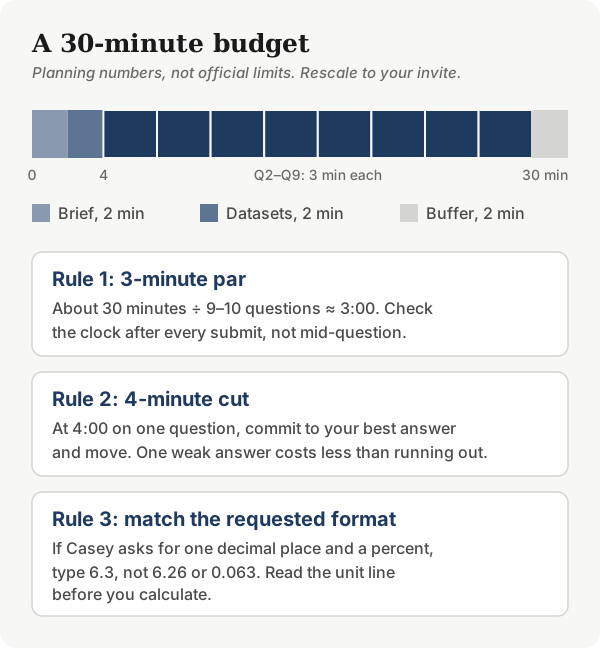
Three decision rules follow from the budget:
| Rule | What to do | Why |
|---|---|---|
| 3-minute par | Divide the stated minutes by the expected number of questions. Check the clock after each submit | Checking mid-question breaks concentration. Checking between questions costs 2 seconds |
| 4-minute cut | At 4:00 on one question, commit to your best answer and move on | You must answer to proceed. A rushed final three questions cost more than one imperfect answer |
| Format first | Read the unit and rounding line before you calculate | If Casey asks for one decimal place, 6.26 risks being marked wrong where 6.3 would not be |
What question types does Casey ask?
Candidate reports agree on five formats: single-select multiple choice, multi-select multiple choice, short numeric entry, longer written answers, and the recorded video. Those formats carry six kinds of question. The table below is the index for this topic: each type links to a deep-dive guide where one exists, and to a place to practice it.
| Question type | Typical format (reported) | What it tests | Decision rule | Go deeper | Practice |
|---|---|---|---|---|---|
| Dataset selection | Multi-select, about 8 options, pick 3 or 4 | Hypothesis-driven scoping | Fewest datasets that cover every branch of your issue tree; drop overlaps | Dataset selection guide | Free demo case |
| Structuring / brainstorming | Multi-select or a short written list | MECE thinking, idea breadth | Split first (internal vs external, revenue vs cost), then fill each branch | Chatbot format breakdown | Case library |
| Calculation | Numeric entry | Setting up the math correctly | Write the formula before you touch the calculator; check units and rounding | This guide, worked example below | Math drills |
| Chart and exhibit reading | Single-select, sometimes 2 to 3 exhibits combined | Pulling the one relevant number fast | Axes, then units, then the specific series the question names | This guide, worked example below | Chart drills |
| Business judgment | Single- or multi-select | Picking the conclusion the data supports | Eliminate options that go beyond the data, then choose the one that answers the objective | Casey vs CCA | Casey simulation |
| Video recommendation | 60-second recording | Synthesis and delivery | Answer first, two numbers as reasons, one risk or next step | Video script guide | Casey simulation |
Nobody outside BCG knows the exact mix, but the estimates point one way. Hacking the Case Interview puts quantitative work at "roughly 60 to 70%" of the test, citing candidate reports, and elsewhere says quantitative questions are "typically 5 or more of the 8 to 10." If your prep time is short, spend most of it on timed numbers and exhibits.
What does a Casey case look like? A worked example
The example below is original and simplified, written to show how the question types connect. It is not a reproduction of a real BCG case.
Brief. Harbor Coffee runs 120 cafés in one region. Annual revenue is flat at about $150M, but operating profit fell from $18M to $12M over two years. The CEO asks why profit fell and what to do about it.
Objective on your notepad: explain a $6M profit drop at flat revenue; recommend a fix.
Q1. Which datasets would you request?
You are offered eight:
| # | Dataset | Keep? | Reason |
|---|---|---|---|
| A | Store-level P&L by month (revenue, cost of goods, labor, rent) | Keep | Shows which cost lines moved. This is the core of the profit tree |
| B | Revenue by product category (drinks, food) | Keep | Flat revenue can hide a mix shift, and categories carry different margins |
| C | Competitor café openings near each store | Keep | The only external cause on the list |
| D | Coffee bean commodity price index | Drop | Its effect already shows up in cost of goods in A |
| E | Customer satisfaction scores | Drop | Weak link to a profit drop at flat revenue |
| F | Head-office headcount by department | Drop | Store profit is the question; head-office cost is small and not in scope |
| G | Regional GDP growth | Drop | Too far from the mechanism |
| H | Marketing spend by channel | Drop | Possible, but secondary until A shows a spend increase |
The rule at work: map each dataset to a branch of profit = revenue × margin − operating costs, plus one external check. Take the fewest datasets that cover every branch, and drop any that repeat what another already shows (D repeats A). The full method, with six more examples, is in the dataset selection guide.
Q2. A calculation
Casey shows the product mix. Two years ago, drinks were 70% of revenue at a 72% gross margin and food was 30% at 35%. Today food is 40% of revenue. By how many percentage points has the blended gross margin changed? Round to one decimal place.
- Then: 0.70 × 72% + 0.30 × 35% = 50.4% + 10.5% = 60.9%
- Now: 0.60 × 72% + 0.40 × 35% = 43.2% + 14.0% = 57.2%
- Change: 57.2 − 60.9 = −3.7 percentage points
A useful follow-up check: 3.7% of $150M is about $5.6M of lost gross profit. That explains most of the $6M drop without any cost line moving. Checks like this are what make the video recommendation easy later.
The common mistakes here are the reported ones. People average the two margins without weighting them ((72 + 35) ÷ 2 = 53.5%), or they type 3.7 when Casey expected −3.7, or 0.037 when it asked for percentage points.
Q3. An exhibit
A bar chart shows the change in transactions per store: −2% in stores with no new competitor nearby, −3% in stores with one. Which conclusion does the data support?
- (a) Competitor openings are the main cause of the profit decline
- (b) Traffic fell slightly across the board; competition is not the main driver
- (c) Food prices are too low
- (d) Harbor should close stores near competitors
The answer is (b). A one-point gap does not support (a). Options (c) and (d) go beyond anything the exhibit shows. The elimination order is the rule: first remove options the data cannot support, then choose between what remains.
The video, scripted
About 120 words fits in 60 seconds at a calm speaking pace:
"Harbor Coffee should rebalance its menu mix, not fight competitors. Profit fell by six million dollars while revenue stayed flat. The cause is mix: food grew from 30 to 40 percent of sales at under half the margin of drinks, which cut blended gross margin by 3.7 points, or about 5.6 million dollars. Competition is not the driver. Traffic fell only one point more in stores with a new competitor nearby. I recommend two moves: reprice or re-engineer the lowest-margin food items, and push drink attachment at checkout. The main risk is losing food-led morning traffic, so I would pilot in 20 stores for one quarter before rolling out, and track gross margin and transactions per store weekly."
The structure is the recommendation in the first sentence, two numbers as evidence, and one risk with a next step. The video recommendation guide breaks it down second by second, with more sample answers.
How is Casey scored, and what is the pass rate?
BCG has not published a scoring method for Casey. What is known sorts into three levels of confidence:
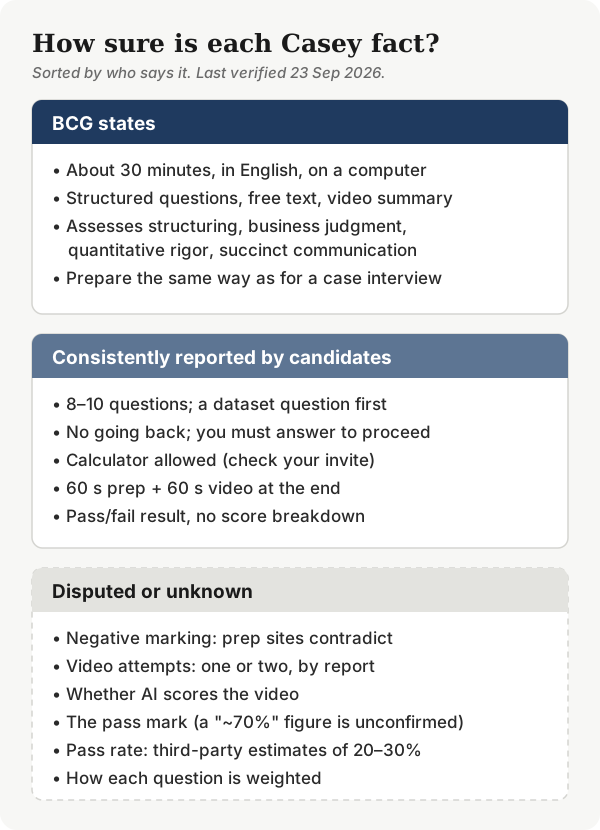
What is reasonably safe to assume. You get a pass or fail result with no breakdown. Candidates report that written reasoning and the video are judged as well as right answers, so the assessment is holistic: one prep site says a strong video "can partially compensate" for a weaker quantitative section. PrepLounge describes answers being compared with those of other candidates rather than against a published cutoff.
Where the prep sites contradict each other. This matters because some tactical advice depends on it:
| Question | What sources say | What to do |
|---|---|---|
| Negative marking? | One guide describes +3 / −1 scoring and advises leaving questions blank. Another page on the same site, plus StrategyCase, reports no negative scoring. Candidates also report that you must answer to proceed | Always answer. You cannot skip, so a penalty for guessing would not change your choice anyway |
| Video attempts | "Only 1 attempt" (HTCI, March 2026; Online Case Secrets, September 2026) vs "about two attempts" (StrategyCase) | Prepare for one take. A second attempt is a bonus |
| Video prep time | 60 seconds (HTCI, MConsultingPrep, Online Case Secrets, PrepLounge) vs a "5-minute prep window" (Management Consulted) | Rehearse with 60 seconds. Extra time only helps |
| Is the video scored by AI? | "Speech-to-text scores the answer" (Road to Offer); "may use AI" (HTCI); BCG is silent | Speak clearly, in full sentences, with the numbers stated out loud |
| Number of questions | 8 to 10 (most sources) vs "6-8" (MConsultingPrep) and 6 to 10 (Road to Offer) | Budget for 10. Finishing early costs nothing |
| Number of cases | One case (most sources) vs "up to 3 short cases" (one HTCI page) | Expect one. If you get more, the same time rules apply |
| Pass mark | A "~70% of maximum score" figure circulates; the source that repeats it says BCG has never confirmed it | Ignore it and maximize accuracy under the clock |
Pass rate. BCG does not publish one. Third-party estimates cluster around 20 to 30 percent: Hacking the Case Interview says "around 30%," and Road to Offer says "roughly 20–30%." Treat these as informed guesses from coaching businesses, not data. Hacking the Case Interview lists the usual reasons for failing as running out of time, careless math errors, unstructured written answers and a rambling video.
How does Casey compare with the Potential Test, the CCA and other BCG tests?
BCG runs several online tests, and which one you get depends on office, role and recruiting cycle. Use the name in your invite to identify it:
| Test | What it is | Length | Calculator | Status (as reported, September 2026) |
|---|---|---|---|---|
| Casey / Online Case Experience | Chatbot-led business case plus a video | About 30 min (BCG); about 35 with the video | Allowed, by candidate report | The standard case screen in most offices |
| Consulting Career Assessment (CCA) | SHL-built assessment of "cognitive functioning and behavioral traits" (BCG FAQ) | 30–35 min including the tutorial (BCG FAQ) | Allowed (BCG FAQ) | BCG's Mexico page describes it as "currently exclusive to the Associate recruiting process"; no retakes |
| BCG Cognitive Test | Proctored numerical and logical speed test | 80 questions in 30 minutes, reported | Not allowed, reported | First used in select German offices from February 2024, per StrategyCase; now in some German-speaking, Nordic and other offices |
| Potential Test | Older multiple-choice case test | 23 questions in 45 minutes (online version), reported | Generally not allowed | Described as retired or legacy by prep sites since early 2026 |
| Pymetrics (Harver) | 12 behavioral mini-games | About 25 minutes | Not applicable | Office-specific; prep sites disagree on how widely it is still used |
Two practical points. First, the CCA is a different kind of test. BCG's FAQ says "there are no 'right' or 'wrong' answers to the behavioral questions" and "there's no need to study or prepare in advance." Some prep sites describe it as a GMAT-style aptitude test, but BCG's own document does not. Second, if you are choosing between Casey and CCA prep, our Casey vs CCA comparison covers the differences.
Where does Pymetrics fit?
Pymetrics is a set of 12 short behavioral games, not a case test. Harver completed its acquisition of pymetrics on 11 August 2022, and candidates still see the pymetrics brand. Where BCG uses it, it comes after the application and before case interviews. Prep sites disagree on how common it still is: MyConsultingCoach calls it "not the assumed default BCG assessment" in 2026, and StrategyCase says BCG has been phasing it out at most offices, while Hacking the Case Interview still lists it as one of the three AI assessments most candidates complete.
What this means for you:
- Casey prep does not transfer to Pymetrics, and Pymetrics prep does not transfer to Casey. There is no pass score in Pymetrics; your pattern of play is compared with a profile the firm has set.
- Retake windows are long. MyConsultingCoach and Online Case Secrets report that you can play the games only once every 330 days, and MyConsultingCoach adds that the result may go to other firms.
- What to do: play the games once in a practice setting so the mechanics are familiar, then play naturally and consistently. Spend your real prep time on Casey.
How do you prepare for Casey in two weeks?
The plan assumes about 60 to 90 minutes a day and that your test is 14 days away. If you have one week, do days 1–3, 8, 10, 12 and 14.
| Day | Focus | Task | Target |
|---|---|---|---|
| 1 | Baseline | One full timed Casey-style case, cold, with a video | Note your time per question and any question over 4:00 |
| 2 | Math | 30 minutes of timed math drills: percentages, weighted averages, growth rates | Standard operations solved in about 15 seconds |
| 3 | Datasets and structure | Five dataset-selection exercises using the elimination rule (guide) | 3–4 picks in under 2 minutes, with no overlapping datasets |
| 4 | Exhibits | 20 chart drills, timed | Correct series and unit on the first read |
| 5 | Full case | Second timed case, forward-only (no rereading earlier answers) | No question over 4:00 |
| 6 | Video | Record a 60-second recommendation for each case so far; watch it back once | Answer in the first sentence, two numbers, finish by 55 seconds |
| 7 | Review | Redo every question you missed, untimed, and write down why you missed it | A written list of your three most common error types |
| 8 | Math plus written answers | Drills, plus three written answers of 2–4 lines explaining a choice | Each answer states a conclusion and a reason |
| 9 | Full case | Third timed case | Finish with at least 2 minutes of buffer |
| 10 | Judgment | Ten "which conclusion does the data support" questions from the case library | Eliminate out-of-scope options first |
| 11 | Full case | Fourth timed case, in a new industry | Same targets under new content |
| 12 | Video | Three recordings on unfamiliar cases, with only 60 seconds to prepare | One take each, no restarts |
| 13 | Dress rehearsal | Full case at your planned test time, with the equipment you will use | Everything works, and paper, pen and calculator are within reach |
| 14 | Light | 15 minutes of math drills, then rest | Stop by early evening |
What to have on the desk
A physical calculator (if your invite allows one), several sheets of paper, a pen, a charged laptop on a wired connection or strong Wi-Fi, and a working webcam and microphone. Close other apps. Once you start, the clock reportedly cannot be paused, so test your setup the day before.
How DrillCase fits
DrillCase's BCG Casey simulation has 25+ Casey-style cases with 250+ questions in a timed chat format, and one demo case is free. The math and chart drills are separate tools you can use between full cases. None of it is BCG material. It is practice built to match the format that candidates report.
What has changed in BCG Casey?
Casey's details shift, and most guides do not date their claims. This log lists what has changed and who reported it. We re-check it when we update this guide.
| Date | Change | Source |
|---|---|---|
| 27 May 2020 | BCG describes Casey as piloted and validated in Southeast Asia and being rolled out globally | BCG Alumni interview |
| August 2022 | Harver completes its acquisition of pymetrics; the games keep the pymetrics brand | Harver press release |
| February 2024 | BCG Cognitive Test (80 questions, 30 min, no calculator) first used in select German offices | StrategyCase |
| January 2025 | BCG updates its CCA candidate FAQ: SHL-designed, 30–35 min, calculator allowed, no retakes | BCG CCA FAQ |
| Early 2026 | Prep sites report the Potential Test fully retired and Casey the standard case screen globally | Hacking the Case Interview; MyConsultingCoach calls the Potential Test a legacy format |
| March 2026 | Video reported as one attempt only; earlier versions reportedly allowed two | Hacking the Case Interview |
| September 2026 | A second source reports one video attempt in the latest version | Online Case Secrets |
| 23 September 2026 | This guide last verified against all listed sources | DrillCase |
If your Casey looked different from what is described here, tell us through the contact details on our editorial policy page. Candidate reports are how everyone, including us, learns about format changes.
Next steps
- Learn the first question in depth: BCG Casey dataset selection
- Script your ending: BCG Casey video recommendation
- Unsure which BCG test you have? BCG Casey vs CCA
- See how Casey compares with McKinsey Solve and the Bain test: MBB online assessments
- Practice under the clock: BCG Casey simulation
Frequently asked questions
How long is BCG Casey?
BCG's careers site says the Online Case Experience takes approximately 30 minutes. Candidates and prep sites report 25 to 30 minutes for the chatbot section plus a separate video step (about 60 seconds to prepare and 60 seconds to record), so plan for roughly 35 minutes of uninterrupted time.
Can you use a calculator in BCG Casey?
Candidates and most prep sites report that a calculator is allowed, and some report Excel as well. BCG has not published a Casey-specific rule, and other BCG tests such as the German cognitive test ban calculators, so follow the instructions in your own invitation.
Is Casey scored by AI?
BCG has not said how Casey answers are scored. Multiple-choice and numeric answers are presumably marked automatically. Some prep sites report that speech-to-text or AI analysis is applied to the video, but this is unconfirmed. Treat every written and spoken answer as if a consultant will read it.
How many questions does Casey have?
Candidates most often report 8 to 10 questions on a single case, with some sources reporting 6 to 10. The first is usually a dataset selection question where you pick 3 or 4 of about 8 data sources. One prep site has reported up to three short cases, which other sources do not confirm.
Can you go back or skip a question in Casey?
No, by consistent candidate report. Questions come one at a time, you must answer to move on, and a submitted answer cannot be changed. Read the whole prompt and the unit or rounding line before you submit.
What happens after Casey?
You receive a pass or fail result, reportedly within a few days to about two weeks, without a score breakdown. A pass typically leads to first-round case interviews. In some offices Casey is taken alongside the first round, so your live case performance is weighed as well.
Can you retake BCG Casey?
Assume not within the same recruiting cycle. Prep sites report one attempt per application. Online Case Secrets reports a one- to two-year ban after a fail, and Hacking the Case Interview says 12 to 24 months, with some offices allowing six. BCG has not published a Casey retake policy, so ask your recruiter.
Can you prepare for Casey?
Yes. BCG says preparation for the Online Case Experience is the same as for a case interview. In practice that means case structuring, timed math, chart reading and a rehearsed one-minute recommendation, practiced in a chat-style, forward-only format so the interface does not cost you time on the day.
Sources
- BCG Careers, Mexico: Online Case Experience (OCE) and CCA description
- BCG Alumni, Enlisting Technology to Help Companies with Contactless Hiring (Casey origin, 27 May 2020)
- BCG, Consulting Career Assessment (CCA) FAQs for candidates (last updated January 2025)
- Harver, Harver acquires pymetrics (press release, August 2022)
- Hacking the Case Interview, BCG Online Case: The Complete Guide (updated 20 March 2026)
- Hacking the Case Interview, BCG Casey: How to Prepare and Pass the Test (updated 19 March 2026)
- Hacking the Case Interview, BCG AI Interview Process (updated 10 June 2026)
- StrategyCase, The Complete Guide to the BCG Online Case Casey (updated 13 July 2026)
- StrategyCase, BCG Cognitive Test guide (updated 25 June 2026)
- MyConsultingCoach, BCG Casey: OCE, HireQuotient and online case prep (updated 11 July 2026)
- MyConsultingCoach, BCG Online Assessment: Which Test Did You Receive?
- MyConsultingCoach, BCG Potential Test: legacy format (updated 11 July 2026)
- MyConsultingCoach, BCG Pymetrics / Harver (updated 11 July 2026)
- Road to Offer, BCG Casey guide (updated 18 June 2026)
- Online Case Secrets, BCG Online Case: The Ultimate Guide (updated September 2026)
- MConsultingPrep, BCG Online Case Chatbot guide
- Management Consulted, BCG Online Case (2026)
- PrepLounge, BCG Online Case (last updated 20 March 2025)
- CaseBasix, BCG Online Case: Casey Chatbot Guide (updated 17 August 2026)