Short answer
In BCG Casey's first question, you see about eight datasets and choose the ones you need to solve the case, typically three or four. Keep a dataset only if it feeds a driver of the objective that no other kept dataset already covers. Drop irrelevant, redundant, out-of-scope and drill-down data, then confirm no driver is left uncovered.
Key takeaways
- Prep sites consistently report that Casey opens with a multi-select question offering roughly 8 datasets, often followed by a written justification. BCG publishes no official scoring rule for it.
- Use one rule: the fewest datasets that cover every driver of the objective. Drop anything irrelevant, redundant, out of scope or too detailed for the scoping stage.
- The most-cited mistake is choosing two datasets that say the same thing, such as a P&L plus a cost list the P&L already contains, while leaving a real gap.
In this article
- What is the dataset-selection question in Casey?
- How is the dataset question scored?
- Is it worse to pick too many or too few?
- Which datasets should you pick? The four-test elimination rule
- What do good picks look like? 6 worked examples
- Profitability: coffee chain, profit down while revenue is flat
- Market entry: European e-bike maker considering the US
- M&A: private equity fund buying a regional dental-clinic chain
- Pricing: software firm launching a project-management tool
- Growth: snack brand aiming to double revenue in 5 years
- Operations: hospital emergency department, waits doubled from 2 to 4 hours
- What mistakes do candidates make on the dataset question?
- How can you practice the dataset question?
Part ofBCG Casey Online Case: The Complete Guide
Casey's first question is not math. It shows you about eight datasets and asks which ones you need to solve the case. The right answer is the smallest set that covers every driver of the client's objective, usually three or four. Below: what the question looks like, what candidates report about scoring, a four-test elimination rule and six worked examples you can use as a quiz. For the rest of the test, see the complete BCG online case guide.
What is the dataset-selection question in Casey?
Casey is BCG's chatbot-led online case: one business problem, 8 to 10 sequential questions and a short video recommendation at the end, according to Management Consulted and IGotAnOffer. Some candidates now receive it as a HireQuotient invitation; Management Consulted reports that the underlying case experience is largely the same.
The opening question is "consistently reported as a dataset selection task," in Management Consulted's words. Casey shows roughly eight data sources and asks which ones are most relevant to the client's problem. IGotAnOffer describes it as a multiple-choice question that is usually followed by an open-ended question asking you to justify your choice. No source states a fixed number to pick. CaseBasix reports that only 30 to 60% of the options are correct, which on an eight-option list works out to about three to five, and three or four in most cases.
BCG itself does not publish Casey specifications. Its official case interview page describes the underlying skill: structure your approach and "identify the most important factors." That is what this question tests, before you have seen a single exhibit.
How is the dataset question scored?
Nobody outside BCG knows the exact rule. Here is what is reported:
| Claim | Who reports it | Confidence |
|---|---|---|
| Multi-select, about 8 options | Management Consulted, Road to Offer | Consistent across sources |
| Often followed by a written justification | IGotAnOffer | Reported |
| Answers are final; no going back | MyConsultingCoach, Management Consulted | Consistent across sources |
| Wrong multiple-choice answers are penalized | Hacking the Case Interview says yes; StrategyCase says candidates report no confirmed penalty | Disputed |
| Only 30–60% of options are correct | CaseBasix | Single source |
| Performance is judged holistically on consulting skills | PrepLounge | Expert estimate |
Is it worse to pick too many or too few?
With the rule unknown, pick a strategy that holds up under any plausible one.
- Over-selecting (picking 6 of 8 "to be safe") shows the opposite of the skill being tested. If a justification question follows, you have to defend every extra pick in writing, and a pick you cannot defend costs you there too.
- Under-selecting leaves a driver uncovered. A BCG consultant quoted by IGotAnOffer warns that some datasets "will leave a gap that is impossible to guess through," and that a sub-optimal selection "will have a knock-on effect on the rest of the case."
The tiebreaker when you are torn between a fourth and a fifth pick: if I removed this dataset, which driver would go uncovered? If the answer is "none," drop it.
Which datasets should you pick? The four-test elimination rule
Hacking the Case Interview states the rule in one line: "choose the fewest options that cover the most ground." Here is how to apply it. Start by writing the objective as a decision or an equation, such as profit = volume × price − costs. Its terms are your drivers. Then put each dataset through four tests, in order.
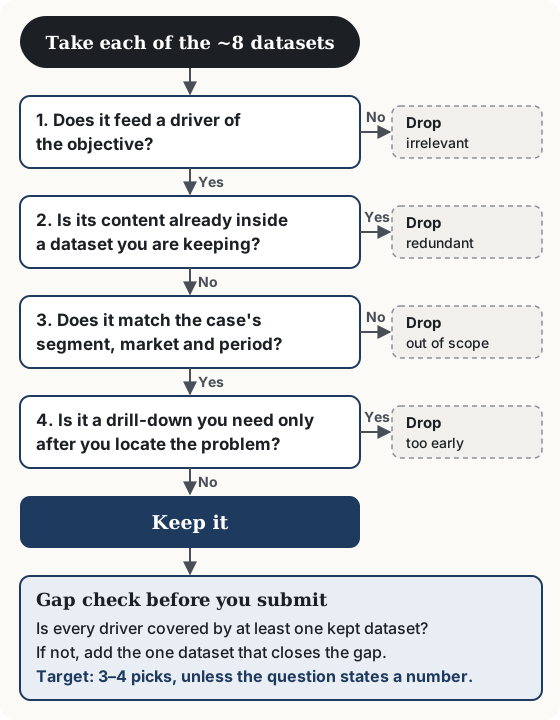
- Irrelevant. Does it feed any driver? Org charts, social media followers and employee surveys rarely do.
- Redundant. Is its content already inside a dataset you are keeping? This is the most-cited mistake. The example from IGotAnOffer is an itemized P&L plus an inventory list with purchase costs, where the P&L already contains those costs.
- Out of scope. Right topic, wrong segment, geography or time period, such as the home market when the question is about entering a new one.
- Too early. A drill-down, such as invoices by supplier, is useful only after you know which cost line moved. The first question is about scoping, not diagnosis.
Then run the gap check. Every driver needs at least one kept dataset. This is the MECE test applied to data: no overlaps (test 2) and no gaps (the gap check).
What do good picks look like? 6 worked examples
These cases are original DrillCase practice examples, not real Casey content. To use them as a quiz, cover the Verdict column and pick your set before you read on.
Profitability: coffee chain, profit down while revenue is flat
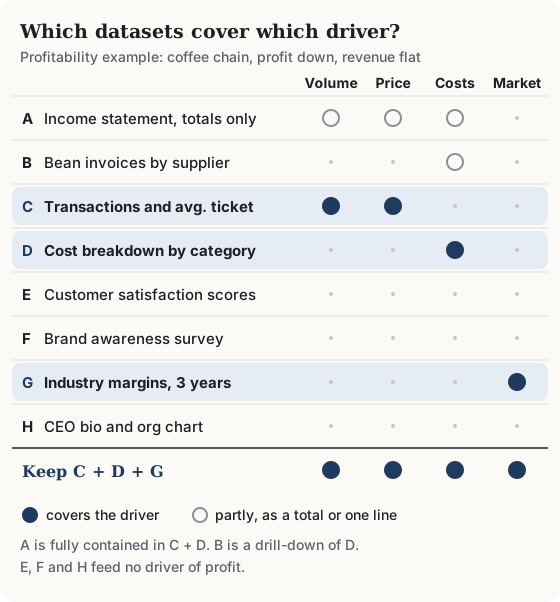
Drivers: volume, price, costs, and a market benchmark to tell a company problem from an industry one.
| Dataset | Verdict | Why |
|---|---|---|
| A. Income statement, totals only | Drop | Contained in C + D |
| B. Bean invoices by supplier | Drop | Drill-down of D |
| C. Transactions and average ticket by store | Keep | Splits revenue into volume and price |
| D. Cost breakdown by category, 3 years | Keep | Shows which cost moved |
| E. Customer satisfaction scores | Drop | Feeds no driver |
| F. Brand awareness survey | Drop | Feeds no driver |
| G. Industry average margins, 3 years | Keep | Company problem or market problem? |
| H. CEO bio and org chart | Drop | Irrelevant |
Market entry: European e-bike maker considering the US
Drivers: market attractiveness, competition, entry cost, unit economics.
| Dataset | Verdict | Why |
|---|---|---|
| A. US e-bike market size and growth | Keep | Attractiveness |
| B. Top 5 US competitors: share and price points | Keep | Competition and achievable price |
| C. Company sales by European country | Drop | Out of scope: home market |
| D. US entry costs, including import duties | Keep | Entry cost |
| E. US non-electric bicycle market | Drop | Wrong segment |
| F. Employee engagement survey | Drop | Irrelevant |
| G. US tariff schedule for e-bikes | Drop | Already inside D |
| H. Unit cost and margin of current models | Keep | Economics at US prices |
M&A: private equity fund buying a regional dental-clinic chain
Drivers: the target's standalone performance, market attractiveness, price paid.
| Dataset | Verdict | Why |
|---|---|---|
| A. Target's 3-year P&L and cash flow | Keep | Standalone performance |
| B. Regional dental market growth and fragmentation | Keep | Attractiveness and room to consolidate |
| C. Comparable deal multiples for dental chains | Keep | Is the asking price fair? |
| D. Dentist roster and years of experience | Drop | Diligence detail, later |
| E. Returns of the fund's other investments | Drop | Irrelevant to this deal |
| F. Online patient reviews | Drop | Soft; revenue effect already in A |
| G. Revenue by clinic | Drop | Drill-down of A |
| H. Office lease terms | Drop | Too early |
Pricing: software firm launching a project-management tool
Drivers: cost floor, competitor reference, customer willingness to pay.
| Dataset | Verdict | Why |
|---|---|---|
| A. Competitor price tiers and features | Keep | Competitive reference |
| B. Willingness-to-pay survey by segment | Keep | Value-based ceiling |
| C. Cost to serve per user | Keep | Price floor |
| D. Pricing of a discontinued older product | Drop | Different product and period |
| E. Website traffic by country | Drop | Irrelevant |
| F. Sales commission structure | Drop | Irrelevant to the price level |
| G. Analyst feature comparison | Drop | Already inside A |
| H. Total addressable market | Drop | Tells you size, not price |
H is the tempting one here. Market size matters for the business case, but the question is what to charge.
Growth: snack brand aiming to double revenue in 5 years
Doubling in five years needs about 15% a year (2^(1/5) ≈ 1.149), which usually means looking beyond the core. Drivers: core baseline, market growth pockets, distribution white space, acquisitions.
| Dataset | Verdict | Why |
|---|---|---|
| A. Revenue by product line and channel, 5 years | Keep | Baseline and momentum |
| B. Snack category growth by segment | Keep | Where the market grows |
| C. Distribution coverage vs competitors by channel | Keep | White space |
| D. Acquisition targets with revenue | Keep | Inorganic lever |
| E. Factory utilization | Drop | An enabler to check once the levers are chosen |
| F. Employee turnover | Drop | Irrelevant |
| G. Social media followers | Drop | Vanity metric |
| H. Revenue by product line (annual report) | Drop | Already inside A |
Operations: hospital emergency department, waits doubled from 2 to 4 hours
Drivers: demand, capacity, process time.
| Dataset | Verdict | Why |
|---|---|---|
| A. Patient arrivals by hour and day, 2 years | Keep | Demand |
| B. Staffing and bed capacity by shift | Keep | Capacity |
| C. Timestamps per step: triage, doctor, tests, discharge | Keep | Where time is lost |
| D. Hospital-wide revenue | Drop | Irrelevant |
| E. Patient complaint comments | Drop | A symptom, not a cause |
| F. Wait times at 3 nearby hospitals | Drop | A measures demand directly |
| G. MRI maintenance log | Drop | Drill-down; C shows whether imaging slowed |
| H. Ambulance fleet size | Drop | Its effect is already in A |
Compare F here with G in Example 1. A benchmark earns its place only when you cannot observe the driver directly. In the hospital case, arrivals data measures demand directly, so the benchmark adds nothing.
What mistakes do candidates make on the dataset question?
- Picking the summary and the detail. A P&L and a cost list, or a market report and the same numbers in an analyst note. According to the BCG consultant quoted by IGotAnOffer, most candidates make this mistake: two datasets that give the same information, with a crucial piece still missing.
- Choosing interesting data over decision data. Satisfaction scores and brand surveys feel relevant but rarely change the answer.
- Diagnosing too early. Supplier invoices and clinic-level splits come after you know where the problem is.
- Scope drift. The home market, the wrong segment, or a period that doesn't match the case.
- Skimming the prompt. Hacking the Case Interview advises an extra 30 seconds on the objective, because every later answer depends on it.
- Rushing to bank time. The consultant quoted by IGotAnOffer notes that candidates often rush the early questions and finish with time to spare, "at the cost of accuracy." Online Case Secrets suggests investing extra time in the first question but capping any single question at four to five minutes.
How can you practice the dataset question?
Practice the scoping step on its own, then inside a full case:
- Self-quiz. Go back to the six tables, cover the Verdict column and give yourself three minutes per case. Score a point for each driver you covered, and lose one for each redundant or irrelevant pick.
- Write the justification. In two sentences, name the driver each pick covers. If you can't, the pick is padding.
- Full-case practice. DrillCase's Casey-style simulations include multi-select scoping questions like this one, followed by exhibits and math. One demo case is free.
Once your scoping is reliable, move on to the last step of the case, the 60-second video recommendation. For a side-by-side view of how chatbot cases differ across firms, see the chatbot case format breakdown.
Frequently asked questions
How many datasets should you pick in BCG Casey?
Typically three or four out of about eight. CaseBasix reports that only 30 to 60% of the options in a Casey multi-select question are correct, which is roughly three to five of eight. If the question states a number, pick exactly that number. Otherwise pick the smallest set that covers every driver of the objective.
Is there a penalty for choosing too many datasets?
BCG has not published how the question is scored, and prep sites disagree about penalties on Casey multiple-choice questions. Treat over-selecting as a risk anyway: padding shows weak prioritization, which is the skill being tested, and it is hard to defend in the justification answer that often follows.
Can you go back and change your dataset selection?
No. Candidates and prep sites consistently report that Casey is forward-only: once you submit an answer you cannot return to it, and you cannot pause the test. Run your gap check before you click submit.
Does the dataset question count toward your score?
BCG does not say how individual questions are weighted. Prep sites treat it as assessed, and a BCG consultant quoted by IGotAnOffer warns that a sub-optimal selection has a knock-on effect on the rest of the case. Prepare as if it counts.
How long should the dataset question take?
Budget about three to four minutes, including reading the case prompt. Hacking the Case Interview puts the average at roughly three minutes per Casey question, and Online Case Secrets suggests giving the opening question a little more time because it depends on understanding the objective, but not more than four to five minutes.
What skill is the dataset question testing?
Scoping: deciding what information you need before you analyze anything. It is the same judgment behind a MECE issue tree in a live case interview, applied to a list of data sources instead of a blank page.
Sources
- Management Consulted: BCG Online Case (Casey Chatbot Interview Guide)
- IGotAnOffer: BCG Online Case Assessment / Casey Chatbot Guide
- Hacking the Case Interview: BCG Online Case, The Complete Guide
- Road to Offer: BCG Online Case (Casey) Format, Questions and Prep
- Online Case Secrets: BCG Online Case, The Ultimate Guide
- MyConsultingCoach: BCG Casey, OCE and HireQuotient
- StrategyCase: BCG Online Case, How to Beat the Casey Chatbot
- PrepLounge: BCG Online Case
- Management Consulted: BCG HireQuotient Online Assessment
- Hacking the Case Interview: BCG Casey, How to Prepare and Pass
- CaseBasix: BCG Casey Structuring Question Guide
- BCG Careers: Case Interview Preparation (official)