BCG Casey practice test
BCG Casey: know the format, then practice it under the clock
Casey is the chatbot behind BCG's online case. Here is what BCG says, what candidates report, and 29 Casey-style cases to run it for real.
Just got your invitation? Check if it's Casey or the CCA, free →
29 cases · 275 questions · one-time payment · facts verified 23 September 2026
Welcome to the Online Case Experience: a business case you solve guided by a chatbot. It takes about 30 minutes, in English.
BCG saysQuestion 1 · Dataset selection. Pick 3 or 4 of about 8 data sources.
Candidates report- Dataset A
- Dataset C
- Dataset D
- Dataset G
Answer saved. Questions come one at a time, and a submitted answer cannot be changed.
Candidates reportLast step: the video. 60 seconds to prepare, 60 seconds to record.
Candidates report
Illustration built from the format facts on this page. Not a real Casey transcript.
Q.1How it runs, step by step
How the BCG online case runs
Every answer is final, so a misread brief carries through the whole case. Write down the client's goal and its metric before question 1.
- ~30 min
- Length of the Online Case Experience, in EnglishBCG says
- 8–10
- Questions on one case (some sources say 6–10)Candidates report
- 60 s + 60 s
- To prepare and record the closing videoCandidates report
- 3–7 days
- Typical window to take it after the invitationCandidates report
- 01 · beforeInvitationEmail link, often from HireQuotient
- 02 · on the clockCase briefClient, objective, exhibit panel
- 03 · on the clockDataset pickChoose 3–4 of about 8 sources
- 04 · on the clockQuestionsOne at a time, no going back
- 05 · afterVideo60 s to prepare, 60 s to record
- 06 · afterResultPass or fail, no breakdown
Source: BCG careers site for the length, language and chatbot format; everything else as candidates report it. Formats vary by office; your invitation is the authority.
Q.2What it takes to practise it
Three plans, measured in cases
Every plan has the exhibits, the running clock, forward-only questions and the points and working for every answer. They differ in how many cases they open, how long you keep them and the refund.
- Chatbot Case Complete20 of 29 cases · lifetime · 7 days if ≤ 3 cases opened$199
- Chatbot Case Starter14 of 29 cases · 1 year · final sale$99
- All-Access PassAll 29 cases + Solve and Bain · lifetime · 7 days, even if used$250
One payment, nothing renews. Why $199, once? Candidates reapply, and if you do, you don't pay again. The full comparison, with the case board and the refund terms, is on the Chatbot Case Complete page.
Q.3Ask Casey
The format, question by question
Open a question, or tap its number on the clock. Everything here is sourced in our Casey guide.
Casey is the chatbot that runs BCG's online case, which BCG's careers site calls the Online Case Experience: an interactive exercise where you solve a business case guided by a chatbot. BCG says it takes about 30 minutes, in English, and that preparation is the same as for a case interview.
A 2020 BCG alumni interview describes how it was built with a recruiting chatbot company, combining structured questions, free-text answers and a video summary. Prep sites name the vendor as HireQuotient, and your invitation email may carry that name.
It feels like the most interviewer-led case you will ever do: you cannot steer the analysis or ask clarifying questions, and Casey does not tell you whether you were right. Everything beyond BCG's short description comes from candidate reports, and we label it that way.
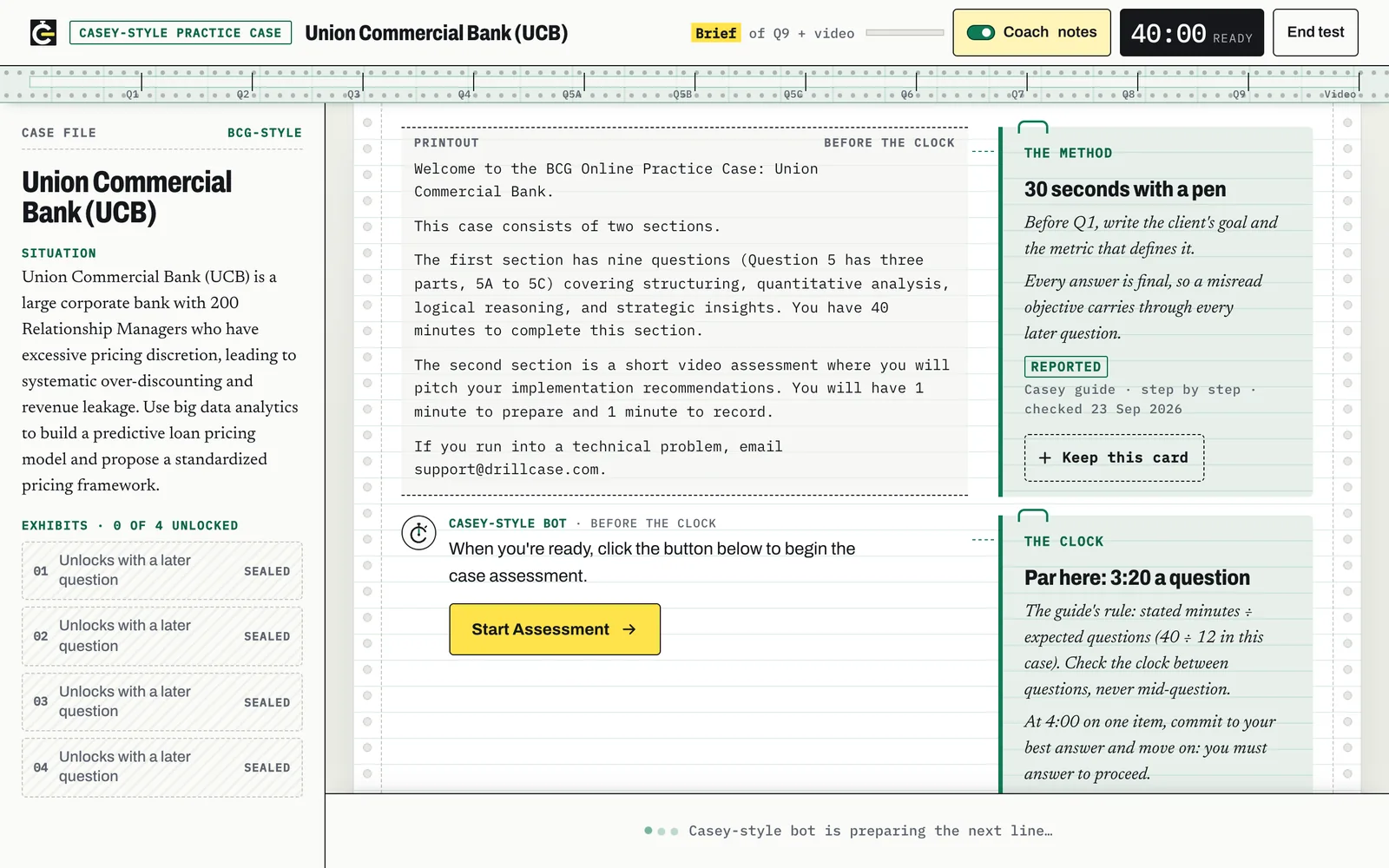
Candidate reports agree on five answer formats: single-select, multi-select, numeric entry, written answers and the recorded video. They carry these six kinds of question. Nobody outside BCG knows the exact mix.
- Q1Dataset selectionMulti-select, pick 3 or 4 of about 8 · Tests: Hypothesis-driven scopingDataset selection guide
- Q2StructuringMulti-select or a short written list · Tests: MECE thinking, idea breadthFree case library
- Q3CalculationNumeric entry · Tests: Setting up the math correctlyMath drills
- Q4Chart and exhibit readingSingle-select, sometimes 2–3 exhibits · Tests: Pulling the one relevant number fastChart drills
- Q5Business judgmentSingle- or multi-select · Tests: Choosing what the data supportsFree demo case
- Q6Video recommendation60-second recording · Tests: Synthesis and deliveryVideo script guide
The skills are the same: structure, math, chart reading and a clear recommendation. The delivery is not, which is why live-case practice alone leaves a gap.
| BCG Casey | Live case | |
|---|---|---|
| Who runs it | A chatbot; no human on the other side | A consultant who adapts as you talk |
| Clarifying questions | Not possible; the chatbot sets each step | Expected and encouraged |
| Pace | Running clock, about 30 minutes (BCG) | Set by the interviewer |
| Going back | No; answers are final (reported) | You can revisit earlier points |
| Calculator | Allowed, by candidate report | Varies by office |
| Answers | Selections, numbers, short text, a video | Spoken, open-ended |
| Result | Pass or fail, no breakdown (reported) | Interviewer's assessment |
No. The CCA is BCG's Consulting Career Assessment, designed by SHL and run alongside Casey in some recruiting processes. BCG's FAQ describes it as a test of cognitive functioning and behavioral traits that takes 30 to 35 minutes including the tutorial, allows a calculator and cannot be retaken. It is not an older version of Casey.
BCG's FAQ also says there are no right or wrong answers to the CCA's behavioral questions and no need to study in advance. Read the name in your invitation and prepare for that test. Not sure what it means? Decode it free: pick the name, see the test and its clock, and get a plan to your test date.
- Casey / Online Case ExperienceChatbot-led business case plus a videoAbout 30 min (BCG); about 35 with the video · Calculator: Allowed (reported)
- Consulting Career Assessment (CCA)SHL-designed test of cognitive functioning and behavioral traits (BCG FAQ)30–35 min incl. tutorial (BCG FAQ) · Calculator: Allowed (BCG FAQ)
- BCG Cognitive TestProctored numerical and logical speed test80 questions in 30 min (reported) · Calculator: Not allowed (reported)
- Potential TestOlder multiple-choice case test23 questions in 45 min (reported) · Calculator: Generally not allowed
- Pymetrics (Harver)12 behavioral mini-gamesAbout 25 min · Calculator: Not applicable
Which tests an office uses changes by role and year. More in BCG Casey vs the CCA and our overview of MBB online assessments.
BCG has not published a scoring method or a pass rate. Candidates receive a pass or fail result, reportedly within a few days to about two weeks, with no breakdown. Reports suggest written answers and the video count as well as right answers.
In DrillCaseChoice and numeric answers are checked against the key; in a multi-select, each wrong pick cancels half of a correct one. Written answers under 15 words score 0; a full answer earns half marks, plus the rest for covering the key ideas in the model answer. The video isn't scored. Compare your written answers with the answer key PDF.
Treat any practice score as a map of what to work on next, not a forecast. The scoring section of our guide lists where prep sites contradict each other.
Hacking the Case Interview puts it plainly: the difficulty comes from time pressure rather than content. Five habits cover most of the gap; the day-by-day version is the two-week plan in our Casey guide.
- Take the free demo case cold. Run it once under the clock to find which question types cost you time. Start the demo
- Drill the math daily. Percentages, weighted averages and growth rates until standard operations take about 15 seconds. Math drills
- Practice dataset picks and charts. Pick 3–4 datasets in under two minutes; read axes, then units, then the series the question names. Chart drills
- Run full cases, forward-only. Several timed cases with no rereading of earlier answers. Aim for no question over four minutes. See the case plans
- Rehearse the 60-second video. Answer first, three reasons each with a number, one risk or next step. Record, watch once, repeat. Video guide
BCG has not published a number. Candidates most often report 8 to 10 questions on a single case, and some sources report 6 to 10. The first is usually a dataset selection question where you pick 3 or 4 of about 8 data sources.
BCG says the Online Case Experience takes about 30 minutes. Candidates report 25 to 30 minutes for the chatbot section plus a separate video step of about 60 seconds to prepare and 60 seconds to record. The invitation usually gives a window of about 3 to 7 days, by candidate report; your invitation email is the authority.
No, by consistent candidate report. Questions come one at a time, you must answer to move on, and a submitted answer cannot be changed. DrillCase cases work the same way.
Candidates and most prep sites report that a calculator is allowed. BCG has not published a Casey-specific rule, and some other BCG tests ban calculators, so follow the instructions in your own invitation.
Don't count on it. BCG doesn't publish its Casey cases, so no practice tool can promise the case you'll get. Practice makes the delivery familiar: the chatbot, the exhibits, the clock. DrillCase is not affiliated with, endorsed by or sponsored by BCG.