Short answer
Sea Wolf checks the average of your three microbes, not each microbe alone. Multiply each range by three and compare sums: an average of 4 to 6 means the three values must total 12 to 18. Then include at least one desired-trait microbe and no undesired-trait microbe. Prep guides report each missed check costs 20% effectiveness.
Key takeaways
- Convert every average range into a sum window (both ends times three) before you look at microbes. Adding three whole numbers is faster and less error-prone than dividing.
- Check constraints in order of cost: strike undesired-trait microbes, anchor a desired-trait microbe, then fill the tightest sum window first.
- Candidates report a single 30-minute timer for three sites. Budget about 9 minutes per site, and take an 80% trio rather than letting site 3 run out of time.
In this article
- What is Sea Wolf?
- How does the averaging rule work?
- Ranges: think in sums, not averages
- Desired and undesired traits
- Elimination order: which constraint should you check first?
- How much time should you spend per site?
- Can you solve these 3 Sea Wolf practice scenarios?
- Scenario 1: find the valid trio
- Scenario 2: the out-of-range microbe you need
- Scenario 3: when 100% is not available
- Where can you practice the averaging rule?
- What should you check at each Sea Wolf stage?

Part ofWhat Is McKinsey Solve? A Guide to Redrock, Sea Wolf and SFL
Sea Wolf scores the average of your three microbes on each attribute, so a single microbe can sit outside the site's range and still belong in the right trio. The fastest way to check is to multiply the range by three and add whole numbers: an average of 4 to 6 means a sum of 12 to 18. The easy ways to lose points are an arithmetic slip under the clock and a strong trio that quietly includes the forbidden trait. Below: the rule as plain math, a fixed checking order, a time plan, and three practice scenarios with every sum written out.
What is Sea Wolf?
Sea Wolf (also called Ocean Cleanup) is one of the games in McKinsey Solve, McKinsey's online screening assessment. Prep guides and candidate reports say a 65-minute invitation usually means Redrock and Sea Wolf, and an 85-minute invitation adds Sustainable Futures Lab. The McKinsey Solve guide covers the full format.
As reconstructed by prep guides, each Sea Wolf site follows the same flow:
| Step | What you do | What it feeds |
|---|---|---|
| 1. Profile | Choose two characteristics to shape the microbes you are offered | The pool you see next |
| 2. Sort | Assign a batch of 10 microbes to this site, a later site, or reject them | Your options for all three sites |
| 3. Prospect | Grow a pool from 6 to 10 microbes over 4 choice rounds | The candidates for your final trio |
| 4. Treat | Submit exactly 3 microbes as the site's treatment | Your product score for the site |
McKinsey says no preparation is needed for Solve, and the in-game tutorial does teach the rules. What practice changes is speed on the mechanical parts, and the averaging math is the most mechanical part of Sea Wolf.
How does the averaging rule work?
Each site lists a target range for three attributes. Attribute names vary between versions: guides report Density, Energy and Size, and this article uses Energy, Mobility and Density. The rule, as every guide we checked describes it: the average of each attribute across your three microbes must fall inside the site's range. No single microbe has to be in range.
Ranges: think in sums, not averages
Dividing by three under time pressure is where errors creep in. Multiply both ends of the range by three once, and you only ever need to add three whole numbers:
| Site range (average) | Sum window for 3 microbes | Number of passing sums |
|---|---|---|
| 2 to 3 | 6 to 9 | 4 |
| 4 to 6 | 12 to 18 | 7 |
| 6 to 7 | 18 to 21 | 4 |
| 7 to 8 | 21 to 24 | 4 |
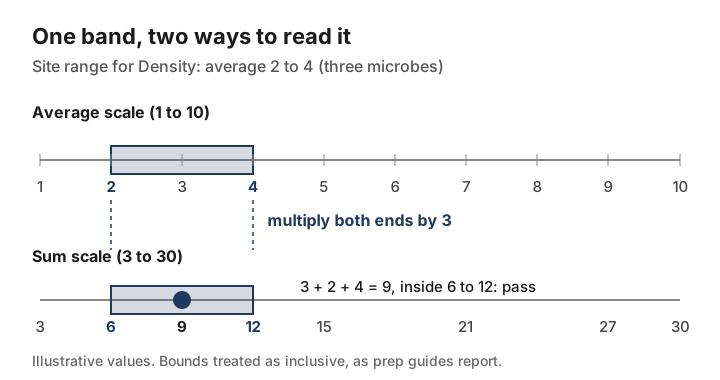
Two details make the sum test exact rather than approximate:
- Bounds are inclusive. Road to Offer and Case Prep both state that an average exactly on the minimum or maximum passes. A sum of exactly 18 passes a 4 to 6 range.
- Values are whole numbers. Reconstructions show each attribute as an integer from 1 to 10, so the sum is an integer too. A sum of 19 against a 12 to 18 window is an average of 6.33: out. You never need the decimal.
The consequence that trips people up: a microbe outside the range can be the right pick. An Energy of 10 is useless alone against a 7 to 8 range, but paired with a 6 and a 7 it gives a sum of 23, inside 21 to 24.
Desired and undesired traits
Each microbe carries one trait. StrategyCase lists four: Aerobic, Heat resistant, Hydrophilic and Light sensitive. Each site names one desired and one undesired trait:
| Check | Pass condition | Reported cost if missed |
|---|---|---|
| Energy average | Inside range | 20% |
| Mobility average | Inside range | 20% |
| Density average | Inside range | 20% |
| Desired trait | At least 1 of 3 microbes has it | 20% |
| Undesired trait | None of the 3 microbes has it | 20% (some guides report 20% per offending microbe, up to 60%) |
Guides agree each site starts at 100% effectiveness and loses 20% per missed check. They disagree on whether two undesired-trait microbes cost 20% or 40% (MConsultingPrep says per microbe; PSG Cracked says once). Either way the target is zero, so the disagreement changes nothing in practice.
Elimination order: which constraint should you check first?
Check the cheapest, most decisive constraint first. Trait checks need no arithmetic and remove microbes outright, so they come before any sums.
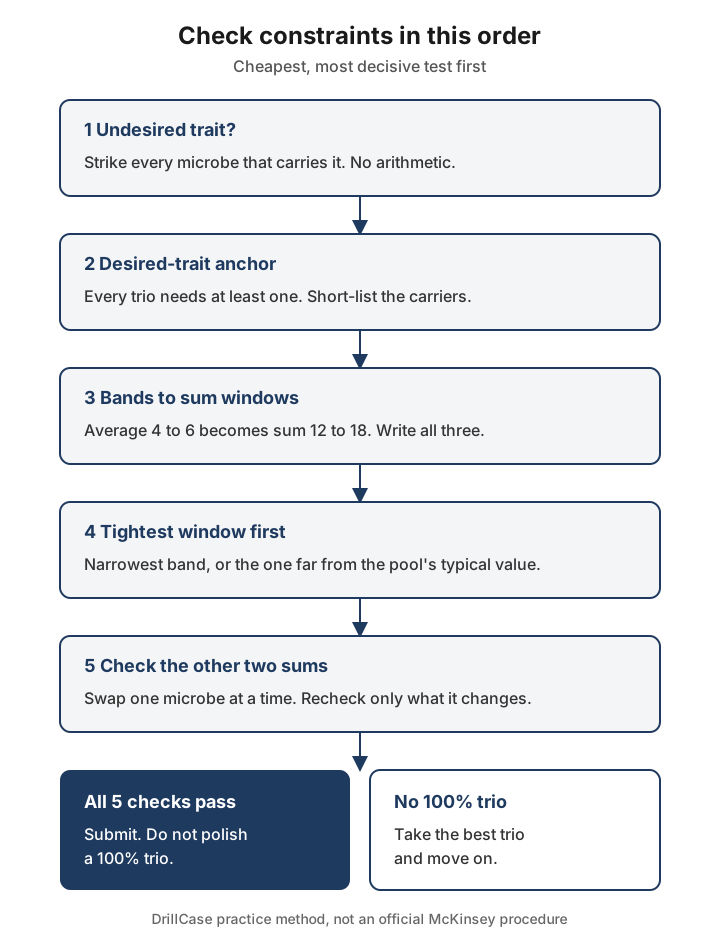
- Strike every undesired-trait microbe. One look at the trait label, no math.
- Short-list desired-trait microbes. Your trio needs at least one, so start from these as anchors.
- Write the three sum windows. Once per site.
- Fill the tightest window first. A range one point wide (such as 6 to 7) allows only 4 passing sums; a range two points wide allows 7. Also treat a range as tight when it sits far from most of your pool, for example a Mobility range of 8 to 9 when most of your microbes are around 5.
- Check the other two sums. When you swap one microbe, adjust each running total by the difference instead of adding all three values again.
- Stop at 100%. As reported, each check is pass or fail, so a trio in the middle of every range scores the same as one on the edge.
The same logic applies earlier in the site. When you sort microbes and pick prospects, you are choosing future trio partners, so keep a spread of high and low values on the attribute with the tightest range instead of keeping only microbes that sit inside it.
How much time should you spend per site?
Candidates and prep guides report one timer of about 30 minutes for all three sites (Leland, via Harvard's career center, says 30 to 35). McKinsey does not publish a per-site split, so treat this as a practice plan:
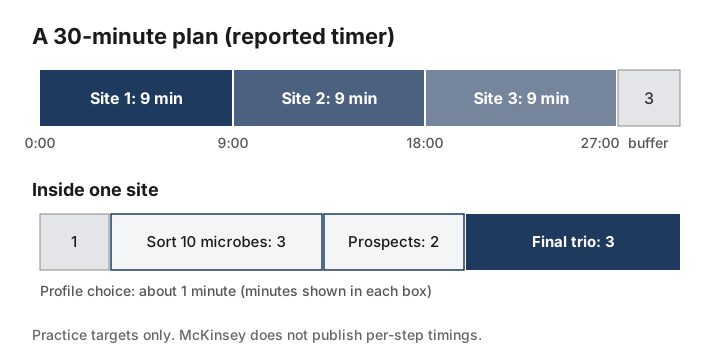
| Checkpoint | Where you should be |
|---|---|
| 9:00 | Site 1 treatment submitted |
| 18:00 | Site 2 treatment submitted |
| 27:00 | Site 3 treatment submitted |
| 30:00 | Buffer used only for a final check |
Why protect site 3: StrategyCase reports that an unfinished site scores zero regardless of the earlier sites. An 80% trio at each of three sites beats a perfect site 1 and an empty site 3.
Can you solve these 3 Sea Wolf practice scenarios?
These are original scenarios written for this article, not items from the real test. Try each before reading the solution.
Scenario 1: find the valid trio
Site ranges: Energy 4 to 5 (sum 12 to 15), Mobility 6 to 7 (sum 18 to 21), Density 2 to 3 (sum 6 to 9). Desired: Aerobic. Undesired: Light sensitive.
| Microbe | Trait | Energy | Mobility | Density |
|---|---|---|---|---|
| M1 | Aerobic | 5 | 7 | 3 |
| M2 | Hydrophilic | 7 | 8 | 2 |
| M3 | Light sensitive | 5 | 6 | 3 |
| M4 | Heat resistant | 3 | 5 | 4 |
| M5 | Aerobic | 8 | 6 | 6 |
| M6 | Hydrophilic | 4 | 9 | 1 |
| M7 | Heat resistant | 6 | 5 | 5 |
| M8 | Aerobic | 2 | 7 | 2 |
Solution. Strike M3 first. Its numbers are perfect, which is why it is a trap. Anchors: M1, M5, M8. The tightest window is Mobility (one point wide, sums 18 to 21). Start with M1 (Mobility 7) and look for two partners whose Mobility adds to 11 to 14: M2 + M4 gives 13.
- Energy: 5 + 7 + 3 = 15, inside 12 to 15 (exactly on the inclusive maximum)
- Mobility: 7 + 8 + 5 = 20, inside 18 to 21
- Density: 3 + 2 + 4 = 9, inside 6 to 9 (again on the maximum)
- Aerobic present, no Light sensitive: 100%
A brute-force check of all 56 possible trios finds six that score 100%. You need one, so stop at the first. Now look at M5: it is an Aerobic anchor, but its Energy of 8 and Density of 6 push two sums over at once. M1 + M4 + M5 sums to 16 on Energy and 13 on Density, for 60%. No 100% trio contains M5.
Scenario 2: the out-of-range microbe you need
Site ranges: Energy 7 to 8 (sum 21 to 24), Mobility 3 to 5 (sum 9 to 15), Density 5 to 6 (sum 15 to 18). Desired: Heat resistant. Undesired: Hydrophilic.
| Microbe | Trait | Energy | Mobility | Density |
|---|---|---|---|---|
| A | Heat resistant | 6 | 4 | 5 |
| B | Aerobic | 10 | 2 | 6 |
| C | Hydrophilic | 8 | 4 | 6 |
| D | Light sensitive | 9 | 7 | 4 |
| E | Heat resistant | 7 | 3 | 10 |
| F | Aerobic | 7 | 5 | 5 |
Solution. Strike C. Anchors: A and E. Two windows are one point wide (Energy and Density). E looks strongest because its Energy is already in range, but its Density of 10 leaves the other two microbes only 5 to 8 of Density between them. The two lowest remaining Density values are D (4) and A (5), which sum to 9, so no trio with E can pass Density. Take A instead. Checking A's partners on the Energy window (15 to 18 still needed) points to B + F:
- Energy: 6 + 10 + 7 = 23, inside 21 to 24 (A is below the range and B is above it, but together they pass)
- Mobility: 4 + 2 + 5 = 11, inside 9 to 15
- Density: 5 + 6 + 5 = 16, inside 15 to 18
- Heat resistant present, no Hydrophilic: 100%
Scenario 3: when 100% is not available
Site ranges: Energy 2 to 3 (sum 6 to 9), Mobility 8 to 9 (sum 24 to 27), Density 3 to 5 (sum 9 to 15). Desired: Light sensitive. Undesired: Aerobic.
| Microbe | Trait | Energy | Mobility | Density |
|---|---|---|---|---|
| P | Light sensitive | 4 | 8 | 4 |
| Q | Heat resistant | 2 | 9 | 3 |
| R | Aerobic | 1 | 10 | 4 |
| S | Hydrophilic | 3 | 6 | 5 |
| T | Heat resistant | 2 | 6 | 2 |
| U | Hydrophilic | 4 | 9 | 6 |
Solution. Strike R, even though it would help both tight sums. P is the only desired-trait microbe, so it belongs in the trio. The trios with P and without R:
| Trio | Energy sum | Mobility sum | Density sum | Score |
|---|---|---|---|---|
| P + Q + S | 9 | 23 (miss) | 12 | 80% |
| P + Q + T | 8 | 23 (miss) | 9 | 80% |
| P + Q + U | 10 (miss) | 26 | 13 | 80% |
| P + S + T | 9 | 20 (miss) | 11 | 80% |
| P + S + U | 11 (miss) | 21 (miss) | 15 | 60% |
| P + T + U | 10 (miss) | 23 (miss) | 12 | 60% |
No trio reaches 100%. Dropping P (for example Q + T + U) or keeping R (P + Q + R) also caps out at 80%, because each gives up a trait check instead of a range. Submit an 80% trio and move on. The real lesson sits earlier in the site: one more non-Aerobic microbe with Energy 3 or less, Mobility 7 or more and Density between 2 and 8, kept during sorting, would have completed P + Q for 100%. That is why sorting and prospecting should keep extremes on your tightest attribute.
Where can you practice the averaging rule?
DrillCase's McKinsey Solve practice includes a Sea Wolf task built for familiarization. Each run draws new sites and microbes, and after you submit, the results table shows the best trio available in your pool next to the one you chose, with the average for every check. Use it to rehearse the elimination order and the time checkpoints until they are automatic.
Practice tools are for the weeks before the test. McKinsey expects candidates to take Solve "alone, without assistance from others" and bans apps, websites and AI tools, so nothing here is meant for use during a live assessment. For what the scores mean afterward, read how McKinsey Solve is scored. You can also browse all McKinsey practice scenarios or the Solve overview.
What should you check at each Sea Wolf stage?
| Before the site | During sorting and prospects | Final trio |
|---|---|---|
| Write three sum windows | Keep high and low values on the tightest attribute | Undesired trait: none |
| Circle the tightest window | Keep at least two desired-trait microbes | Desired trait: at least one |
| Note the desired and undesired traits | Reject undesired-trait microbes early | All three sums inside their windows, then submit |
Frequently asked questions
How many microbes do you select per site in Sea Wolf?
Three. Prep guides that reconstruct the game describe sorting batches of 10 microbes, building a prospect pool of 10 (6 carried in, 4 picked across choice rounds), then submitting a final treatment of exactly three microbes for each of three sites.
Is Sea Wolf harder than Redrock?
It depends on your strengths. Sea Wolf is repeated three-number arithmetic under one timer, while Redrock rewards careful reading and data work across a longer case. If you are quick with mental sums, Sea Wolf is the more predictable of the two. McKinsey publishes no difficulty or pass-rate data for either game.
How much time should you spend per site?
Candidates and prep guides report one 30-minute timer covering all three sites. A practical target is about 9 minutes per site with a 3-minute buffer. McKinsey does not publish per-site or per-step timings, so treat any split as a practice target.
Does McKinsey score your process in Sea Wolf?
Prep guides report that Solve records a product score (what you submit) and a process score (how you work, click by click). McKinsey has not published how either is calculated or weighted, so a consistent, rule-based method from site to site is the safest approach.
Are Sea Wolf ranges inclusive?
Prep guides that rebuild the game report inclusive bounds, so an average exactly on the minimum or maximum passes. With whole-number values, a sum window test gives the same answer as the average test, with no rounding to worry about.
What if no combination of three microbes scores 100%?
It happens. MConsultingPrep's reconstruction notes that you can settle for an 80% treatment and move on. Pick the trio that keeps both trait checks and misses one range by the smallest margin, submit, and protect your time for the next site.
Sources
- McKinsey & Company: Solve FAQs (PDF, August 2025)
- Harvard FAS Mignone Center for Career Success: What Is the McKinsey Solve Game (syndicated from Leland)
- MConsultingPrep: McKinsey Solve Seawolf deep dive
- My Consulting Coach: McKinsey Solve game guide
- PSG Cracked: McKinsey Sea Wolf game structure and math
- Road to Offer: McKinsey Sea Wolf guide
- Solve Games Guide: Sea Wolf guide
- StrategyCase: McKinsey Solve Sea Wolf (Ocean Cleanup)
- Case Prep: McKinsey Sea Wolf Solve guide
- CaseBasix: McKinsey PSG scoring explained