Short answer
Yes, but not in the same application. Coaches most often report a 12-month wait from the rejection date, and some prep sites report up to 24 months. A referral does not reset the clock: a Solve result from the last 12 months is reportedly reused, even for another office. Ask your recruiter for your exact date.
Key takeaways
- McKinsey publishes no reapply rule for Solve. Coaches most often report 12 months from the rejection date, with reports ranging up to 18 or 24 months. Ask your recruiter for your eligible date in writing.
- Switching offices or getting a referral is not a shortcut. Sources disagree on whether the cooldown is global, and coaches report that a Solve result from the last 12 months is attached to new applications.
- McKinsey gives no score breakdown, so diagnose the weak game yourself the same day, then spend the 30 days before your next invitation on that game first.
In this article

Part ofWhat Is McKinsey Solve? A Guide to Redrock, Sea Wolf and SFL
If you failed McKinsey Solve, you cannot retake it in the same application. Coaches most often report a 12-month wait from the rejection date before you can reapply, and some prep sites report up to 24. You are in large company: McKinsey publishes no pass rate, but prep sites estimate that only 10 to 30 percent of candidates pass (StrategyCase, CaseBasix). This page covers the cooldown by situation, whether a referral or another office changes it, how to work out which game cost you, and a 30-day plan for the next attempt. For the format itself, start with our McKinsey Solve guide.
Can you retake McKinsey Solve?
Not in the same application. If Solve does not lead to an interview invitation, the application ends there, and prep sites report no retake until the cooldown is over and no feedback on your performance (StrategyCase, CaseBasix). A new attempt means a new application.
The one official exception is technical. McKinsey's Solve FAQ says the support team can give you extra time or reset your link, depending on the issue. It also says that if you have a technical problem and do not contact support, it cannot make an exception for a reset (McKinsey FAQ). If your game froze and you said nothing, that attempt stands.
Two more lines in the same FAQ matter here. Solve results are "taken into considerations with the rest of your application and any other assessment results", so a rejection after Solve does not prove the test alone sank you. And McKinsey says preparation is "not required or necessary to do well". That is its official position, not a ban: familiarity with the task types is still the cheapest improvement you can make.
How long is the McKinsey cooldown after a failed Solve?
McKinsey does not publish a reapply period for Solve. Everything below comes from former McKinsey staff and coaches answering candidates, except the two technical rows, which come from McKinsey's FAQ.
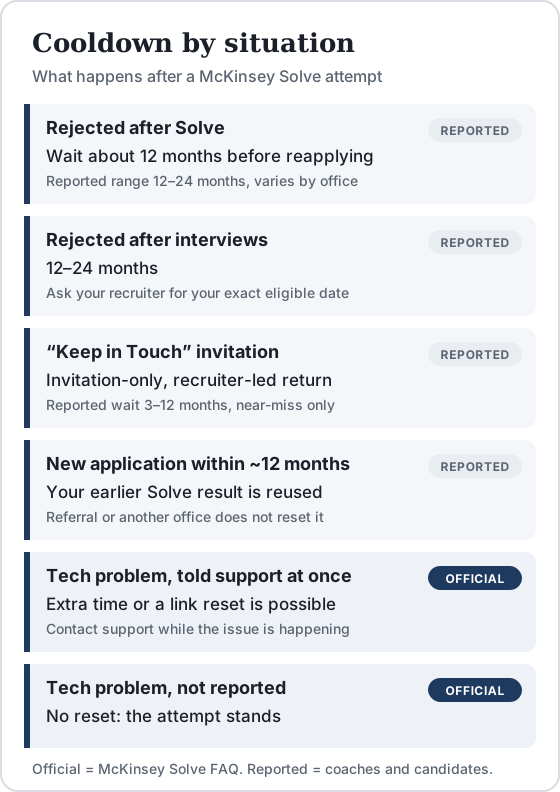
| Situation | What is reported | Source |
|---|---|---|
| Rejected after Solve | Usually 12 months from the rejection date; up to 18 months in some European offices | Coaches, PrepLounge, Feb 2026 |
| Rejected after Solve, by office | 12 to 24 months "depending on the office" | StrategyCase |
| London | "Normally" 12 months, per a coach who lists McKinsey Associate Partner | PrepLounge, Jun 2025 |
| New application within about 12 months (referral, other role or office) | Your earlier Solve result is reused, not retaken | Coaches, PrepLounge, Nov 2025 |
| "Keep in Touch" invitation | Invitation-only for near-miss candidates; recruiter-led return after 3 months in one candidate's case, 6 to 12 months per StrategyCase | PrepLounge, Jan 2026, StrategyCase |
| Technical issue reported during the test | Extra time or a link reset is possible | McKinsey FAQ |
| Technical issue not reported | No exception for a reset | McKinsey FAQ |
Three details change your date:
- The clock starts at the rejection, not at the application. Coaches on PrepLounge and StrategyCase agree on this.
- Reapplying early without a visible change almost always ends in an auto-reject, according to a coach who lists McKinsey Senior Engagement Manager. "Material change" means something on your CV, such as a promotion or a new degree, not more practice. One ex-McKinsey coach adds that an exception, if a recruiter grants it, usually means applying at about nine months.
- Your recruiter knows your date. Email them: "Given my rejection on [date], what is the earliest date I can reapply, and does that apply to all offices?" Keep the reply.
Does a referral or a different office reset the cooldown?
Probably not, and the sources disagree on how far the cooldown reaches.
The referral question has a clearer answer. In a November 2025 PrepLounge thread, coaches report that a Solve result stays valid for about 12 months and is attached automatically to a new application, even one for a different role or office (PrepLounge). So a referral three months after a failed Solve does not buy a fresh attempt. It brings back the same result. Save the referral for the application after the cooldown, when you will sit a new test.
Your other firms are unaffected. StrategyCase says a ban applies only to the firm that rejected you, and both BCG and Bain run their own tests: see our guides to the BCG online case and the Bain online test. A McKinsey cooldown is a good time to apply there.
How do you find out which Solve game you failed?
McKinsey tells you nothing about your score, so your only data is your memory of the attempt, and it fades within days. The same day, write down how many minutes you had left in each game, which questions you guessed, and anything that went wrong with your setup. Then run it through this flow:
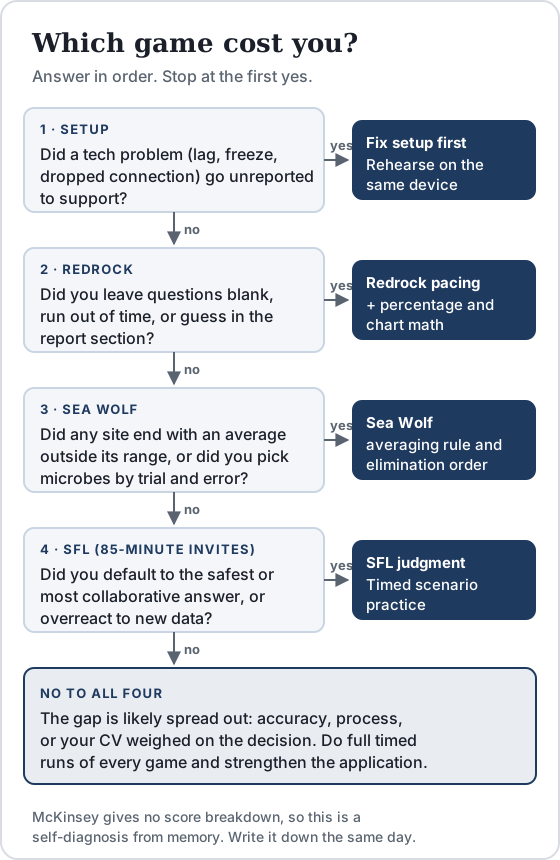
How to read each branch:
- Redrock. Running out of time or guessing in the report points to pacing and calculation speed. Redrock mixes data selection, calculations and chart choice, each section has its own time limit, and going back to the investigation costs time (MyConsultingCoach). Train percentages and ratios first, then reading values off charts.
- Sea Wolf. In MyConsultingCoach's reconstruction of the scoring, each attribute whose three-microbe average lands inside the site's range is worth 20 percent, so one average outside its range costs product score directly. Our Sea Wolf averaging rule guide covers the math and the order in which to eliminate microbes.
- SFL. Sustainable Futures Lab usually comes with 85-minute invitations. The common mistakes MyConsultingCoach lists are always picking the safest or most collaborative answer, overanalyzing, and letting one new dataset override your hypothesis. See our SFL guide.
- No to all four. McKinsey publishes no pass mark, and Solve scores both your final answers (product) and how you work (process). Finishing everything is not the same as scoring well, and your CV counts in the same decision. Our guide to how Solve is scored explains both scores.
What should you do in the 30 days before you retake Solve?
Use the early months of the cooldown to strengthen your CV, since that is what coaches say recruiters look for in a reapplication. Start this plan about 30 days before you reapply, so it peaks when the new invitation arrives. Check the time in the invitation first: a 65-minute invitation typically means Redrock and Sea Wolf, and 85 minutes often adds SFL (MyConsultingCoach).
| Week | Focus | What to do | Check |
|---|---|---|---|
| 1 | Baseline | One full timed run of every game in your invitation. Log the minutes left per game and every guess. Re-run the diagnostic flow. | You know your weakest game from data, not memory |
| 2 | Weakest game | Five 45-minute sessions on that game only. Redrock: daily math drills and chart drills. Sea Wolf: the averaging rule until you can check a site in your head. | Weak game finished on time twice in a row |
| 3 | Second game, plus SFL if you have 85 minutes | Three sessions on the next-weakest game, two mixed. For SFL, practice choosing the answer that moves the recommendation forward, not the safest one. | No blank answers in any timed run |
| 4 | Full rehearsals | Two full timed runs at the same time of day as your real slot, on the same computer. McKinsey's FAQ says Solve runs only on a PC or Mac, not a tablet or phone. | Both runs finished, with 2 minutes or more to spare per game |
Keep the drill path going daily through all four weeks. Short daily math sessions are easier to sustain than a cram the night before.
DrillCase's McKinsey practice has 10 Redrock-style and 10 SFL-style scenarios, and the drill library includes 500 math drills and 50 chart drills. It is a practice environment built to familiarize you with the tasks, not a replica of McKinsey's test. You can start on the McKinsey practice page, where one scenario is free.
For how long each stage of the process usually takes, see the consulting assessment timeline, and for the test itself, the McKinsey Solve page.
Frequently asked questions
How long must you wait to reapply to McKinsey after failing Solve?
McKinsey does not publish a fixed rule. Former McKinsey consultants coaching on PrepLounge most often report 12 months from the rejection date, with some European offices at up to 18 months. StrategyCase reports 12 to 24 months depending on the office. Your recruiter can give you the exact date, so ask them in writing.
Can you retake McKinsey Solve in the same application?
No. Coaches and prep sites agree that a Solve fail ends that application, with no retake until the cooldown is over. The one official exception is technical: McKinsey's FAQ says support may give extra time or reset your link, but only if you contact them while the problem is happening.
Does failing Solve affect BCG or Bain applications?
No. StrategyCase says a ban applies only to the firm that rejected you, and none of the sources we reviewed report McKinsey sharing Solve results with other firms. BCG and Bain use their own tests (Casey and, in some offices, Pymetrics at BCG; SOVA or TestGorilla at Bain), so you can apply there while you wait.
Will McKinsey tell you why you failed Solve?
No. Prep sites report a short pass or fail email with no breakdown of product or process scores and no feedback. McKinsey's FAQ also says Solve results are considered together with the rest of your application, so a rejection after Solve may not come from the test alone.
Can a referral get you a Solve retake sooner?
Usually not. Coaches on PrepLounge report that a Solve result stays valid for about 12 months and is attached automatically to a new application, including one for a different office or role. A referral can help your CV get noticed, but it does not give you a fresh attempt.
How many times can you reapply to McKinsey?
McKinsey publishes no limit. The practical limit is the cooldown: at 12 months or more per cycle, each attempt costs a year. Make each one count by changing your preparation and your CV, not only by waiting out the clock.
Sources
- McKinsey: Problem Solving Game FAQs (PDF; archived copy dated July 2024)
- PrepLounge Q&A: Waiting period after McKinsey and Bain assessment rejections (February 2026)
- PrepLounge Q&A: McKinsey reapplication (June 2025)
- PrepLounge Q&A: Do I need to retake the McKinsey assessment after a referral? (November 2025)
- PrepLounge Q&A: McKinsey Keep in Touch (January 2026)
- StrategyCase: Consulting ban periods at McKinsey, BCG and Bain (updated July 2026)
- StrategyCase: McKinsey Solve guide
- MConsultingPrep: How long to wait before reapplying to an MBB firm
- CaseBasix: Can you fail the McKinsey game?
- MyConsultingCoach: McKinsey Solve guide (updated June 2026)