Short answer
The Sustainable Futures Lab (SFL) is a text-based judgment module that candidates report as the third McKinsey Solve game, after Redrock and Sea Wolf. It comes with 85-minute invitations and runs 20 minutes: one ranking task, then 12 multiple-choice decisions in an environmental team scenario. McKinsey has not published how it is scored.
Key takeaways
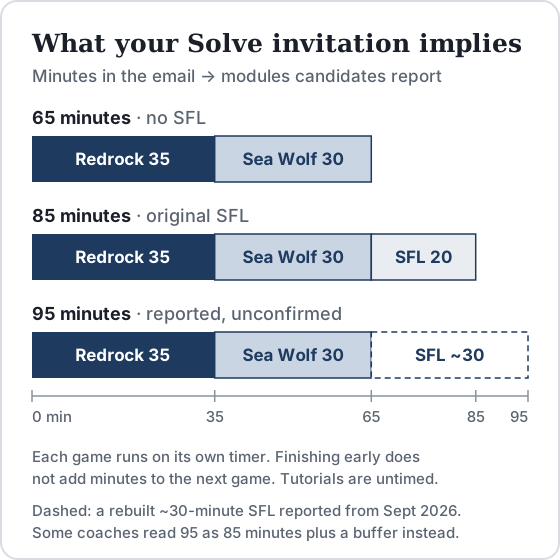
- The minutes in your invitation are the best signal you have. Candidates report 65 minutes as Redrock and Sea Wolf only, 85 minutes as those two plus the 20-minute SFL, and 95 minutes, reported since late August 2026, as a rebuilt SFL of about 30 minutes.
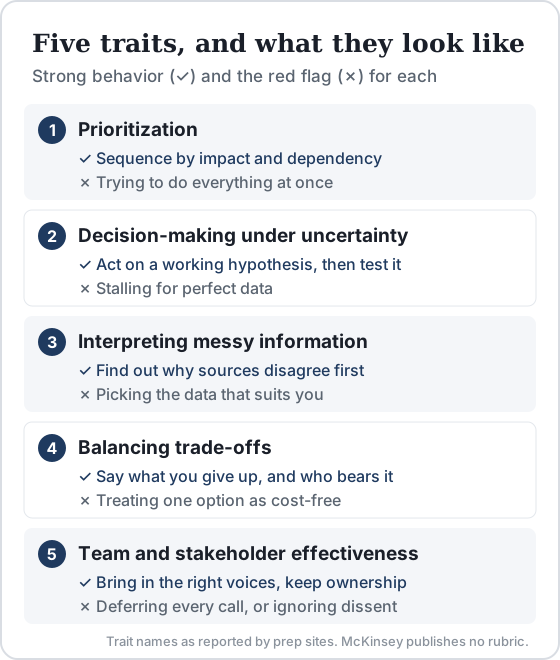
- Prepmatter, case-prep and CaseBasix list the same five traits: prioritization, decision-making under uncertainty, interpreting messy information, balancing trade-offs, and team and stakeholder effectiveness. There is almost no math and no calculator.
- Your answers are read as a pattern, so consistency matters more than any single choice. Budget about 75 seconds per decision and choose the option that moves the work forward while reducing uncertainty and bringing in the right people.
In this article
- What is the Sustainable Futures Lab?
- 65 vs 85 minutes: which invitation includes SFL?
- What does the Sustainable Futures Lab measure?
- What do SFL questions look like? Three examples
- Example 1: the opening ranking
- Example 2: two numbers that disagree
- Example 3: a quiet objection
- How do you prepare for the Sustainable Futures Lab?

Part ofWhat Is McKinsey Solve? A Guide to Redrock, Sea Wolf and SFL
The Sustainable Futures Lab (SFL) is the third McKinsey Solve game and the only one with no numbers to crunch. You join a fictional environmental research team and make 13 judgment calls in 20 minutes as the project changes. You get it if your invitation says 85 minutes, or 95 in newer reports. Below: how to read your invitation, the five traits prep sites say it scores, and three practice items. For Redrock and Sea Wolf, see our complete McKinsey Solve guide.
What is the Sustainable Futures Lab?
SFL is a scenario-based situational judgment module. You get a mission briefing about a team working on an environmental project. Examples of the rotating themes include wetland restoration, urban air quality and coastal habitat recovery (MConsultingPrep). Then you answer questions as a member of that team. McKinsey has not published the module's mechanics or a scoring rubric, but prep sites that collect candidate reports agree on the core format:
| Element | What candidates report | Source |
|---|---|---|
| Position in Solve | Third game, after Redrock and Sea Wolf | Prepmatter, case-prep |
| Length | 20 minutes for all 13 questions | MConsultingPrep, case-prep |
| Question 1 | Drag-and-drop ranking of four actions | MConsultingPrep, CaseBasix |
| Questions 2–13 | Single-choice decisions with two to four options, each a full paragraph | Prepmatter, MConsultingPrep |
| Math | Almost none; no calculator | case-prep, Prepmatter |
| Structure | One connected storyline; case-prep says earlier choices shape what you see next | case-prep |
Rollout, as of September 23, 2026: the first reports came in early 2026. StrategyCase published its guide on March 25, 2026, and PSG Secrets named Germany and the Middle East among the first regions. Prepmatter says most offices had moved to the 85-minute version by May 2026, while case-prep, updated in June, still called the rollout "regional but growing". MyConsultingCoach now calls SFL "a standard part of many assessments". From late August 2026, candidates began reporting a longer, rebuilt version, covered below.
65 vs 85 minutes: which invitation includes SFL?
The total time in your invitation email is the best clue to which games you will get. Prep sites that track candidate reports map it like this:
| Your invitation says | Modules candidates report | What to prepare |
|---|---|---|
| 65 minutes | Redrock (35) + Sea Wolf (30) | No SFL. Spend all your time on the two analytical games |
| 85 minutes | Redrock (35) + Sea Wolf (30) + SFL (20) | The original 13-question SFL, covered in this guide |
| 95 minutes | Redrock + Sea Wolf + a rebuilt SFL of about 30 minutes, or the 85-minute test plus a buffer | Both SFL versions (see the callout) |
Three details from the invitation stage matter:
- Timers do not pool. Each game has its own time limit, and minutes you save in Redrock or Sea Wolf do not carry over (MConsultingPrep). SFL gets its 20 minutes however fast you were before it.
- Tutorials are untimed. McKinsey's own FAQ says each task "begins with an untimed tutorial" (McKinsey FAQ PDF). Read the SFL tutorial properly; it costs nothing.
- Block more time than the invitation says. Tutorials, animations and end-of-test surveys sit outside the game timers (MConsultingPrep), so plan for well over the stated minutes. McKinsey's FAQ also says Solve runs only on a PC or Mac.
What does the Sustainable Futures Lab measure?
Prepmatter, case-prep and CaseBasix list the same five traits. McKinsey has published no rubric, so treat the table as a well-supported inference, not an official answer key. The sample responses are DrillCase's own illustrations.
| Trait | Strong behavior | Sample response that signals it |
|---|---|---|
| Prioritization | Sequence work by impact and by what unlocks what; drop low-value tasks | "Agree on the success metric first. Every later analysis depends on it." |
| Decision-making under uncertainty | Act on a working hypothesis, then test it; match the size of your reaction to the evidence | "Proceed with the pilot site, and add a two-week check before scaling." |
| Interpreting messy information | Ask why sources disagree before choosing a number; flag the limits of the data | "Report the range and the likely cause, then verify a sample." |
| Balancing trade-offs | Name what you give up and who bears the cost; look for a partial option | "Split the milestone, so the funder gets the first result on time." |
| Team and stakeholder effectiveness | Bring in the people with relevant knowledge, credit them and keep ownership of the decision | "Raise the concern in the team meeting, credit the researcher, and propose a fix." |
Prepmatter reports that McKinsey is not scoring answers as right or wrong but measuring how consistently you respond across all 13. case-prep says the connected format "is built to expose answer-shopping". So decide what kind of colleague you are before question 1 and answer like that colleague every time. Collaborative in question 3 and a lone decision-maker in question 9 is a weaker signal than slightly conservative throughout.
What do SFL questions look like? Three examples
These three items are original DrillCase practice material, written in the SFL format. They are not McKinsey questions. The project: your team is restoring 40 hectares of mangrove along a coastline, funded by a foundation that expects a first progress report in six weeks.
Example 1: the opening ranking
Rank these four kickoff actions in the order you would do them. A. Agree with the team on how "restoration success" will be measured. B. Audit the existing satellite and field-survey data for gaps. C. Visit the site with the local fishing cooperative. D. Draft a first hypothesis on why earlier replanting failed.
One defensible order: A, D, B, C. The metric defines what counts as useful data. The hypothesis tells you which gaps in the audit matter. The site visit is more productive once you know what to ask. The weaker orders run B first (a full data audit with no question to answer) or C first (meeting stakeholders before the team agrees on its goal). Other orders can be defensible too. What matters is that the reasons behind yours match how you answer the next 12 questions.
Example 2: two numbers that disagree
A drone survey shows 62% seedling survival. The field team's plot counts show 41%. Your lead needs one figure for tomorrow's funder update. What do you do? (a) Report 62%, because the drone covers the whole site. (b) Report 41%, to be conservative. (c) Report the range, give the likely reason for the gap (drones can count older trees and other vegetation as seedlings, and the plots may sit in the hardest zones), and propose checking five plots against the drone imagery this week. (d) Postpone the update until the gap is resolved.
Strongest signal: (c). It meets the deadline, explains the uncertainty instead of hiding it, and sets out a cheap way to resolve it. Options (a) and (b) each pick a number without explaining why. Option (d) stalls for perfect data.
Example 3: a quiet objection
A junior researcher tells you privately that the planting schedule clashes with the cooperative's spawning-season fishing closure. Fixing it pushes the milestone back three weeks. (a) Keep the schedule, since the funder agreed the date. (b) Raise it at the team meeting, credit the researcher, set out the three-week cost against the risk to the cooperative relationship, and propose delivering a partial milestone on time. (c) Tell the researcher to email the project lead. (d) Move the schedule quietly and tell the funder later.
Strongest signal: (b). It covers three traits at once: it includes a dissenting voice, names the trade-off openly and offers a partial solution. Option (c) passes the problem to someone else, and (d) hides it from the stakeholder who is paying for the work.
How do you prepare for the Sustainable Futures Lab?
McKinsey's careers page says of Solve: "There's no need to prepare" (McKinsey Careers). No content knowledge is tested, but knowing the format saves reading time, which is SFL's real constraint. A one-week plan:
- Learn the five traits in the table above until you can name the trait behind any option.
- Run two timed 13-question scenarios in 20 minutes each. Pace yourself this way: briefing read by about 1:30, ranking done by about 3:30, question 7 by about 11:00 and question 13 by about 18:30. That is about 75 seconds per decision, close to MConsultingPrep's suggestion of 2 minutes for the ranking and 1.25 minutes for each decision after it.
- Audit your consistency after each run. Mark every answer on a scale from "I decide alone" to "I defer to the group", and from "act now" to "wait for data". If the marks scatter, the answers tell no consistent story.
- Use three decision rules when two options look good: prefer the one that (a) keeps work moving, (b) reduces the biggest uncertainty and (c) brings in the person with the relevant knowledge. Extremes such as "immediately", "ignore" or "escalate everything" are usually the weaker options. That is a heuristic from our practice sets, not a published rule.
- If you have a 95-minute invitation, also practice the three-day version: keep a one-line log of what you told each researcher, because StrategyCase reports that your end-of-day confidence ratings have to be consistent with the advice you gave. Only take notes on paper if your setup allows it. Our calculator and tools guide covers what McKinsey permits.
DrillCase's Solve practice includes 10 SFL-style scenarios in the 13-question format, alongside Redrock and Sea Wolf practice, and one Solve scenario is free to try. See the McKinsey Solve practice page. For how SFL fits into your overall result, read how Solve is scored. If Sea Wolf worries you more, start with the Sea Wolf averaging rule.
Frequently asked questions
Is the Sustainable Futures Lab in every McKinsey Solve?
No. Candidates report that 65-minute invitations contain only Redrock and Sea Wolf, and that SFL appears with 85-minute (and, since late August 2026, some 95-minute) invitations. The rollout went region by region from early 2026. Prepmatter says most offices used the 85-minute version by May 2026, and MyConsultingCoach calls SFL a standard part of many assessments. Check the total time in your own invitation.
How long is the Sustainable Futures Lab?
The original version runs about 20 minutes for 13 questions, according to Prepmatter, case-prep and MConsultingPrep. A rebuilt version of about 30 minutes, split into three simulated project days, has been reported with 95-minute invitations since late August 2026. McKinsey has not confirmed either timing publicly.
Can you prepare for the Sustainable Futures Lab?
McKinsey says no preparation is needed for Solve, and each task starts with an untimed tutorial. You can still get familiar with the format: learn the five traits, run a 13-question practice scenario under a 20-minute timer, and review your answers for consistency. What you cannot do is memorize an answer key, because none has been published.
Do timers carry over between Solve games?
No, according to prep sites that track the test. MConsultingPrep states that each game has a separate time limit and that time you save in Redrock or Sea Wolf does not carry over into the Sustainable Futures Lab. The untimed tutorials do not use up game time.
Does the Sustainable Futures Lab involve math or a calculator?
Prep sites that collect candidate reports say it involves almost no math and no calculator. It is a reading-and-judgment task: long scenario text and paragraph-length answer options. Your mental math matters in Redrock and Sea Wolf, not here.
What does a 95-minute McKinsey Solve invitation mean?
Nobody outside McKinsey knows for certain. Solve Games Guide and StrategyCase report a rebuilt Sustainable Futures Lab of about 30 minutes: three project days in which you spend tokens on information and assign researchers to workstations. Two coaches answering a PrepLounge question in August 2026 read it as the 85-minute test plus a buffer for setup and instructions. Prepare for the 30-minute version to be safe.
Sources
- McKinsey Careers: Interviewing (Solve and AI-use guidance)
- McKinsey: Problem Solving Game FAQs (PDF)
- Prepmatter: McKinsey Solve Sustainable Future Lab, 5 traits, format and prep
- case-prep: McKinsey Solve Sustainable Futures Lab guide
- MConsultingPrep: McKinsey Solve Sustainable Future Lab deep dive
- MConsultingPrep: McKinsey Solve overview (per-game timing)
- StrategyCase: McKinsey Sustainable Future Lab, the new 30-minute version (published March 25, 2026; updated September 2026)
- Solve Games Guide: McKinsey Solve 65 vs 85 minutes
- Solve Games Guide: McKinsey Solve 95-minute assessment (September 2, 2026)
- PrepLounge forum: McKinsey Solve game timing inquiry
- MyConsultingCoach: McKinsey Solve guide
- PSG Secrets: McKinsey Sustainable Futures Lab
- CaseBasix: McKinsey Solve Sustainable Future Lab guide (updated July 15, 2026)