Short answer
Five skills carry across every consulting screen: fast, accurate business math; reading a chart correctly the first time; sizing a market from a few assumptions; structuring a problem so nothing important is missing; and stating a recommendation with its reasons. They are learnable, and short daily practice builds them faster than long weekend sessions.
Key takeaways
- McKinsey Solve, BCG Casey, the Bain test and live case interviews look different but lean on the same five skills. Building them first makes every firm's format easier to learn.
- Math and chart reading carry the most weight in online tests, where a number goes in a box on a clock. Structure and synthesis carry more in live interviews and Casey's written and video answers.
- Twenty to thirty minutes a day of timed drills, plus one full case every few days, beats a weekend of reading guides. Track errors by type, not just your score.
In this article
- What are the core case interview skills?
- Where is each skill tested?
- How do you build business math?
- How do you read charts without mistakes?
- How do you size a market?
- How do you structure a problem?
- How do you synthesize a recommendation?
- How should you practice each day?
- What does a four-week skills plan look like?
- What are the most common skill mistakes?
- Where can you practice case skills for free?
- Every case skills article
You can spend weeks learning the rules of McKinsey Solve, then BCG Casey, then the Bain test, and still lose points in all three for the same reason: a percentage on the wrong base, a chart axis read in thousands instead of millions, a recommendation that buries the answer. The formats differ. The skills underneath them do not. This guide sets out the five skills every consulting screen checks, shows where each one appears in each firm's process, and gives you a daily routine and a four-week plan to build them, with free practice for each.
What are the core case interview skills?
McKinsey describes its case interview as a test of problem solving, and its Solve FAQ says no business knowledge is needed. BCG describes its online case as one business problem, and Bain's assessment covers numerical and logical reasoning. Strip the formats away and five skills remain.
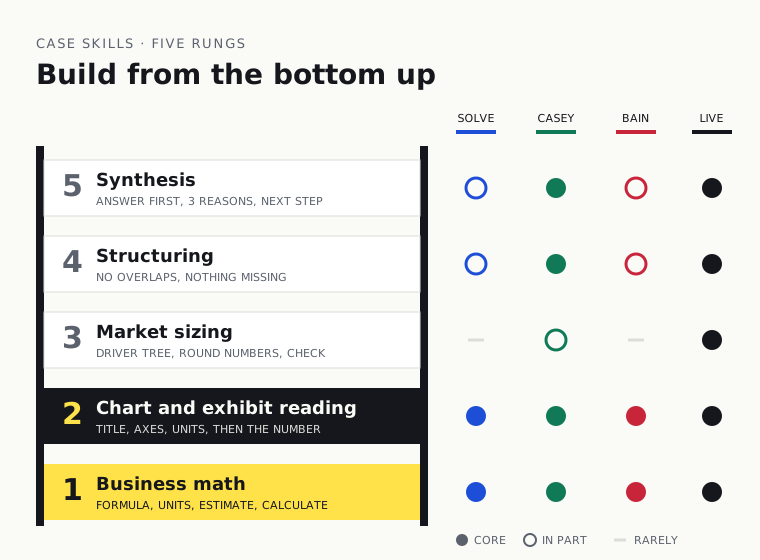
| Skill | What it is | What failure looks like |
|---|---|---|
| 1. Business math | Percentages, growth, margins, breakeven, weighted averages, quick multiplication | A right method with a wrong base, or a missed factor of 1,000 |
| 2. Chart and exhibit reading | Pulling the one number that matters from a table or chart, first time | Reading the wrong series, unit or year |
| 3. Market sizing | Estimating a quantity from a few clear assumptions | An unstructured guess, or a result that fails a sanity check |
| 4. Structuring | Breaking a problem into parts that do not overlap and leave nothing out | A list of ideas instead of a tree; a missing branch |
| 5. Synthesis | Stating the answer first, with reasons and a next step | A summary of the analysis with no recommendation |
- timed math questions across 10 skills
- 500
- Source: DrillCase drill bank, counted September 2026
- chart reading questions
- 50
- Source: DrillCase drill bank, counted September 2026
- market sizing questions
- 32
- Source: DrillCase drill bank, counted September 2026
- practice cases with model answers
- 63
- Source: DrillCase case library, counted September 2026
Where is each skill tested?
Every firm tests all five somewhere, but each format leans on different ones. This is where to put your hours.
| Skill | McKinsey Solve | BCG Casey | Bain online test | Live case interview |
|---|---|---|---|---|
| Business math | Redrock analysis and cases; Sea Wolf sums | Most questions (estimated 60 to 70% quantitative) | Numerical reasoning section | Every quantitative step |
| Chart reading | Redrock exhibits and report | Exhibit questions | Numerical tables and charts | Exhibits handed over mid-case |
| Market sizing | Rarely as a standalone task | One step inside a case | Rarely | Common, especially in first rounds |
| Structuring | Choosing what to collect in Redrock | Dataset selection; brainstorming questions | Logical reasoning (deductive items) | The opening framework |
| Synthesis | Redrock report | Written answers and the 60-second video | Situational judgement, indirectly | The final recommendation |
Sources: firm pages and prep sites as listed below, and our guides to McKinsey Solve, BCG Casey and the Bain online test. Firms do not publish skill weightings.
The pattern: online tests reward math and chart reading most, because answers go into boxes on a clock. Live interviews reward structure and synthesis more, because an interviewer hears how you think. Build math and charts first; they pay off in every round.
How do you build business math?
Consulting math is the arithmetic of a P&L, done quickly and without setup errors. Ten operations cover almost everything: percentages, growth rates, margins, breakeven, CAGR, market share, weighted averages, unit economics, and fast multiplication and division with large numbers.
The method that removes most errors:
- Write the formula in words before you touch a number.
- Pull the numbers with their units.
- Estimate the size of the answer.
- Calculate, then check the answer against the estimate.
Three traps that appear in every firm's test:
| Trap | Example | Fix |
|---|---|---|
| Wrong base | Growth from 40 to 52 is 30%, not 23% | Divide by the starting value |
| Percent vs percentage points | Share from 12% to 15% is +3 points, or +25% | Read which unit the question wants |
| Missing weights | Two product lines at 45% and 30% margin are not 37.5% blended unless they are the same size | Weight by revenue or volume |
Go deeper: BCG Casey math has a formula sheet and six worked problems; the Redrock guide covers the math traps in Solve; the Bain numerical tips cover aptitude-style tables.
How do you read charts without mistakes?
Most chart errors are reading errors, not analysis errors. A fixed reading order prevents them:
- Title. What is this chart about?
- Axes and units. Thousands or millions? Percent or absolute? Which years?
- Legend. Which series is which?
- The question. Which series, year and unit does it ask about?
- The number. Only now find the value.
Two habits help. Say the unit out loud (in your head) as you read a value: "forty-six thousand units", not "forty-six". And when two exhibits are combined, write down which number came from which before you calculate. The free chart drills train exactly this reading order with a timer.
How do you size a market?
Market sizing tests whether you can turn a vague question into a clear calculation. The shape is always the same: pick a driver tree, make round assumptions, calculate and sanity-check.
Worked example. How many coffees are sold each day in a city of 2 million people?
| Step | Assumption | Running total |
|---|---|---|
| Population | 2,000,000 | 2,000,000 |
| Adults who drink coffee | About 60% of the population | 1,200,000 |
| Coffees per drinker per day | About 2 | 2,400,000 |
| Share bought, not made at home | About 25% | 600,000 coffees sold per day |
Sanity check: if a typical café sells about 400 coffees a day, 600,000 implies about 1,500 cafés, or one per roughly 1,300 people. Plausible for a large city. If the check had given one café per 50 people, an assumption would need revisiting.
The numbers are invented for practice. What interviewers listen for is the tree, the round assumptions said out loud and the check at the end. The market sizing drills give you 32 timed problems to practice the shape.
How do you structure a problem?
A good structure splits a problem into parts that do not overlap and together cover everything that matters. Consultants call this MECE (mutually exclusive, collectively exhaustive); our glossary has the short definition.
Start from the question, not a framework. "Why did profit fall?" splits naturally into revenue and costs, then revenue into price and volume, and costs into fixed and variable. "Should we enter this market?" splits into market attractiveness, our ability to win and the economics of entry.
Then test the split:
- Can any cause fit in two branches? If so, they overlap.
- Is there a plausible cause that fits in none? If so, something is missing.
- Can each branch be checked with data? If not, it is too vague.
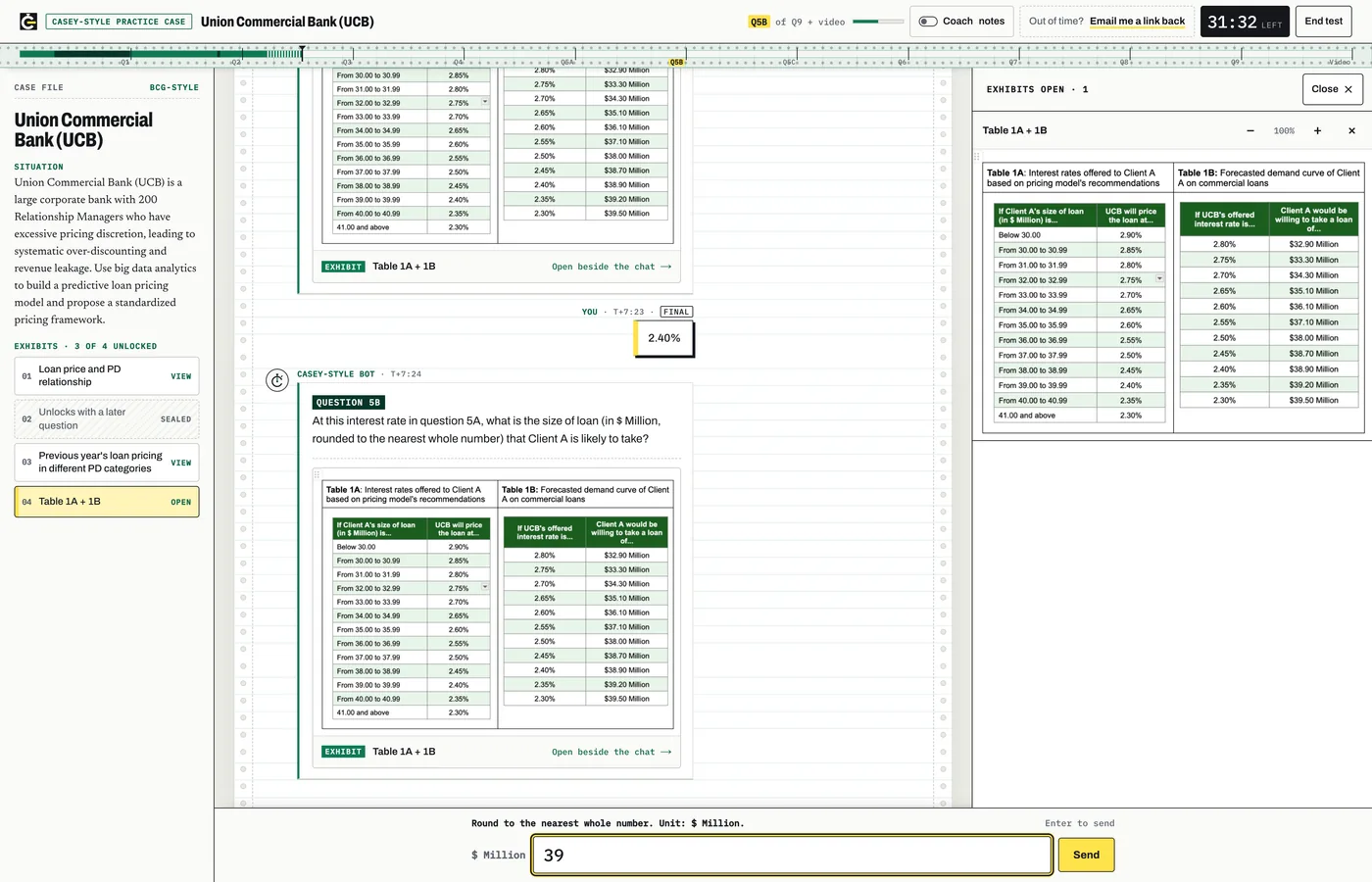
In online tests, structure shows up indirectly. In Casey's dataset selection question you pick the fewest datasets that cover every branch of your tree; our dataset selection guide shows the method. In Redrock, structure is what you choose to save in the research journal.
How do you synthesize a recommendation?
Synthesis is the skill most candidates practice least, and it decides the end of every live case and Casey's video. The structure is short:
- Answer first. "The client should do X."
- Three reasons, each with a number. Use the figures you already calculated.
- One risk and one next step. Show you know what could go wrong.
About 120 words fits in a 60-second recording at a calm pace. Our video recommendation guide has annotated examples; the same shape works for the final two minutes of any live case.
How should you practice each day?
Short daily sessions build these skills faster than occasional long ones, because the goal is speed and accuracy under a clock, not understanding.
| Minutes | Skill | Practice |
|---|---|---|
| 10 | Business math | Timed drills, one skill per day in rotation |
| 5 | Chart reading | Three to five chart questions, reading order out loud |
| 5 | Market sizing or structure | One sizing problem, or one issue tree for a case prompt |
| 5 | Review | Write down each error by type: base, unit, weight, reading, setup |
Every few days, replace the routine with one full case: a library case for live interviews, or a timed simulation in the format your firm uses.
What does a four-week skills plan look like?
If you are applying in a month, this plan builds the shared skills first and leaves the last week for the format you will face. Online tests often arrive within days of applying, so the earlier you start, the better.
| Week | Focus | Daily | Weekly |
|---|---|---|---|
| 1 | Math and charts | 25-minute routine, math-heavy | One untimed library case |
| 2 | Sizing and structure | 25-minute routine, sizing and trees | Two library cases, timed |
| 3 | Synthesis | Routine, plus one 60-second recommendation recorded | Three cases, each ending in a spoken recommendation |
| 4 | Your firm's format | Routine at half length | Timed format practice: Solve, Casey or Bain |
Short on time? The assessment timeline shows when each firm's test usually arrives, and the date-based plans for Solve in 7 days and after a Casey invite compress this into the days you have.
What are the most common skill mistakes?
| Mistake | Why it hurts | Fix |
|---|---|---|
| Reading guides instead of practicing | Understanding is not speed | Put a timer on every practice session |
| Practicing only full cases | Too few repetitions of each skill | Daily drills, cases every few days |
| Tracking only the score | The same error repeats | Log errors by type and drill the top one |
| Skipping math because "the calculator will do it" | Setup errors, not arithmetic, cost the points | Write the formula and estimate first |
| Leaving synthesis to the end | It decides the last impression | Finish every practice case with a spoken answer |
Our article on mistakes that end applications before the interview covers the format-level mistakes that sit on top of these.
Where can you practice case skills for free?

DrillCase's drills cover math across ten skills, chart reading and market sizing, one timed question at a time, and the case library has 63 practice cases with model answers, tagged by difficulty and type, each with a practice mode and a PDF by email. Both are free. When you know which firm's test you face, the firm-specific simulators add the format: Solve-style games, Casey-style chatbot cases and Bain-style aptitude sets.
DrillCase is independent practice material and is not affiliated with McKinsey, BCG or Bain. The cases and drills are written for practice; they are not firm material.
Every case skills article
| Article | Skill | Read it when |
|---|---|---|
| Case interview mistakes | All five | You want to know what ends applications early |
| BCG Casey math | Business math | You need a formula sheet and worked problems |
| Redrock Study guide | Math, charts, synthesis | You face McKinsey Solve |
| Casey dataset selection | Structuring | You want a rule for picking data |
| Casey video recommendation | Synthesis | You need a 60-second answer structure |
| Bain numerical reasoning tips | Math, charts | You face the Bain test |
| MBB online assessments | All five, by firm | You are applying to more than one firm |
Frequently asked questions
What skills do case interviews test?
Firms describe problem solving, structured thinking and communication. In practice that breaks into five skills: business math, chart and exhibit reading, market sizing, structuring a problem, and synthesizing a recommendation. Online tests weight the first two most; live interviews weight all five.
How good does my math need to be for consulting?
Not advanced, but fast and accurate: percentages, growth rates, margins, breakeven, weighted averages and rough multiplication with large numbers. The common failure is a setup error (the wrong base or a missing weight), not the arithmetic itself.
How long does it take to build case interview skills?
It depends on your starting point, and no firm publishes a figure. Speed comes from repetition, so a few weeks of short daily sessions does more than the same hours crammed into a weekend. Online tests often arrive within days of applying, so start the math and chart work before you apply.
Is market sizing still asked?
Yes, in live interviews and as one step inside online cases (for example estimating demand before a profit calculation). The skill is the same either way: choose a clear driver tree, state assumptions in round numbers, and sanity-check the result.
Can I practice case interview skills for free?
Yes. DrillCase's math, chart and market sizing drills and its library of 63 practice cases with model answers are free. Paid practice is useful later for each firm's specific test format.
What is the difference between case skills and the online test?
The skills are the raw material; the online test is a format with its own clock and rules. Solve is a set of games, Casey is a chatbot case and the Bain test is an aptitude battery. Skill practice transfers to all three; format practice is test-specific.
Practice what you just read
Applying to more than one firm? Practice all three formats
Each firm tests something different, so each needs its own practice. DrillCase has a simulator per format and a free case library for the skills they share.
- simulations across 3 firms
- 75
- practice questions
- 1,333
- free library cases
- 63
- 29 BCG Casey-style cases, 21 McKinsey Solve-style scenarios, 476 Bain-style questions
- 63 free library cases and 582 drill questions (math, charts, market sizing)
- The All-Access Pass unlocks every firm product for one payment; the top tier of each bought separately comes to $457
The All-Access Pass ($250) carries a 7-day money-back guarantee. Refund policy. DrillCase is independent practice material and is not affiliated with McKinsey, BCG or Bain.
Sources
- McKinsey & Company, Getting ready for your interviews (careers page)
- McKinsey & Company, Solve: McKinsey's Assessment Game FAQs (August 2025 PDF)
- BCG Careers, Mexico: Online Case Experience (OCE) and CCA description
- Bain & Company, Digital assessment (hiring process)
- Hacking the Case Interview, BCG Casey: How to Prepare and Pass the Test (updated 19 March 2026)
- StrategyCase, The Complete Guide to the BCG Online Case Casey (updated 13 July 2026)
- Road to Offer, McKinsey Redrock Study guide (updated 22 September 2026)