Short answer
BCG Casey math is business arithmetic under a clock: percentages, growth, margins, breakeven, weighted averages and payback, entered as a number. Prep sites estimate quantitative work at most of the 8 to 10 questions. A calculator is reportedly allowed, so points are lost to setup, units and rounding, not to hard sums.
Key takeaways
- Hacking the Case Interview puts quantitative work at roughly 60 to 70% of Casey. Math speed is the single best use of short prep time.
- Write the formula with units before you calculate. Most lost points are a wrong base, a missing weight or a percent typed as a decimal, not a wrong sum.
- Read the rounding and unit line first, and run a 5-second sanity check before you submit. You reportedly cannot go back to fix it.
In this article
- How much of BCG Casey is math?
- Can you use a calculator or Excel in Casey?
- Which calculations does Casey ask for?
- How do you set up a Casey calculation without mistakes?
- Which mental math shortcuts save the most time?
- Can you solve these six Casey-style math problems?
- Problem 1: growth on the right base
- Problem 2: blended margin with weights
- Problem 3: breakeven volume
- Problem 4: percentage points, not percent
- Problem 5: payback period
- Problem 6: a two-step market sizing
- How do you get faster at Casey math?
- What should you check on every Casey math question?
Part ofBCG Casey Online Case: The Complete Guide
If you are a strong case interviewee and you fail Casey, the math is the most likely reason. Not because it is advanced: it is the arithmetic of a P&L. It is because Casey asks for a number in a box, on a clock, with no interviewer to say "are you sure that's right?" and, as candidates report, no going back. This article lists the calculations that come up, gives you a one-page formula sheet with the trap each formula invites, and works six problems the way Casey would ask them.
How much of BCG Casey is math?
BCG describes the Online Case Experience as a business case of about 30 minutes, in English. It publishes no question mix. The prep sites that track candidate reports agree that numbers dominate:
- per question, if you split the clock evenly
- ~3 min
- Source: DrillCase calculation from the two figures above
Hacking the Case Interview says quantitative questions are "typically 5 or more of the 8 to 10." Even the questions that are not pure calculation (exhibit reading, which option the data supports, the final video) lean on numbers you have already worked out. The BCG online case guide covers the full format; this article is only about the math.
Can you use a calculator or Excel in Casey?
Candidates and most prep sites report that a calculator is allowed, and StrategyCase reports Excel and scratch paper as well. BCG has not published a Casey-specific rule, and other BCG tests (the German cognitive test, for one) ban calculators. So read your invitation and follow it.
A calculator does not make the math easy. It removes arithmetic errors and leaves the errors that matter: the wrong base, the wrong weight, the wrong unit. Use it for multiplication and division of awkward numbers; do simple steps like 10% of 450 or 12 × 5 in your head, because reaching for the calculator for those costs more time than it saves.
Which calculations does Casey ask for?
StrategyCase lists "percentages, growth rates, breakeven, and simple profit calculations, done at speed." Candidate reports add weighted averages, market share and payback. Here is the sheet to know cold, with the trap each one sets.
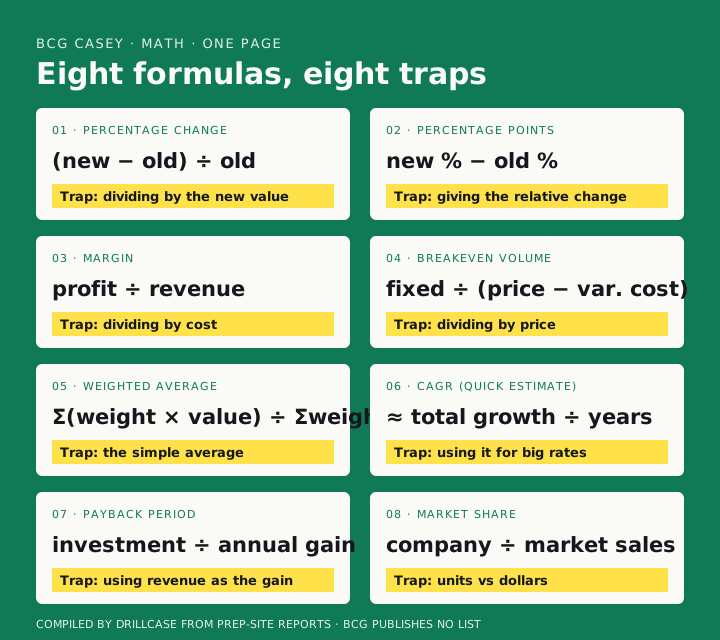
| Calculation | Formula | Trap |
|---|---|---|
| Percentage change | (new − old) ÷ old | Dividing by the new value |
| Percentage points | new % − old % | Reporting the relative change instead |
| Margin | profit ÷ revenue | Using cost as the denominator |
| Breakeven volume | fixed costs ÷ (price − variable cost per unit) | Dividing by price instead of contribution |
| Weighted average | Σ (weight × value) ÷ Σ weights | Averaging the values without weights |
| CAGR (approximation) | total growth ÷ years, for small rates | Using it for large rates or many years |
| Payback period | upfront investment ÷ annual cash gain | Using revenue instead of the gain |
| Market share | company sales ÷ market sales | Mixing units (units vs dollars) |
How do you set up a Casey calculation without mistakes?
The method that removes most errors is boring and takes about ten seconds:
- Read the last line first. Find the unit, the number of decimal places and whether a sign is expected. "Round to one decimal place" and "in percentage points" are instructions, not decoration.
- Write the formula in words. "Breakeven = fixed cost ÷ (price − variable cost)". If you cannot write it, you do not yet know which numbers to pull.
- Pull the numbers with units. Write "$2.4M fixed" and "$18 per unit", not "2.4" and "18".
- Estimate before you calculate. Know the rough size of the answer so a slipped decimal is obvious.
- Calculate, then sanity-check. Is the answer the right size, sign and unit? Then submit.
Step 4 is the one candidates skip. It costs five seconds and catches the errors that cost the most: a factor of 10, 100 or 1,000.
Which mental math shortcuts save the most time?
You will use the calculator for awkward numbers, but a handful of shortcuts let you estimate before you type and catch a slipped decimal after:
| Shortcut | Example | Use it for |
|---|---|---|
| Split percentages into 10%, 5% and 1% | 15% of 480 = 48 + 24 = 72 | Quick margins and shares |
| Flip the percentage | 8% of 25 = 25% of 8 = 2 | Awkward percentage of a round number |
| Round, then adjust | 49 × 21 ≈ 50 × 21 − 21 = 1,029 | Estimates before the calculator |
| Rule of 72 | At 8% a year, a value doubles in about 9 years (72 ÷ 8) | Sense-checking growth questions |
| Count zeros separately | 3,000 × 40,000 = 3 × 4 with 7 zeros = 120,000,000 | Market sizes and revenues in the millions |
| Fractions for common percentages | 12.5% = 1/8, 33% ≈ 1/3, 20% = 1/5 | Fast division in your head |
Practice them until you use them without deciding to. The point is not to avoid the calculator; it is to know the rough answer before the calculator gives you the exact one.
Can you solve these six Casey-style math problems?
The problems below are invented for practice and follow the formats candidates report. Each has one trap. Try them with a timer: about 2 minutes each.
Problem 1: growth on the right base
A client's online revenue grew from $40M to $52M. By what percentage did online revenue grow? Answer as a whole number.
Answer: 30. (52 − 40) ÷ 40 = 12 ÷ 40 = 30%. The trap is dividing by 52 (23%).
Problem 2: blended margin with weights
A retailer sells two lines. Apparel is $60M of revenue at a 45% gross margin. Footwear is $40M at a 30% gross margin. What is the blended gross margin, in percent, to one decimal place?
Answer: 39.0. (0.6 × 45%) + (0.4 × 30%) = 27% + 12% = 39%. The trap is the simple average, (45 + 30) ÷ 2 = 37.5%.
Problem 3: breakeven volume
A meal-kit start-up has fixed costs of $2.4M a year. Each kit sells for $18 and costs $12 to make and deliver. How many kits must it sell a year to break even?
Answer: 400,000. Contribution per kit = $18 − $12 = $6. $2.4M ÷ $6 = 400,000. The trap is $2.4M ÷ $18 = 133,333.
Problem 4: percentage points, not percent
Market share was 12% last year and 15% this year. By how many percentage points did share change?
Answer: 3. The trap is 25 (the relative change, 3 ÷ 12). If the question had asked "by what percentage did share grow?", 25 would be right. Read the unit.
Problem 5: payback period
A factory upgrade costs $9M and is expected to cut operating costs by $2M a year and raise revenue by $1M a year at a 50% margin. What is the payback period in years, to one decimal place?
Answer: 3.6. Annual gain = $2M cost saving + (50% × $1M) = $2.5M. $9M ÷ $2.5M = 3.6 years. The trap is counting the full $1M of revenue as gain, which gives 3.0.
Problem 6: a two-step market sizing
A city has 800,000 households. 30% own a dog, and dog-owning households spend on average $40 a month on pet food. What is the city's annual dog food market, in millions of dollars?
Answer: 115.2. 800,000 × 30% = 240,000 households. 240,000 × $40 × 12 = $115.2M. The trap is forgetting the × 12 and answering 9.6.
Six problems, six traps, and none needs more than a calculator and a clear head. That is Casey math.
How do you get faster at Casey math?
Speed comes from making setup automatic, so your attention goes to the trap. Three kinds of practice help, in this order:
| Practice | Why | How much |
|---|---|---|
| Timed single-step drills | Builds instant recall of each formula | 15–20 minutes a day, aim for about 15 seconds per standard operation |
| Multi-step problems like those above | Builds the setup habit and trap awareness | 5–10 a day, 2 minutes each |
| Full timed cases | Builds pacing with exhibits and context around the math | One every two or three days |
DrillCase's math drills are free and cover ten math skills, including breakeven, CAGR, margin, weighted average and growth rate, one timed question at a time. The chart drills train the exhibit reading that most Casey math starts from.
For full cases, the free demo case runs in a chat panel with exhibits beside it, 12 questions on a 40-minute clock, and ends with the 60-second video step. The paid Casey-style practice has more cases in the same format. DrillCase is independent practice and is not affiliated with BCG, and none of it is BCG material. Practice tools are for the days before your test, never during it.
If you already have an invitation, the free Casey Invite Decoder confirms which test your email names (Casey or the CCA, which has different math), shows its clock, and sends one task a day to your date. Our guide on what to do after your Casey invite arrives covers the first 24 hours.
What should you check on every Casey math question?
| Before calculating | While calculating | Before submitting |
|---|---|---|
| Unit, decimals and sign read | Formula written in words | Answer is the right size (estimate) |
| % or percentage points? | Numbers pulled with units | Sign is right (growth vs decline) |
| Which base? Which weights? | Calculator only for awkward steps | Typed in the unit the question asks for |
Frequently asked questions
Can you use a calculator in BCG Casey?
Candidates and most prep sites report that a calculator is allowed, and StrategyCase reports Excel as well. BCG has not published a Casey-specific rule, and other BCG tests such as the German cognitive test ban calculators, so follow your own invitation.
How hard is the math in Casey?
The operations are basic business arithmetic. StrategyCase warns that Casey math 'runs harder than typical free practice' because questions stack two or three steps and the clock keeps running. The difficulty is setup and speed, not advanced math.
How many Casey questions are math?
BCG does not publish a mix. Hacking the Case Interview estimates quantitative work at roughly 60 to 70% of the test and says quantitative questions are typically five or more of the 8 to 10.
How should I enter answers in Casey?
Follow the question's own instruction on unit, decimal places and sign. Candidates report numeric entry boxes, so 3.7 and −3.7, or 25 and 0.25, may be marked differently. If no format is stated, use the unit in the question and round sensibly.
What formulas should I know for BCG Casey?
Percentage change, percentage points, gross and operating margin, breakeven volume, weighted average, CAGR (as an approximation), payback period and market share. The formula sheet in this article covers each with the trap it invites.
Practice what you just read
Rehearse the chatbot case in the same kind of screen
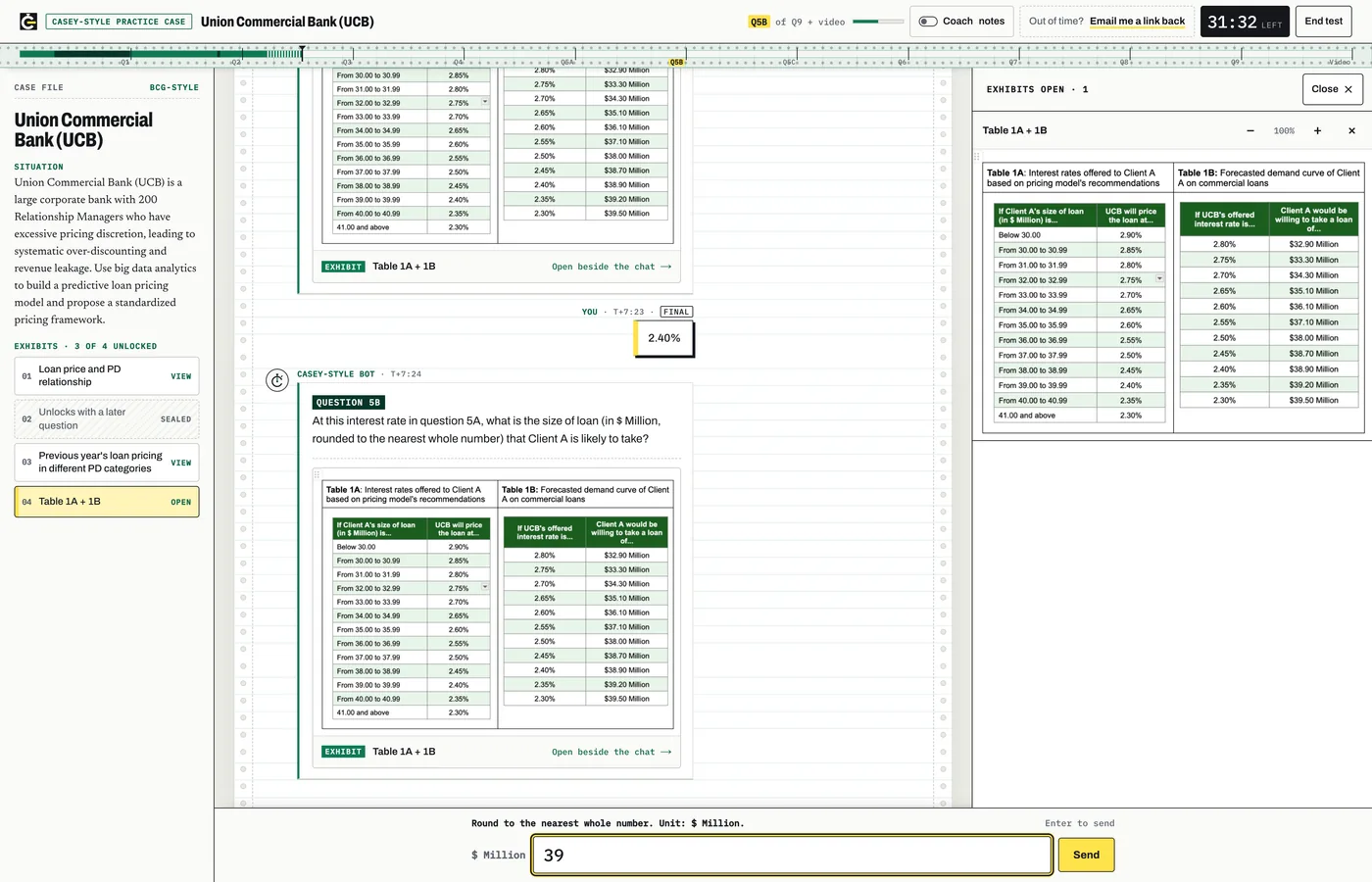
Reading about Casey helps. Answering a timed question while an exhibit sits next to the chat is what builds the habit. Each DrillCase case runs in a chat panel with exhibits you open as you go and a clock that keeps running.
- chatbot-style cases
- 29
- case questions
- 275
- free demo case
- 1
- 29 cases and 275 questions: calculations, chart reading, data choices and written answers
- Exhibits open beside the chat, as in the format candidates describe
- Start with the free demo case, then buy 14 or 20 cases, or all 29 with the All-Access Pass
Complete refunds within 7 days if you have opened no more than 3 cases (the free demo case included). Starter is final sale, so try the free demo case first. All-Access has a 7-day money-back guarantee. Refund policy. DrillCase is independent practice material and is not affiliated with McKinsey, BCG or Bain.
Sources
- BCG Careers, Mexico: Online Case Experience (OCE) and CCA description
- Hacking the Case Interview, BCG Casey: How to Prepare and Pass the Test (updated 19 March 2026)
- Hacking the Case Interview, BCG Online Case: The Complete Guide (updated 20 March 2026)
- StrategyCase, The Complete Guide to the BCG Online Case Casey (updated 13 July 2026)
- StrategyCase, BCG Cognitive Test guide (updated 25 June 2026)
- MyConsultingCoach, BCG Casey: OCE, HireQuotient and online case prep (updated 11 July 2026)
- MConsultingPrep, BCG Online Case Chatbot guide