Short answer
Bain's verbal reasoning items give a short passage and a statement. True means the passage alone proves it, False means the passage contradicts it, and Cannot Say means it does not settle it. Prep sites report verbal now appears less often in Bain's Sova test, so check your invitation and drill numerical first.
Key takeaways
- Judge only from the passage. Outside knowledge, however correct, is the most common way to turn a Cannot Say into a wrong True.
- Reported claims are the classic trap: "the CEO attributed the rise to X" makes the attribution True and the cause itself Cannot Say.
- StrategyCase and Bain's own pages suggest recent Sova sittings centre on numerical, logical, SJT and personality. Verbal is worth a few days, not your whole plan.
In this article
- Is verbal reasoning still on the Bain online test?
- How do True, False and Cannot Say work?
- Can you answer these six verbal reasoning items?
- Which traps cost the most points?
- How should you pace verbal reasoning?
- What about Bain's logical reasoning section?
- What about the situational judgement test?
- Where can you practice Bain verbal reasoning?
- What should you check before a verbal block?
Part ofBain Online Test: Which Assessment You'll Get and How to Prepare
Verbal reasoning looks like the easy part of the Bain test until you get a run of Cannot Say answers wrong. The rule is short: judge only from the passage. The hard part is following it at speed, when a statement sounds right and you already know it is true in the real world. Below: the rule as a three-question check, six worked items, the traps that cost the most points, an honest look at whether Bain still sets this section, and short primers on the logical and situational judgement sections that usually sit beside it.
Is verbal reasoning still on the Bain online test?
Before you spend a week on verbal, check that you will face it. Bain uses two platforms, and the section mix depends on which one your invitation names.
| Source | What it says about verbal | Type |
|---|---|---|
| Bain London page | Lists numerical, logical and a personality questionnaire for the Sova test. No verbal | Bain says |
| StrategyCase (July 2026) | "Through 2026, most reported Bain Sova sittings have centered on numerical and logical reasoning plus the personality and SJT sections, with verbal reasoning appearing far less often" | Reported |
| PrepLounge (June 2026) | Describes a verbal section in the classic True, False, Cannot Say format | Reported |
| Bain Seoul FAQ (TestGorilla) | Case study skills, critical thinking, numerical reasoning, working with data. No separate verbal test | Bain says |
The honest reading: verbal is possible but no longer the safe bet. If your invitation is for TestGorilla, the reading skills below still help with critical thinking items, but you will not see a True, False, Cannot Say block. Our Sova vs TestGorilla comparison covers how to tell which platform you have.
If you are not sure which platform you will get, the free Bain Platform Check shows each platform's clock, sittings and rules, then sends one short timed task a day to your deadline.
How do True, False and Cannot Say work?
Each item gives you a passage of a paragraph or two and a statement about it. You choose one of three answers.
| Answer | Means | Test |
|---|---|---|
| True | The statement follows from the passage alone | Can you point to the sentence that proves it? |
| False | The passage contradicts the statement | Can you point to the sentence that disproves it? |
| Cannot Say | The passage does not settle it either way | You need a fact the passage does not give |
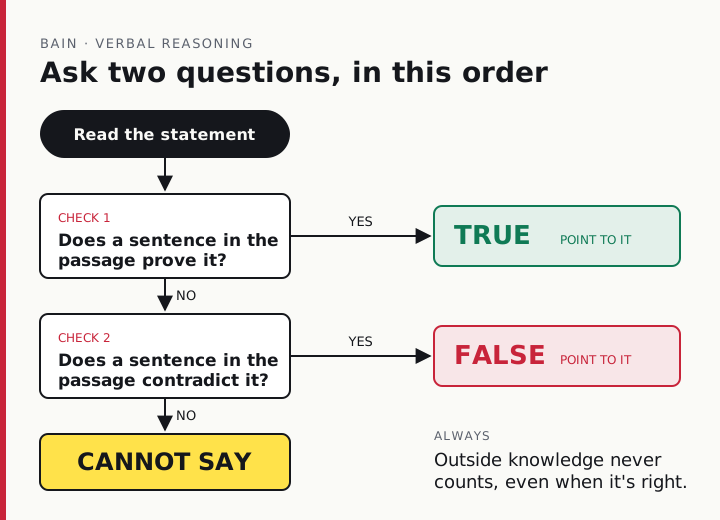
The order matters. Look for proof first, then for a contradiction. Only when you find neither is the answer Cannot Say. Choosing Cannot Say early, because a statement "feels unsupported", is a common way to miss True answers that rest on a sentence you skimmed.
Can you answer these six verbal reasoning items?
The passage below is invented for practice. Answer all six before reading the solutions.
Harlow Foods opened 14 new grocery stores in 2025, bringing its total to 120. Sales at stores open for more than a year rose 4% over the year. The company's finance director said the rise was mainly due to a new loyalty scheme launched in March. Two rival chains closed stores in Harlow's region during the same period. Harlow plans to open a further 10 stores in 2026, although the board has not yet approved the budget.
| # | Statement |
|---|---|
| 1 | Harlow opened more stores in 2025 than it plans to open in 2026. |
| 2 | The loyalty scheme caused the rise in sales. |
| 3 | Harlow's finance director credited the loyalty scheme for most of the rise. |
| 4 | Sales at Harlow stores open for more than a year fell in 2025. |
| 5 | Harlow will have 130 stores by the end of 2026. |
| 6 | Harlow is the largest grocery chain in its region. |
Solutions.
- True. It opened 14 in 2025 and plans 10 in 2026. The statement compares a fact with a plan, and the passage gives both, so no outside assumption is needed. Simple arithmetic or comparison on the passage's own numbers counts as following from it.
- Cannot Say. The passage reports the finance director's view and gives a rival explanation (two competitors closed stores). It establishes neither.
- True. This is a statement about what the director said, and the passage says exactly that.
- False. The passage says those sales rose 4%. Note how narrow the statement is: it names the same group of stores the passage does. A broader statement, such as "Harlow's total sales fell", would be Cannot Say, because the passage gives no total.
- Cannot Say. It is a plan, and the budget is not approved. Plans and forecasts are almost never True.
- Cannot Say. Nothing in the passage compares Harlow's size with other chains.
Items 2 and 3 are the pair to remember. They are about the same sentence, and they have different answers. A statement about what someone said is True when the passage reports it; a statement about whether they were right is usually Cannot Say. Watch the scope too: a statement that covers more than the passage does (all stores instead of older stores, total sales instead of like-for-like) usually moves from True or False to Cannot Say.
Which traps cost the most points?
| Trap | Looks like | Correct answer usually |
|---|---|---|
| Outside knowledge | A statement true in real life but absent from the passage | Cannot Say |
| Reported claims | "The CEO attributed…", "experts believe…", "the company expects…" | The claim exists: True. The underlying fact: Cannot Say |
| Plans and forecasts | "will", "plans to", "is expected to" | Cannot Say |
| Absolute words | "all", "always", "never", "only" in the statement but not the passage | Cannot Say or False |
| Correlation as cause | Two things happen together; the statement says one caused the other | Cannot Say |
| Near-synonyms | "Most" in the passage, "all" in the statement | Cannot Say or False |
Two habits make these traps visible:
- Underline the statement's key word first. If the statement says "caused", "all" or "will", that word is usually what the item is testing.
- Find the matching sentence before you decide. Do not answer from memory of the passage. Find the sentence, then compare word by word.
How should you pace verbal reasoning?
Bain says the whole assessment takes about 30 to 40 minutes, and it does not publish per-section timings. StrategyCase reports that Sova scores speed as well as accuracy and suggests about one question per minute.
A workable rhythm for each passage:
- Read the statement first, then the passage. You will know what to look for.
- Read the passage once at normal speed. Do not try to memorise it.
- For each statement, find the sentence that matters, then apply the three-question check.
- Move on after about a minute. Pick your best answer. TestGorilla says it has no penalty for wrong answers; Sova does not publish its rule, but an unanswered item cannot score.
What about Bain's logical reasoning section?
Logical reasoning is more likely to appear than verbal, by every source above. Prep sites describe two kinds of item:
| Kind | What you see | Method |
|---|---|---|
| Inductive (abstract) | A sequence of shapes or symbols with one missing | Check one feature at a time: count, position, rotation, shading, size |
| Deductive | A set of facts and a question about what follows | Write the constraints down before reading the options |
Sample inductive item. A sequence of squares has 1, 3, 5 and 7 dots, and the shaded corner moves clockwise one step each time, starting top-left. What comes next? 9 dots, with the shaded corner at top-left again (four steps clockwise bring it back to the start). Two features change together, and the item tests whether you track both.
Sample deductive item. All analysts on Team A use Excel. Some analysts who use Excel also use Python. Priya is on Team A. Does Priya use Python? Cannot be determined. She uses Excel, but only "some" Excel users use Python. This is the same discipline as Cannot Say: the facts given do not settle it.
The Bain online test guide has a longer deductive example with an ordering puzzle.
What about the situational judgement test?
The SJT gives a workplace scenario and asks you to rate or rank the responses. StrategyCase reports both written and video scenarios, with responses ranked from least to most favourable. It also reports that the SJT and personality sections are "not 'passed' so much as read for fit and consistency."
Three rules cover most items:
- Prefer direct, early and collaborative action. Talk to the person involved before escalating, and act before a deadline, not after it.
- Protect the client and the team's work. Responses that hide a problem or delay it until it is urgent rank low.
- Be consistent. If you rate "raise concerns early" highly in one scenario, do not rank it last in the next.
Where can you practice Bain verbal reasoning?
DrillCase's paid Bain practice includes five timed verbal sets of 30 True, False or Cannot Say statements each, alongside numerical, logical and situational judgement sets. The free verbal sample gives you 10 timed questions drawn from a separate bank of analogy, reading comprehension and inference items. It is a fair warm-up for careful reading, but it is not in the True, False or Cannot Say format, so use the worked items above for that.
DrillCase is independent practice and is not affiliated with Bain or Sova. Bain asks you to take its assessment yourself, so use practice before the test, never during it.
Given what candidates report about recent sittings, the best use of limited time is numerical first. Our ten numerical reasoning tips are the place to start.
What should you check before a verbal block?
| Before you start | On every statement | If you are stuck |
|---|---|---|
| Your invitation names the platform | Underline the key word ("caused", "all", "will") | Look for proof, then contradiction, then Cannot Say |
| Pen and paper ready, as Bain allows | Find the matching sentence before deciding | Never use what you know from outside the passage |
| You know the rough pace: about a minute per item | Reported claims: the claim is True, the fact is Cannot Say | Choose your best answer and move on |
Frequently asked questions
Does the Bain online test still include verbal reasoning?
Sometimes. Bain's London page lists numerical, logical and a personality questionnaire for Sova. StrategyCase reports that through 2026 most Sova sittings centre on numerical and logical reasoning plus personality and SJT, with verbal appearing far less often. PrepLounge still describes a True, False, Cannot Say section. Your invitation decides.
What is the difference between False and Cannot Say?
False means the passage states or proves the opposite of the statement. Cannot Say means the passage gives too little to decide either way, even if the statement sounds likely. If you need a fact the passage does not contain, the answer is Cannot Say.
Can I use general knowledge in verbal reasoning?
No. Every answer must follow from the passage alone. If a statement is true in the real world but the passage does not say so, the answer is Cannot Say.
How fast do you need to be?
Bain says its assessment takes about 30 to 40 minutes in total. StrategyCase reports that Sova scores both speed and accuracy and suggests a pace of about one question per minute. Bain does not publish per-section timings.
What is on the Bain logical reasoning section?
Prep sites describe two kinds of item: inductive (find the rule in a sequence of shapes or symbols) and deductive (decide what follows from a set of facts). PrepLounge describes Sova's logical section as abstract patterns; StrategyCase reports both kinds.
How is the Bain situational judgement test scored?
Bain does not publish a method. StrategyCase reports that SJT and personality sections are read for fit and consistency rather than passed, and that careless or contradictory answers can raise a flag. Answer as the person you are at work, consistently.
Practice what you just read
Practice each Bain section on its own clock
Most points on an aptitude test are lost to the clock, not to hard questions. DrillCase sets are timed and auto-scored, one question per screen, so you learn the pace section by section before you sit a full mock.
- Bain-style questions
- 476
- timed test sets
- 23
- full mock tests
- 3
- 174 numerical, 150 verbal, 80 situational judgement and 32 logical questions, plus data interpretation and case items
- 3 full-length mock tests built from those pools
- A free 50-question verbal sample bank to try first
Comprehensive refunds within 7 days if you have opened no more than 3 sets (mock papers included). Single modules are final sale, so start with the free verbal sample. Refund policy. DrillCase is independent practice material and is not affiliated with McKinsey, BCG or Bain.
Sources
- Bain & Company, Digital assessment (hiring process)
- Bain & Company, Bain London, Associate Consultant
- Bain & Company, About AC recruiting in Seoul office (FAQ PDF)
- Sova, Candidate Preparation Hub
- StrategyCase, Bain SOVA test (updated 13 July 2026)
- PrepLounge, Bain Sova test (updated 11 June 2026)
- CaseBasix, Bain aptitude test (Sova) guide (updated 17 August 2026)
- TestGorilla Candidates, Common questions about assessments and tests